Ch. 3 - Polynomial and Rational Functions
Lial - College Algebra 13th Edition
Lial13th EditionCollege AlgebraISBN: 9780136881063Not the one you use?Change textbook
Chapter 4, Problem 95

Use the technique described in Exercises 87–90 to solve each inequality. Write the solution set in interval notation. -x2 + 4x + 1 ≥ 0

Verified step by step guidance
1
Rewrite the inequality in a standard form by moving all terms to one side: \(-x^{2} + 4x + 1 \geq 0\).
Multiply the entire inequality by \(-1\) to make the quadratic coefficient positive, remembering to reverse the inequality sign: \(x^{2} - 4x - 1 \leq 0\).
Find the roots of the quadratic equation \(x^{2} - 4x - 1 = 0\) using the quadratic formula: \(x = \frac{-b \pm \sqrt{b^{2} - 4ac}}{2a}\), where \(a=1\), \(b=-4\), and \(c=-1\).
Determine the intervals defined by the roots and test values within each interval to see where the inequality \(x^{2} - 4x - 1 \leq 0\) holds true.
Write the solution set in interval notation based on the intervals where the inequality is satisfied, including endpoints if the inequality is non-strict (\(\geq\) or \(\leq\)).

Verified video answer for a similar problem:

This video solution was recommended by our tutors as helpful for the problem above.
Video duration:
6m
Was this helpful?

Key Concepts

Here are the essential concepts you must grasp in order to answer the question correctly.

Solving Quadratic Inequalities

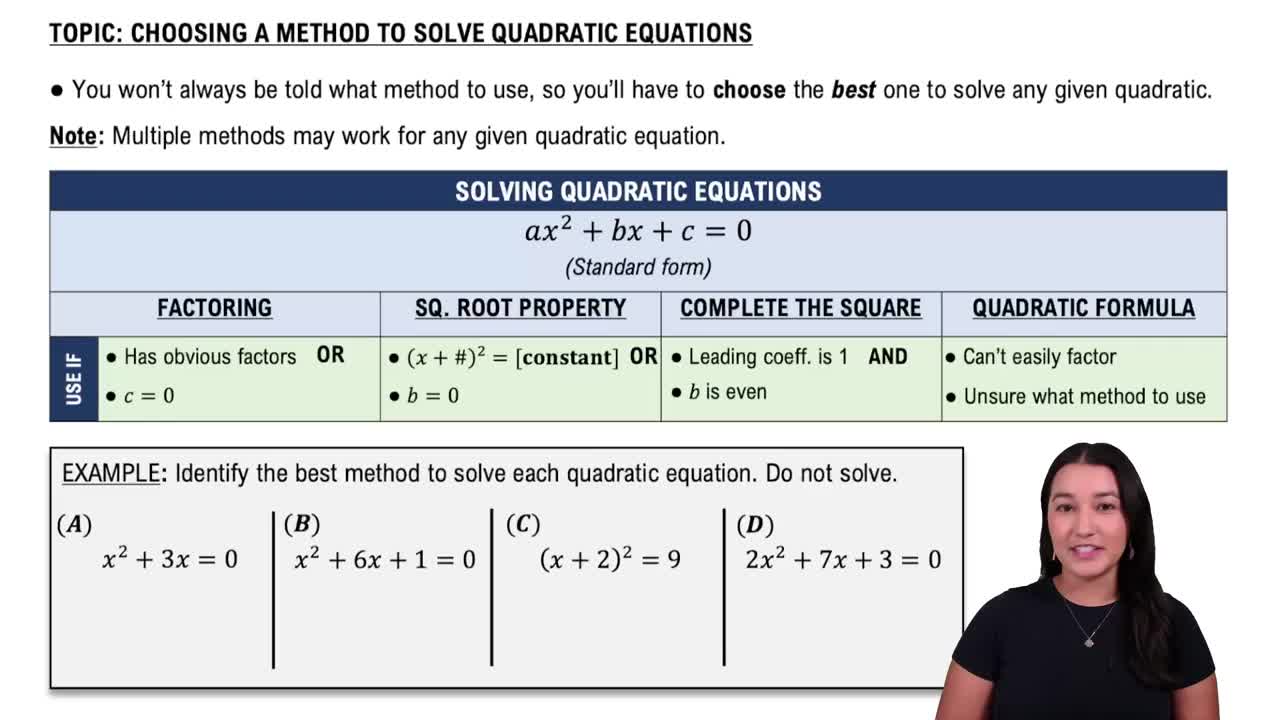
Quadratic inequalities involve expressions where a quadratic polynomial is compared to zero or another value using inequality signs. To solve them, first rewrite the inequality in standard form, then find the roots of the corresponding quadratic equation. These roots divide the number line into intervals to test for where the inequality holds true.
Recommended video:
04:03
Choosing a Method to Solve Quadratics

Factoring and Finding Roots of Quadratic Equations

Finding the roots of a quadratic equation involves setting the quadratic expression equal to zero and solving for the variable. This can be done by factoring, completing the square, or using the quadratic formula. The roots are critical points that help determine the intervals for testing the inequality.
Recommended video:
06:08
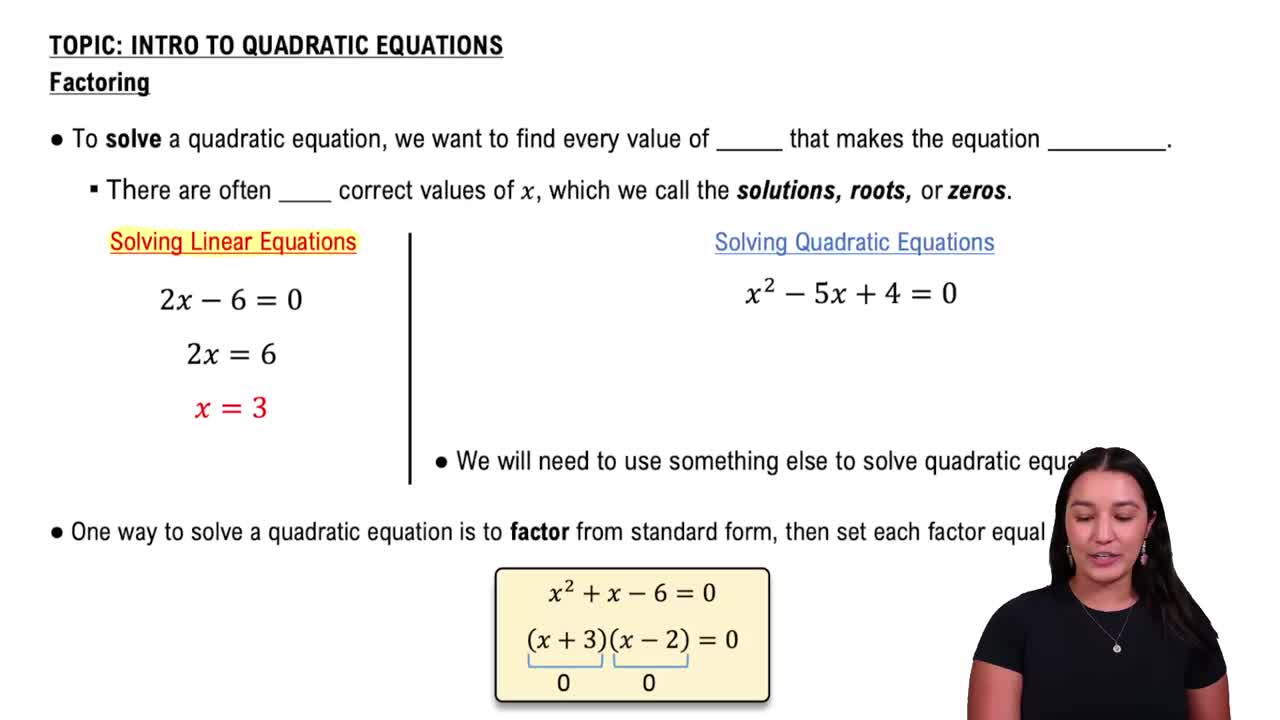
Solving Quadratic Equations by Factoring

Interval Notation and Solution Sets

Interval notation is a concise way to represent sets of real numbers that satisfy inequalities. It uses parentheses and brackets to indicate open or closed intervals, respectively. After determining where the quadratic inequality holds, express the solution set using interval notation to clearly communicate the range of valid values.
Recommended video:
05:18
Interval Notation
Related Practice
Textbook Question

Find all complex zeros of each polynomial function. Give exact values. List multiple zeros as necessary.* ƒ(x)=x4+2x3-3x2+24x-180

436
views
Textbook Question

The following exercises are geometric in nature and lead to polynomial models. Solve each problem. A standard piece of notebook paper measuring 8.5 in. by 11 in. is to be made into a box with an open top by cutting equal-size squares from each cor-ner and folding up the sides. Let x represent the length of a side of each such square in inches. Use the table feature of a graphing calculator to do the following. Round to the nearest hundredth.

a. Find the maximum volume of the box.

571
views
Textbook Question

Use the technique described in Exercises 87–90 to solve each inequality. Write the solution set in interval notation. -x2 + 2x + 6 > 0

468
views
Textbook Question

Determine the different possibilities for the numbers of positive, negative, and nonreal complex zeros of each function. ƒ(x)=2x5+10x46x3+8x2x+1ƒ(x)=-2x^5+10x^4-6x^3+8x^2-x+1

545
views
Textbook Question

The following exercises are geometric in nature and lead to polynomial models. Solve each problem. A certain right triangle has area 84 in.2. One leg of the triangle measures 1 in. less than the hypotenuse. Let x represent the length of the hypotenuse. Express the length of the leg mentioned above in terms of x. Give the domain of x.

95
views
Textbook Question

Use the technique described in Exercises 87–90 to solve each inequality. Write the solution set in interval notation. 3x2 + x ≥ 4

481
views