Ch. 3 - Polynomial and Rational Functions
Lial - College Algebra 13th Edition
Lial13th EditionCollege AlgebraISBN: 9780136881063Not the one you use?Change textbook
Chapter 4, Problem 7

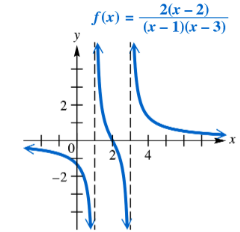
Use the graph to solve each equation or inequality. Use interval notation where appropriate. 2(x-2) / {(x-1)(x-3)} = 0

Verified step by step guidance
1
Identify the given rational function: \(\frac{2(X-2)}{(X-1)(X-3)} = 0\).
Recall that a rational function equals zero when its numerator equals zero (and the denominator is not zero). So, set the numerator equal to zero: \$2(X-2) = 0$.
Solve the numerator equation: \$2(X-2) = 0\( implies \)X-2 = 0\(, so \)X = 2$.
Check the denominator at \(X=2\) to ensure it is not zero: \((2-1)(2-3) = 1 \times (-1) = -1 \neq 0\), so \(X=2\) is a valid solution.
Use the graph to confirm that the function crosses the x-axis at \(X=2\), which matches the solution found algebraically.

Verified video answer for a similar problem:

This video solution was recommended by our tutors as helpful for the problem above.
Video duration:
2m
Was this helpful?

Key Concepts

Here are the essential concepts you must grasp in order to answer the question correctly.

Rational Functions and Their Graphs

A rational function is a ratio of two polynomials. Its graph can have vertical asymptotes where the denominator is zero and horizontal or oblique asymptotes based on the degrees of numerator and denominator. Understanding these features helps interpret the behavior of the function and solve related equations.
Recommended video:
8:19
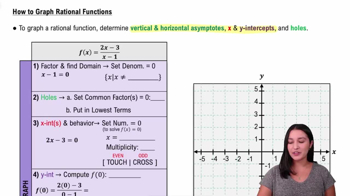
How to Graph Rational Functions

Solving Rational Equations

To solve rational equations like 2(x-2)/((x-1)(x-3)) = 0, set the numerator equal to zero and ensure the denominator is not zero. The solutions are the x-values that make the numerator zero but do not make the denominator zero, as those points are undefined.
Recommended video:
05:56
Introduction to Rational Equations

Interval Notation and Inequalities

Interval notation expresses the set of solutions for inequalities or equations on the number line. When solving inequalities involving rational functions, consider where the function is positive, negative, or zero, and exclude points where the function is undefined, using parentheses or brackets accordingly.
Recommended video:
05:18
Interval Notation
Related Practice
Textbook Question

Use synthetic division to perform each division. (x3 + 3x2 +11x + 9) / x+1

768
views
Textbook Question

Solve each problem. During the course of ayear, the number of volunteers available to run a food bank each month is modeled by V(x),V(x), where V(x)=2x232x+150V(x)=2x^2-32x+150 between the months of January and August. Here x is time in months, with x=1 representing January. From August to December, V(x)V(x) is modeled by V(x)=31x226V(x)=31x-226. Find the number of volunteers in each of the following months.

August

742
views
Textbook Question

Solve each problem. During the course of a year, the number of volunteers available to run a food bank each month is modeled by V(x)V(x), where V(x)=2x232x+150V(x)=2x^2-32x+150 between the months of January and August. Here x is time in months, with x=1 representing January. From August to December, V(x)V(x) is modeled by V(x)=31x226V(x)=31x-226. Find the number of volunteers in each of the following months.

May

713
views
Textbook Question

Provide a short answer to each question. Is ƒ(x)=1/x2 an even or an odd function? What symmetry does its graph exhibit?

884
views
Textbook Question

Solve each problem. If y varies directly as x, and y=20 when x=4, find y when x = -6.

647
views
Textbook Question

Solve each problem. During the course of a year, the number of volunteers available to run a food bank each month is modeled by V(x)V(x), where V(x)=2x232x+150V(x)=2x^2-32x+150 between the months of January and August. Here x is time in months, with x=1 representing January. From August to December, V(x) is modeled by V(x)=31x226V(x)=31x-226. Find the number of volunteers in each of the following months.

January

743
views