Ch. R - Review of Basic Concepts
Lial - College Algebra 13th Edition
Lial13th EditionCollege AlgebraISBN: 9780136881063Not the one you use?Change textbook
Chapter 1, Problem 37

Write each expression without negative exponents, and evaluate if possible. Assume all variables represent nonzero real numbers. (-4)-3

Verified step by step guidance
1
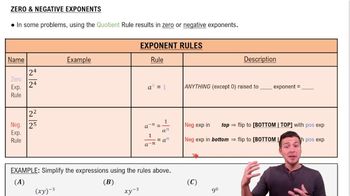
Recall the rule for negative exponents: for any nonzero number \(a\) and integer \(n\), \(a^{-n} = \frac{1}{a^n}\). This means a negative exponent indicates the reciprocal of the base raised to the positive exponent.
Apply this rule to the expression \((-4)^{-3}\). Rewrite it as \(\frac{1}{(-4)^3}\) to eliminate the negative exponent.
Calculate the denominator \((-4)^3\) by multiplying \(-4\) by itself three times: \((-4) \times (-4) \times (-4)\).
Evaluate the multiplication step-by-step: first \((-4) \times (-4)\), then multiply the result by \(-4\) again.
Write the final expression as \(\frac{1}{\text{the value you found}}\). This is the expression without negative exponents and evaluated.

Verified video answer for a similar problem:

This video solution was recommended by our tutors as helpful for the problem above.
Video duration:
1m
Was this helpful?

Key Concepts

Here are the essential concepts you must grasp in order to answer the question correctly.

Negative Exponents

A negative exponent indicates the reciprocal of the base raised to the corresponding positive exponent. For example, a^-n = 1/a^n, where a ≠ 0. This rule allows rewriting expressions without negative exponents by moving the base to the denominator.
Recommended video:
Guided course
6:37
Zero and Negative Rules

Evaluating Powers of Negative Numbers

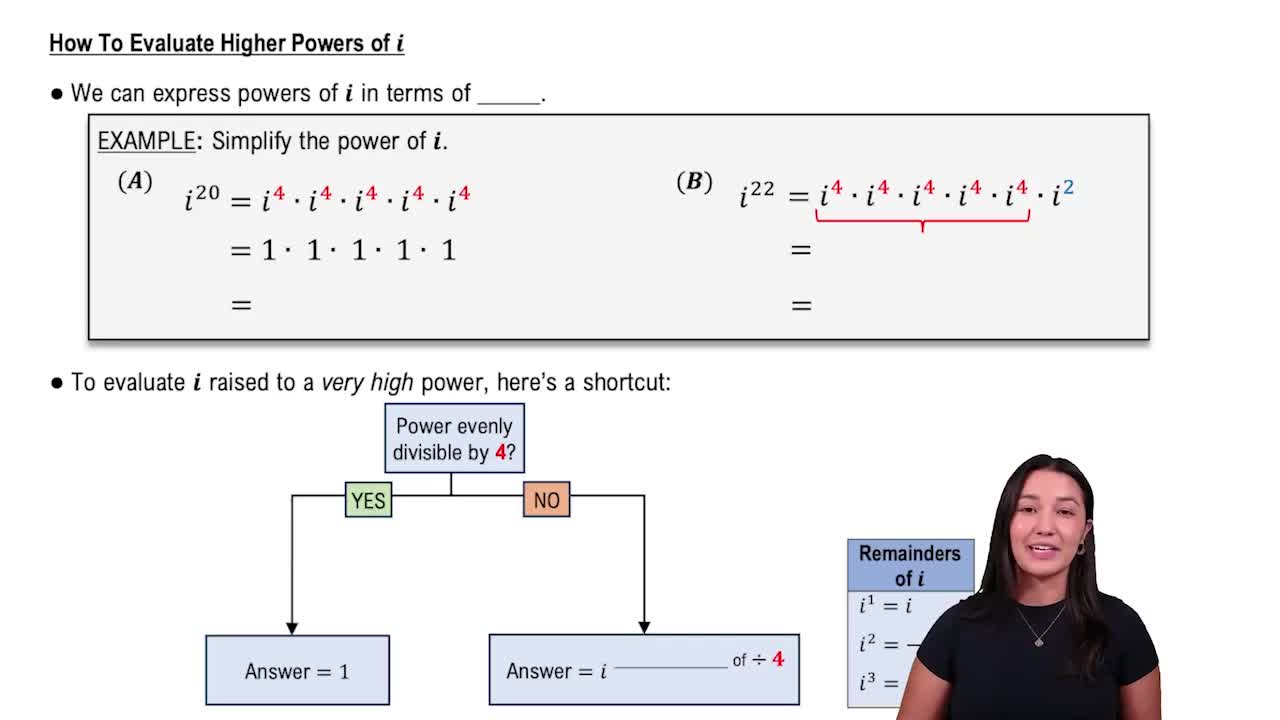
When raising a negative number to a power, consider whether the exponent is even or odd. An odd exponent preserves the negative sign, while an even exponent results in a positive value. For example, (-4)^3 = -64 because 3 is odd.
Recommended video:
05:10
Higher Powers of i

Simplifying Expressions with Exponents

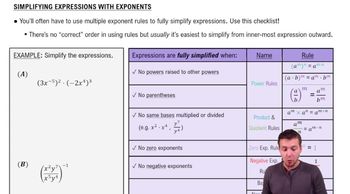
Simplifying expressions involves applying exponent rules systematically, such as converting negative exponents to positive, and then calculating numerical values when possible. This process ensures expressions are in standard form and easier to interpret.
Recommended video:
Guided course
6:39
Simplifying Exponential Expressions