Ch. 3 - Polynomial and Rational Functions
Lial - College Algebra 13th Edition
Lial13th EditionCollege AlgebraISBN: 9780136881063Not the one you use?Change textbook
Chapter 4, Problem 59

Show that the real zeros of each polynomial function satisfy the given conditions. ƒ(x)=x4+x3-x2+3; no real zero less than -2

Verified step by step guidance
1
First, understand the problem: we need to show that any real zero \( x \) of the polynomial function \( f(x) = x^4 + x^3 - x^2 + 3 \) is not less than \( -2 \). In other words, if \( f(x) = 0 \), then \( x \geq -2 \).
Evaluate the polynomial at \( x = -2 \) to check the value of \( f(-2) \). This helps determine if \( -2 \) is a root or if the function changes sign around this point. Write \( f(-2) = (-2)^4 + (-2)^3 - (-2)^2 + 3 \).
Analyze the behavior of \( f(x) \) for values less than \( -2 \). For example, pick a test value such as \( x = -3 \) and compute \( f(-3) \) to see if the function is positive or negative there. This helps identify if the function crosses the x-axis to the left of \( -2 \).
Use the Intermediate Value Theorem: if \( f(x) \) does not change sign between \( -10 \) and \( -2 \) (or any interval to the left of \( -2 \)), then there are no real zeros less than \( -2 \).
Optionally, analyze the derivative \( f'(x) \) to understand the shape and monotonicity of the polynomial on the interval \( (-1\text{, } -2) \), which can support the conclusion about the location of zeros.

Verified video answer for a similar problem:

This video solution was recommended by our tutors as helpful for the problem above.
Video duration:
6m
Was this helpful?

Key Concepts

Here are the essential concepts you must grasp in order to answer the question correctly.

Polynomial Functions and Their Zeros

A polynomial function is an expression involving variables raised to whole-number exponents with coefficients. The zeros of a polynomial are the values of x for which the function equals zero. Understanding how to find and interpret these zeros is essential for analyzing the behavior of the function.
Recommended video:
03:42
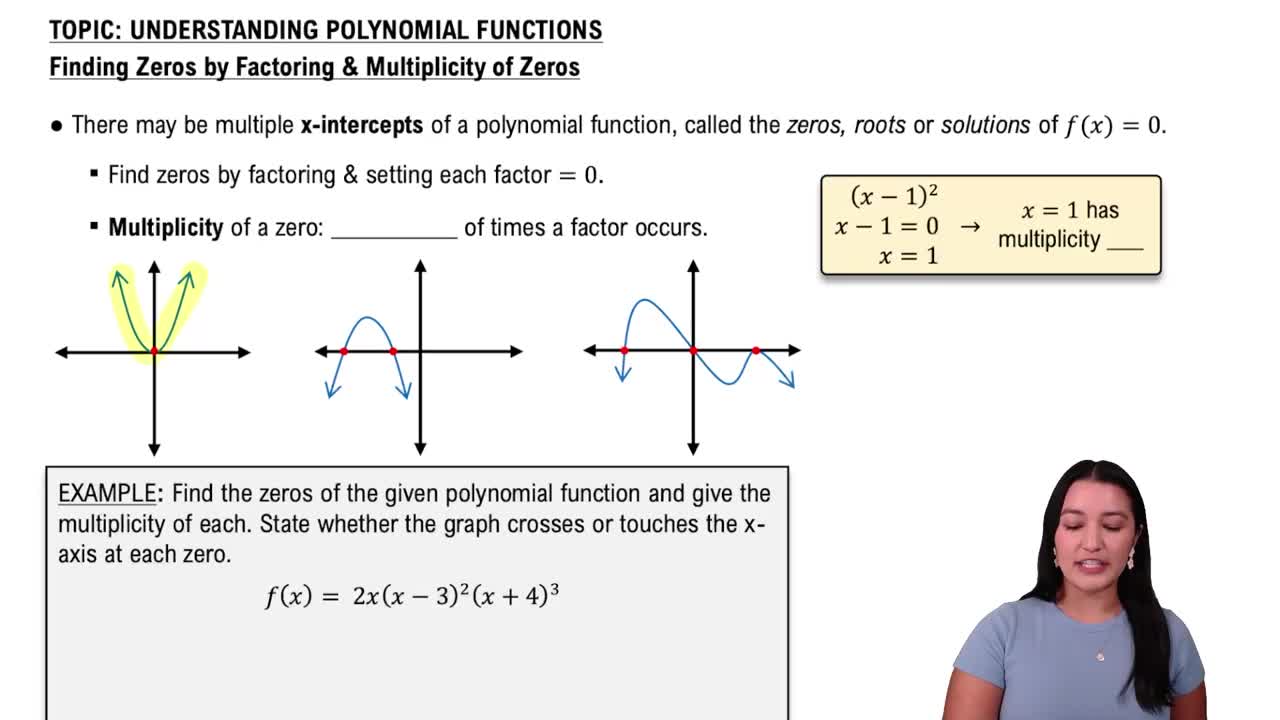
Finding Zeros & Their Multiplicity

Evaluating Polynomial Values at Specific Points

Evaluating a polynomial at a given point involves substituting the value into the function and calculating the result. This helps determine whether the function crosses the x-axis at or near that point, which is useful for verifying conditions about the location of zeros.
Recommended video:
02:44
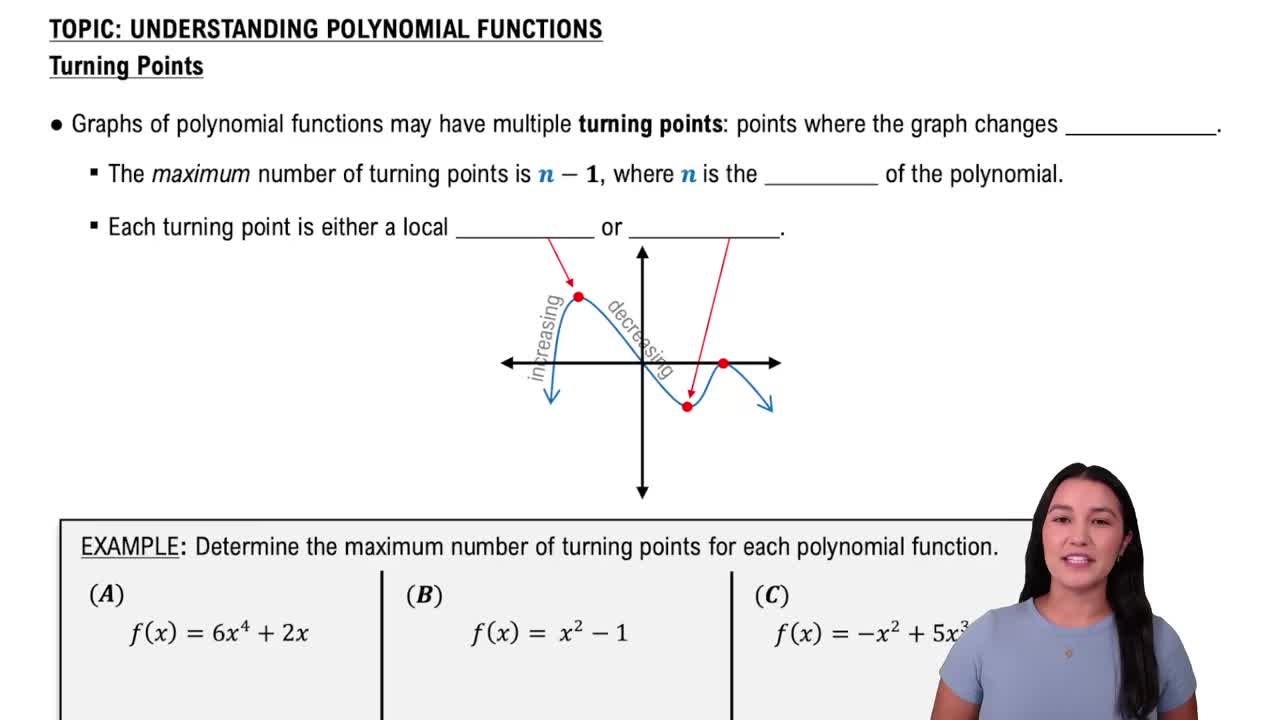
Maximum Turning Points of a Polynomial Function

Using Inequalities to Bound Zeros

Inequalities can be used to establish intervals where zeros of a polynomial may or may not exist. By testing values and applying the Intermediate Value Theorem or sign analysis, one can show that no real zeros lie below or above a certain number, as required in the problem.
Recommended video:
Guided course
3:21
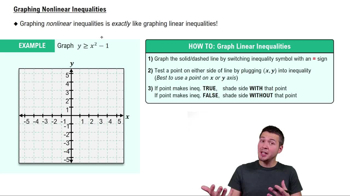
Nonlinear Inequalities