Ch. 2 - Graphs and Functions
Lial - College Algebra 13th Edition
Lial13th EditionCollege AlgebraISBN: 9780136881063Not the one you use?Change textbook
Chapter 3, Problem 30

Graph each line. Give the domain and range. 3 + x = 0

Verified step by step guidance
1
Rewrite the given equation \$3 + x = 0\( to isolate \)x\(. Subtract 3 from both sides to get \)x = -3$.
Recognize that the equation \(x = -3\) represents a vertical line on the coordinate plane where \(x\) is always \(-3\) regardless of \(y\).
To graph the line, draw a vertical line passing through the point \((-3, 0)\) on the \(x\)-axis. This line extends infinitely up and down.
Determine the domain of the line. Since \(x\) is always \(-3\), the domain is the single value \(\{ -3 \}\).
Determine the range of the line. Because \(y\) can be any real number along the vertical line, the range is all real numbers, expressed as \((-\infty, \infty)\).

Verified video answer for a similar problem:

This video solution was recommended by our tutors as helpful for the problem above.
Video duration:
3m
Was this helpful?

Key Concepts

Here are the essential concepts you must grasp in order to answer the question correctly.

Graphing Linear Equations

Graphing linear equations involves plotting all points (x, y) that satisfy the equation on the coordinate plane. For equations like 3 + x = 0, rewriting or identifying the form helps determine the line's position. Understanding how to represent lines visually is essential for interpreting their behavior.
Recommended video:
06:00
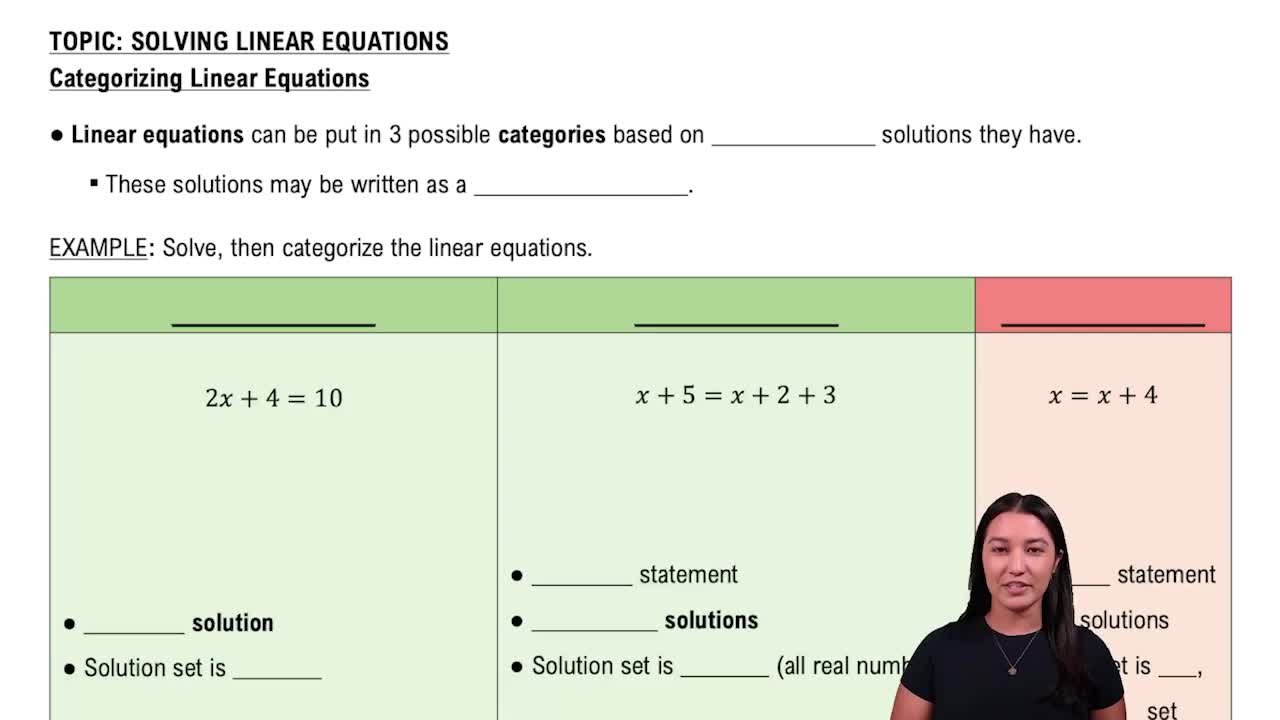
Categorizing Linear Equations

Domain of a Function

The domain is the set of all possible input values (x-values) for which the function or equation is defined. For linear equations, the domain often includes all real numbers unless restricted by the equation. Identifying the domain helps understand the scope of the function.
Recommended video:
3:51
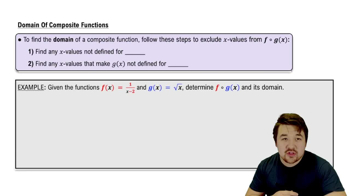
Domain Restrictions of Composed Functions

Range of a Function

The range is the set of all possible output values (y-values) that the function can produce. For lines, the range depends on the slope and orientation; vertical or horizontal lines have specific ranges. Knowing the range helps describe the function's output behavior.
Recommended video:
4:22
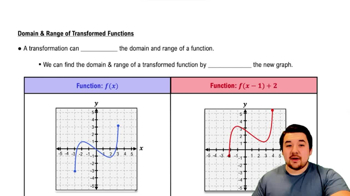
Domain & Range of Transformed Functions