Ch. 4 - Inverse, Exponential, and Logarithmic Functions
Lial - College Algebra 13th Edition
Lial13th EditionCollege AlgebraISBN: 9780136881063Not the one you use?Change textbook
Chapter 5, Problem 33

Solve each equation. x=log4163x = \(\log\)_4 \(\sqrt\)[3]{16}

Verified step by step guidance
1
Recognize that the equation is given as \(x = \log_{4} \sqrt[3]{16}\), where you need to find the value of \(x\).
Rewrite the cube root expression using fractional exponents: \(\sqrt[3]{16} = 16^{\frac{1}{3}}\).
Express 16 as a power of 4, since the logarithm base is 4. Note that \$16 = 4^2$, so substitute to get \(16^{\frac{1}{3}} = (4^2)^{\frac{1}{3}}\).
Use the power of a power property: \((a^m)^n = a^{m \cdot n}\), to simplify \((4^2)^{\frac{1}{3}}\) to \(4^{\frac{2}{3}}\).
Now the equation becomes \(x = \log_{4} 4^{\frac{2}{3}}\). Use the logarithm power rule \(\log_b (a^m) = m \log_b a\) and the fact that \(\log_b b = 1\) to simplify and solve for \(x\).

Verified video answer for a similar problem:

This video solution was recommended by our tutors as helpful for the problem above.
Video duration:
4m
Was this helpful?

Key Concepts

Here are the essential concepts you must grasp in order to answer the question correctly.

Logarithms and Their Properties

A logarithm answers the question: to what exponent must the base be raised to produce a given number? For example, log₄(16) asks, '4 raised to what power equals 16?' Understanding how to interpret and manipulate logarithms is essential for solving equations involving them.
Recommended video:
5:36
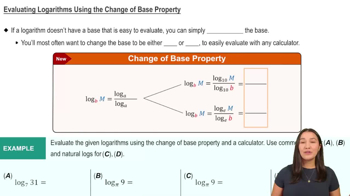
Change of Base Property

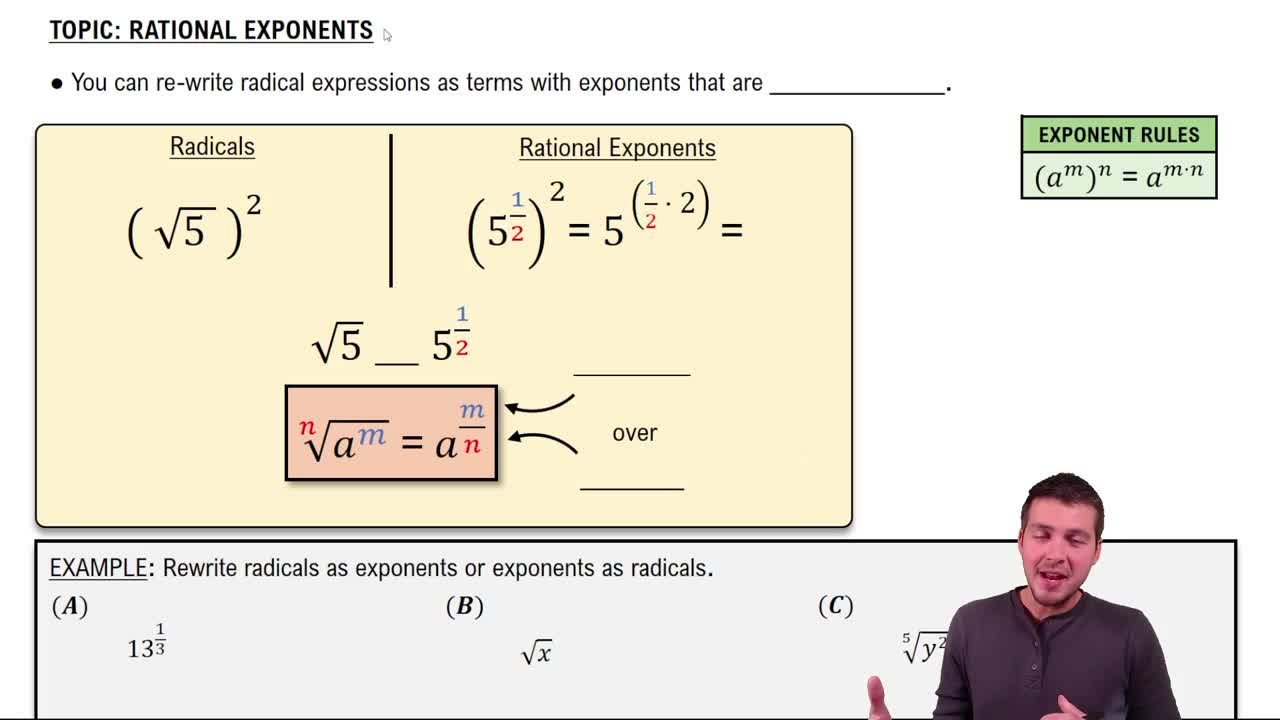
Radicals and Rational Exponents

Radicals like cube roots can be expressed as rational exponents; for instance, the cube root of 16 is 16^(1/3). Converting between radical notation and exponents helps simplify expressions and apply logarithmic rules effectively.
Recommended video:
Guided course
04:06
Rational Exponents

Change of Base and Simplification Techniques

Simplifying logarithmic expressions often requires rewriting numbers as powers of the same base or using properties like log(a^b) = b·log(a). Recognizing how to rewrite 16 and apply these properties is key to solving the given equation.
Recommended video:
5:36
Change of Base Property