Use the graph to evaluate each expression. See Example 3(a). (ƒ-g)(1)
Verified step by step guidance
1
Identify the value of x for which you need to evaluate the expression (f - g)(1). Here, x = 1.
Find the value of f(1) by locating x = 1 on the horizontal axis and then moving vertically to the orange curve representing f(x). Read the corresponding y-value.
Find the value of g(1) by locating x = 1 on the horizontal axis and then moving vertically to the blue line representing g(x). Read the corresponding y-value.
Use the definition of the difference of functions: (f - g)(1) = f(1) - g(1).
Subtract the value of g(1) from f(1) to get the result of (f - g)(1).
Verified video answer for a similar problem:
This video solution was recommended by our tutors as helpful for the problem above
Video duration:
3m
Play a video:
0 Comments
Key Concepts
Here are the essential concepts you must grasp in order to answer the question correctly.
Function Evaluation
Function evaluation involves finding the output value of a function for a given input. For example, to evaluate f(1), locate x = 1 on the graph and find the corresponding y-value on the curve of f(x). This process is essential for understanding how functions behave at specific points.
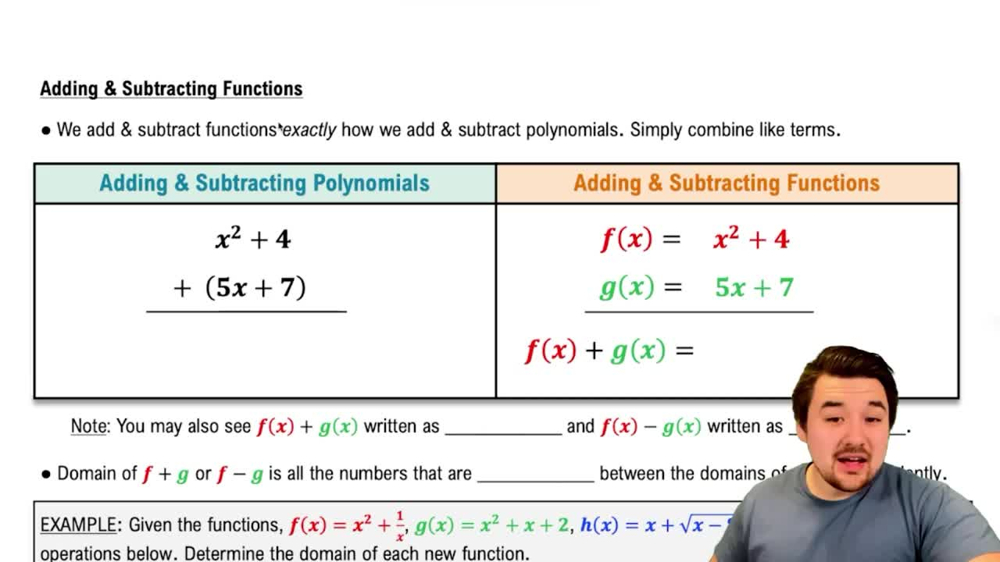
Function operations combine two functions to create a new function. In subtraction, (f - g)(x) means subtracting the value of g(x) from f(x) for the same input x. Evaluating (f - g)(1) requires finding f(1) and g(1) separately, then subtracting g(1) from f(1).
Interpreting graphs involves reading values from the plotted curves of functions. By identifying points on the graph at a specific x-value, you can determine the corresponding y-values for f(x) and g(x). This skill is crucial for evaluating expressions like (f - g)(1) using graphical data.

 3:04 minutes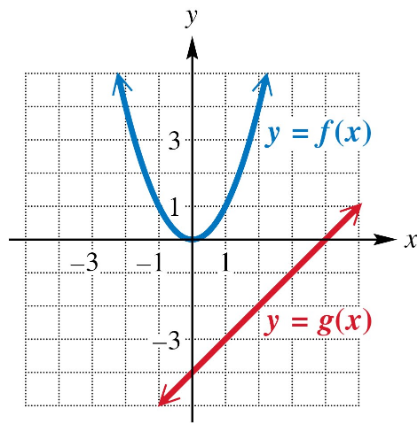
 Verified step by step guidance
 4:26
4:26