Recognize that the equation \$4x^{4} + 3x^{2} - 1 = 0\( is a quartic equation but can be treated as a quadratic in terms of \)x^{2}\(. To do this, let \)y = x^{2}$.
Rewrite the equation in terms of \(y\): \$4y^{2} + 3y - 1 = 0$.
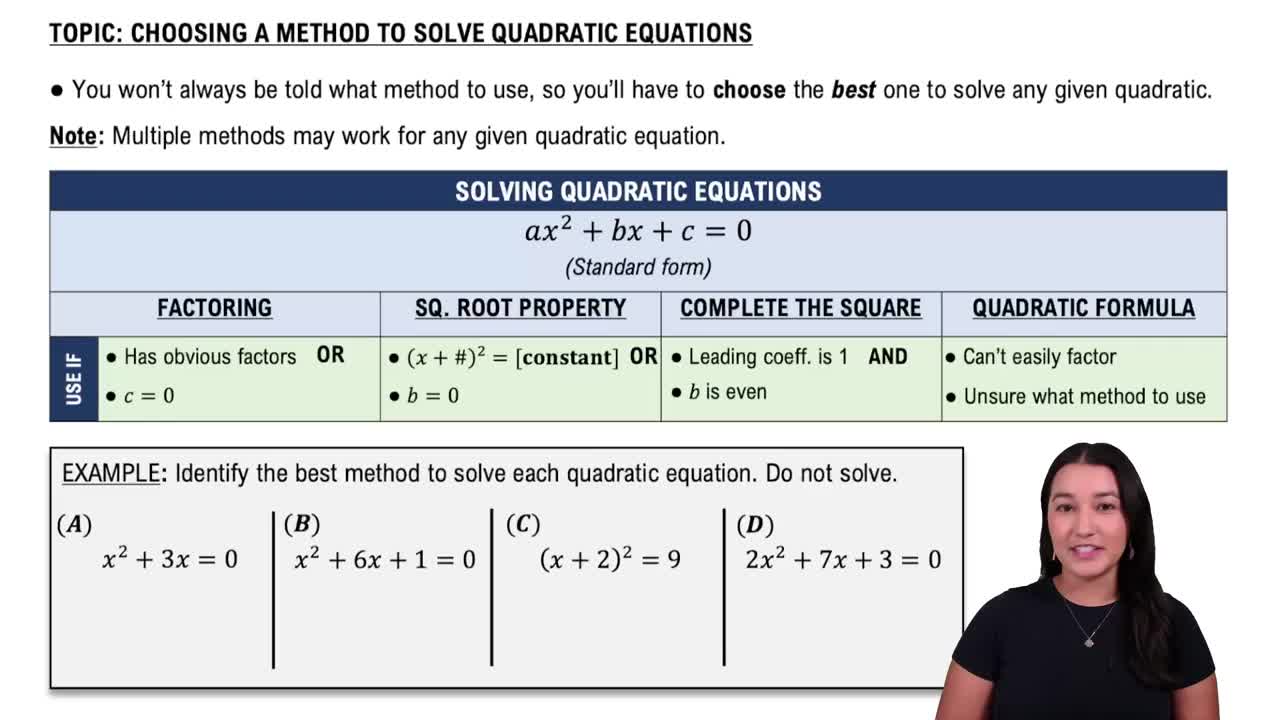
Solve the quadratic equation \$4y^{2} + 3y - 1 = 0\( using the quadratic formula: \(y = \frac{-b \pm \sqrt{b^{2} - 4ac}}{2a}\), where \)a=4\(, \)b=3\(, and \)c=-1$.
After finding the values of \(y\), substitute back \(y = x^{2}\) and solve for \(x\) by taking the square root: \(x = \pm \sqrt{y}\).
Check each solution for \(x\) to ensure it satisfies the original equation, and write the final solution set.
Verified video answer for a similar problem:
This video solution was recommended by our tutors as helpful for the problem above
Video duration:
6m
Play a video:
0 Comments
Key Concepts
Here are the essential concepts you must grasp in order to answer the question correctly.
Polynomial Equations
Polynomial equations involve expressions with variables raised to whole-number exponents and coefficients. Solving them means finding all values of the variable that satisfy the equation. Understanding the degree and structure of the polynomial helps determine the methods used for solving.
Substitution Method for Quadratic in Form Equations
When a polynomial equation can be rewritten so that a higher power term is expressed as a square of a lower power term (e.g., x⁴ as (x²)²), substitution simplifies it into a quadratic equation. This method involves letting a new variable represent the lower power term to solve more easily.
Quadratic equations are second-degree polynomials that can be solved by factoring, completing the square, or using the quadratic formula. Once the substitution reduces the original equation to quadratic form, these techniques help find the roots, which can then be back-substituted to find the original variable values.

 6:14 minutes
 Verified step by step guidance
 05:13
05:13