Ch. 1 - Equations and Inequalities
Blitzer - College Algebra 8th Edition
Blitzer8th EditionCollege AlgebraISBN: 9780136970514Not the one you use?Change textbook
Chapter 2, Problem 10

Solve each polynomial equation in Exercises 1–10 by factoring and then using the zero-product principle. 3x4=81x3x^4 = 81x

Verified step by step guidance
1
Start by rewriting the equation to set it equal to zero: \(3x^4 - 81x = 0\).
Factor out the greatest common factor (GCF) from the left side. Identify the GCF of \$3x^4\( and \)81x\(, which is \)3x$, and factor it out: \(3x(x^3 - 27) = 0\).
Recognize that \(x^3 - 27\) is a difference of cubes, since \(27 = 3^3\). Use the difference of cubes formula: \(a^3 - b^3 = (a - b)(a^2 + ab + b^2)\), where \(a = x\) and \(b = 3\).
Apply the formula to factor \(x^3 - 27\) as \((x - 3)(x^2 + 3x + 9)\), so the full factorization is \(3x(x - 3)(x^2 + 3x + 9) = 0\).
Use the zero-product principle, which states that if a product of factors equals zero, then at least one of the factors must be zero. Set each factor equal to zero: \(3x = 0\), \(x - 3 = 0\), and \(x^2 + 3x + 9 = 0\), then solve each equation for \(x\).

Verified video answer for a similar problem:

This video solution was recommended by our tutors as helpful for the problem above.
Video duration:
9m
Was this helpful?

Key Concepts

Here are the essential concepts you must grasp in order to answer the question correctly.

Polynomial Equations

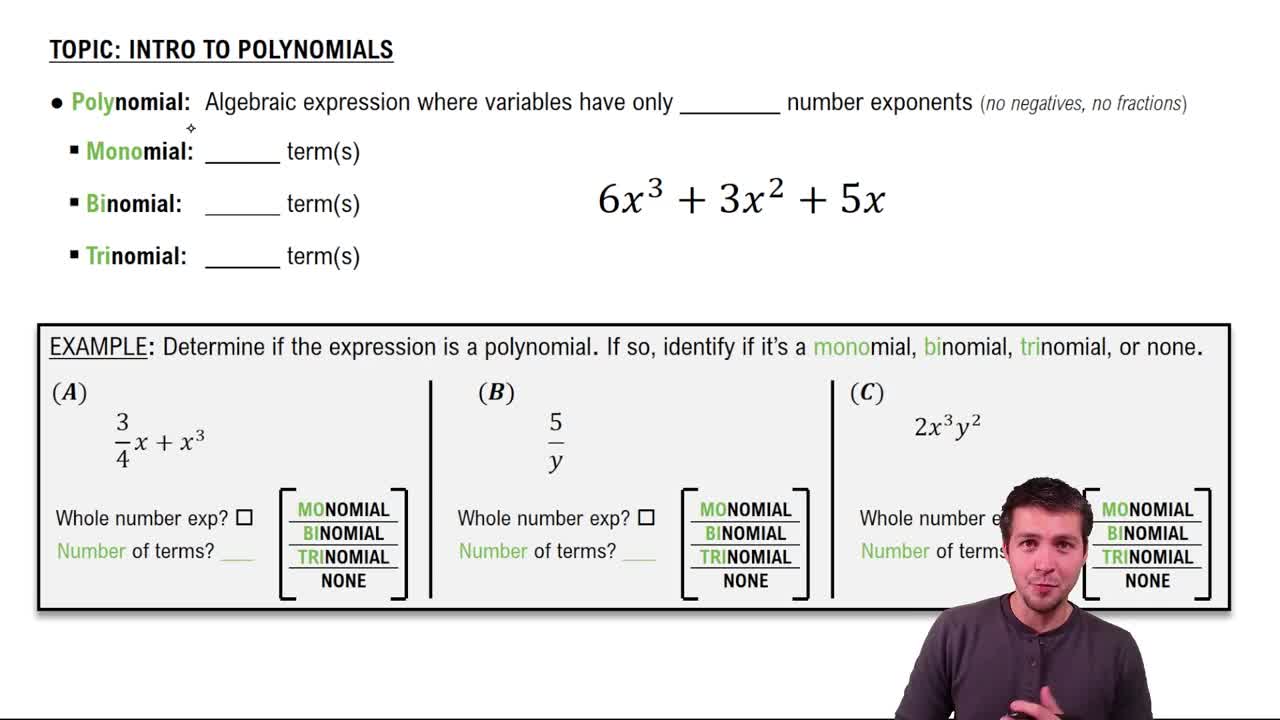
A polynomial equation involves expressions with variables raised to whole-number exponents and coefficients. Solving these equations means finding all values of the variable that make the equation true. Understanding the structure of polynomials helps in applying appropriate methods like factoring.
Recommended video:
Guided course
05:13
Introduction to Polynomials

Factoring Polynomials

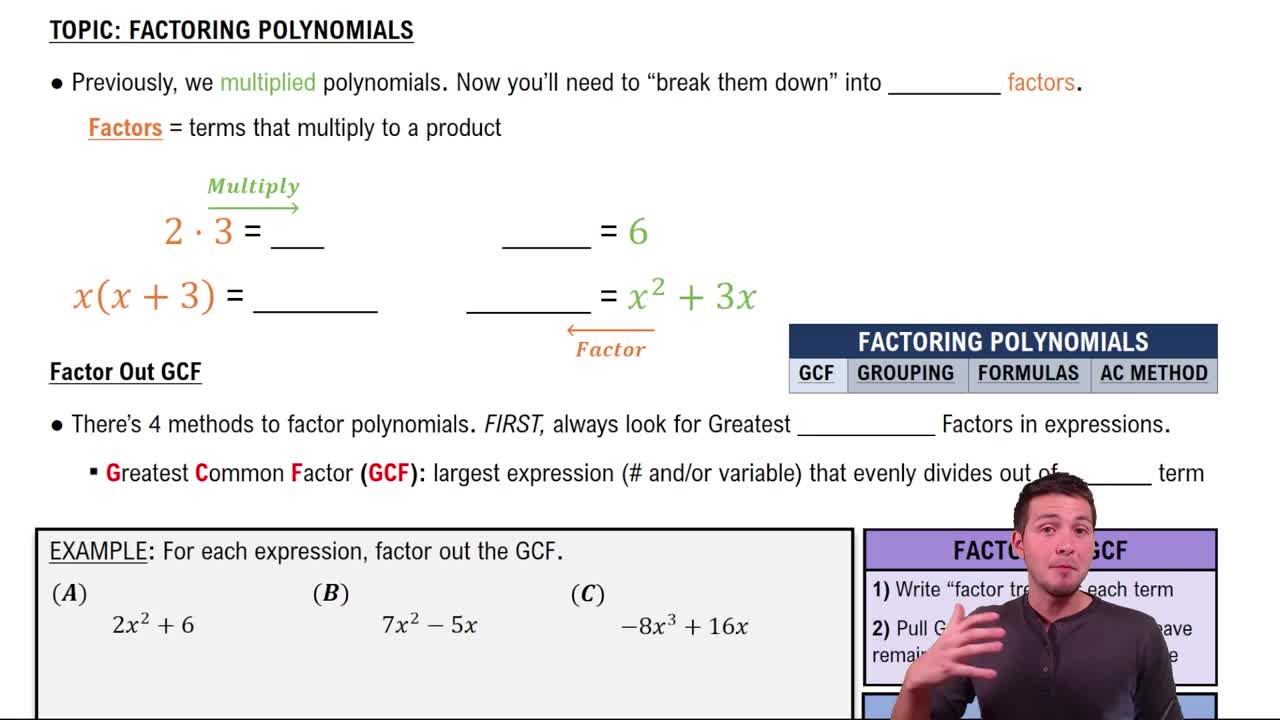
Factoring is rewriting a polynomial as a product of simpler polynomials or factors. This process simplifies solving equations by breaking them down into manageable parts. Common factoring techniques include factoring out the greatest common factor, difference of squares, and grouping.
Recommended video:
Guided course
07:30
Introduction to Factoring Polynomials

Zero-Product Principle

The zero-product principle states that if the product of two or more factors equals zero, then at least one of the factors must be zero. This principle allows us to set each factor equal to zero and solve for the variable, providing the solutions to the polynomial equation.
Recommended video:
4:04
Fundamental Counting Principle