Ch. R - Review of Basic Concepts
Lial - College Algebra 13th Edition
Lial13th EditionCollege AlgebraISBN: 9780136881063Not the one you use?Change textbook
Chapter 1, Problem 66

Perform the indicated operations. 2(3r2+4r+2)3(r2+4r5)2(3r^2+4r+2) - 3(-r^2+4r-5)

Verified step by step guidance
1
Start by distributing the constants outside the parentheses to each term inside the parentheses. For the first part, multiply 2 by each term in the expression \(3r^2 + 4r + 2\), and for the second part, multiply -3 by each term in the expression \(-r^2 + 4r - 5\). This gives you:
\[ 2 \times 3r^2 + 2 \times 4r + 2 \times 2 - 3 \times (-r^2) - 3 \times 4r - 3 \times (-5) \]
Simplify each multiplication to rewrite the expression without parentheses:
\[ 6r^2 + 8r + 4 + 3r^2 - 12r + 15 \]
Combine like terms by adding or subtracting the coefficients of \(r^2\) terms, \(r\) terms, and constant terms separately to get the simplified expression.

Verified video answer for a similar problem:

This video solution was recommended by our tutors as helpful for the problem above.
Video duration:
2m
Was this helpful?

Key Concepts

Here are the essential concepts you must grasp in order to answer the question correctly.

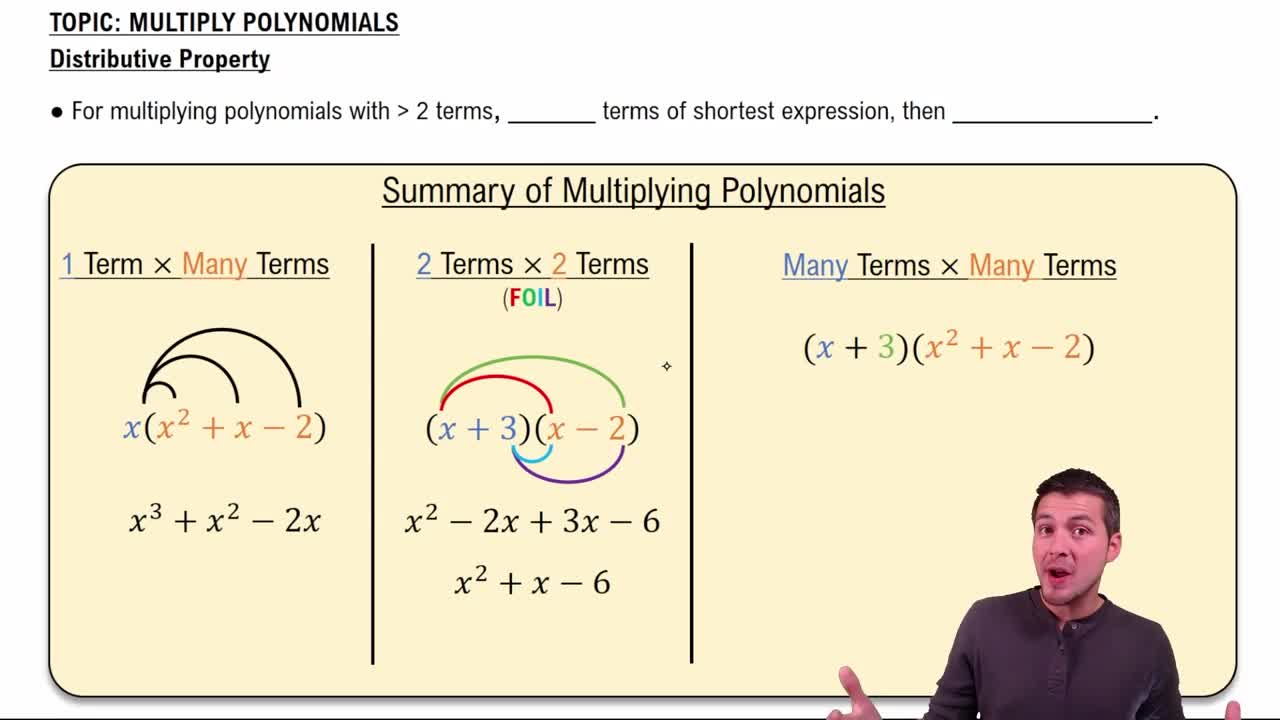
Distributive Property

The distributive property allows you to multiply a single term by each term inside a parenthesis. For example, a(b + c) = ab + ac. This property is essential for expanding expressions like 2(3r^2 + 4r + 2) by multiplying 2 with each term inside the parentheses.
Recommended video:
Guided course
04:15
Multiply Polynomials Using the Distributive Property

Combining Like Terms

Combining like terms involves adding or subtracting terms that have the same variable raised to the same power. For instance, 3r^2 and -3r^2 are like terms. After distributing, you combine these terms to simplify the expression into a single polynomial.
Recommended video:
5:22
Combinations

Handling Negative Signs

When subtracting an expression, the negative sign affects all terms inside the parentheses. For example, -3(-r^2 + 4r - 5) requires multiplying -3 by each term, changing signs accordingly. Properly managing these signs is crucial to avoid errors in simplification.
Recommended video:
Guided course
6:37
Zero and Negative Rules