Ch. R - Review of Basic Concepts
Lial - College Algebra 13th Edition
Lial13th EditionCollege AlgebraISBN: 9780136881063Not the one you use?Change textbook
Chapter 1, Problem 148

Perform the indicated operations and/or simplify each expression. Assume all variables represent positive real numbers.
52216+154\(\frac{5}{∛2}\)-\(\frac{2}{∛16}\)+\(\frac{1}{∛54}\)

Verified step by step guidance
1
Rewrite each cube root in the denominators as an exponent of 1/3. For example, express \(\sqrt[3]{2}\) as \$2^{1/3}\(, \(\sqrt[3]{16}\) as \)16^{1/3}\(, and \(\sqrt[3]{54}\) as \)54^{1/3}$. This gives the expression: \(\frac{5}{2^{1/3}} - \frac{2}{16^{1/3}} + \frac{1}{54^{1/3}}\).
Simplify the radicands where possible by expressing them as products of prime factors or perfect cubes. For example, \$16 = 2^4\( and \(54 = 2 \times 3^3\). Use this to rewrite the cube roots: \)16^{1/3} = (2^4)^{1/3} = 2^{4/3}$ and \(54^{1/3} = (2 \times 3^3)^{1/3} = 2^{1/3} \times 3\).
Rewrite each term using the simplified exponents: \(\frac{5}{2^{1/3}} - \frac{2}{2^{4/3}} + \frac{1}{2^{1/3} \times 3}\). This will help in combining like terms later.
Find a common denominator for all three terms. Since the denominators involve powers of 2 and possibly 3, the common denominator will be the least common multiple of \$2^{1/3}\(, \)2^{4/3}$, and \(2^{1/3} \times 3\). Express each term with this common denominator.
Combine the numerators over the common denominator by performing the indicated addition and subtraction. After combining, simplify the numerator if possible, and write the final expression as a single fraction.

Verified video answer for a similar problem:

This video solution was recommended by our tutors as helpful for the problem above.
Video duration:
7m
Was this helpful?

Key Concepts

Here are the essential concepts you must grasp in order to answer the question correctly.

Properties of Radicals and Cube Roots

Understanding how to work with cube roots is essential, including simplifying expressions like ∛16 or ∛54 by factoring under the radical. Recognizing that cube roots can be expressed as fractional exponents (e.g., ∛x = x^(1/3)) helps in manipulation and simplification.
Recommended video:
02:20
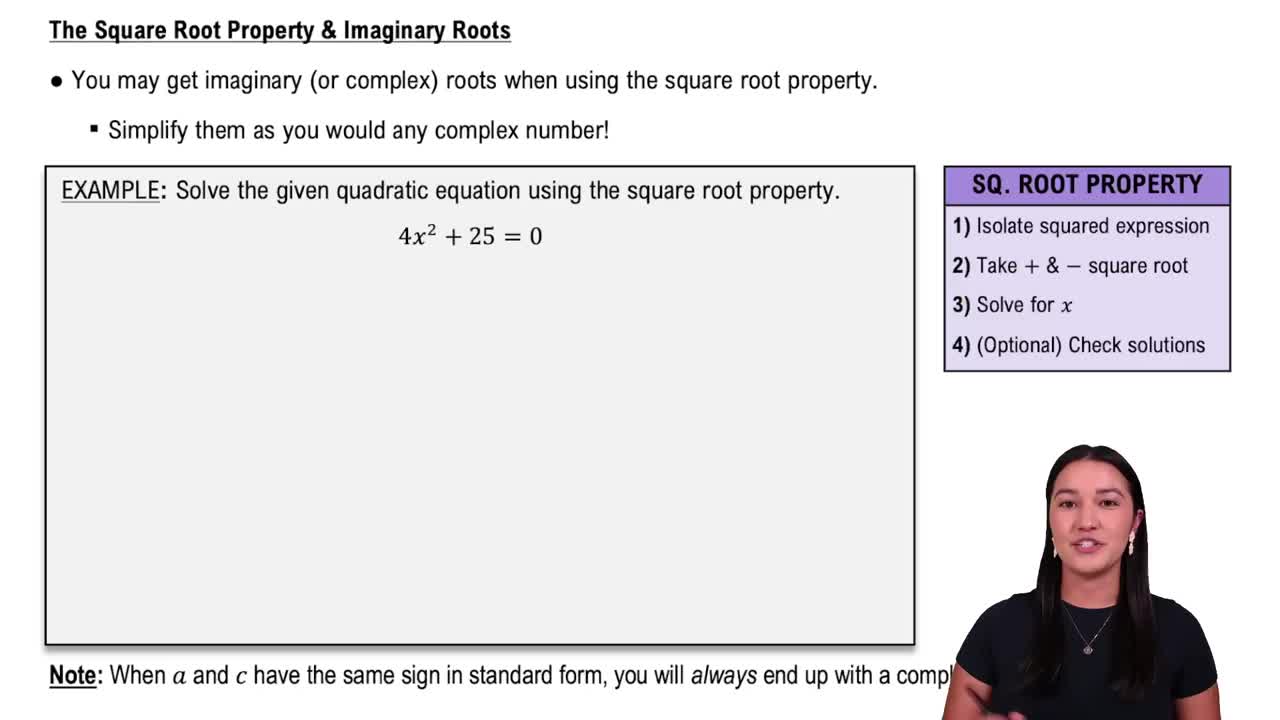
Imaginary Roots with the Square Root Property

Operations with Fractions

Performing addition and subtraction with fractions requires finding a common denominator. In this problem, the denominators involve cube roots, so identifying a common radical denominator or rewriting terms with a common base is necessary to combine the fractions correctly.
Recommended video:
Guided course
8:38
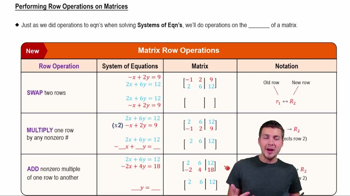
Performing Row Operations on Matrices

Simplification of Expressions with Variables and Radicals

Simplifying expressions involving radicals and variables includes reducing radicals to simplest form and combining like terms. Since variables represent positive real numbers, this allows for certain simplifications, such as removing absolute value considerations and applying standard radical rules.
Recommended video:
Guided course
06:44
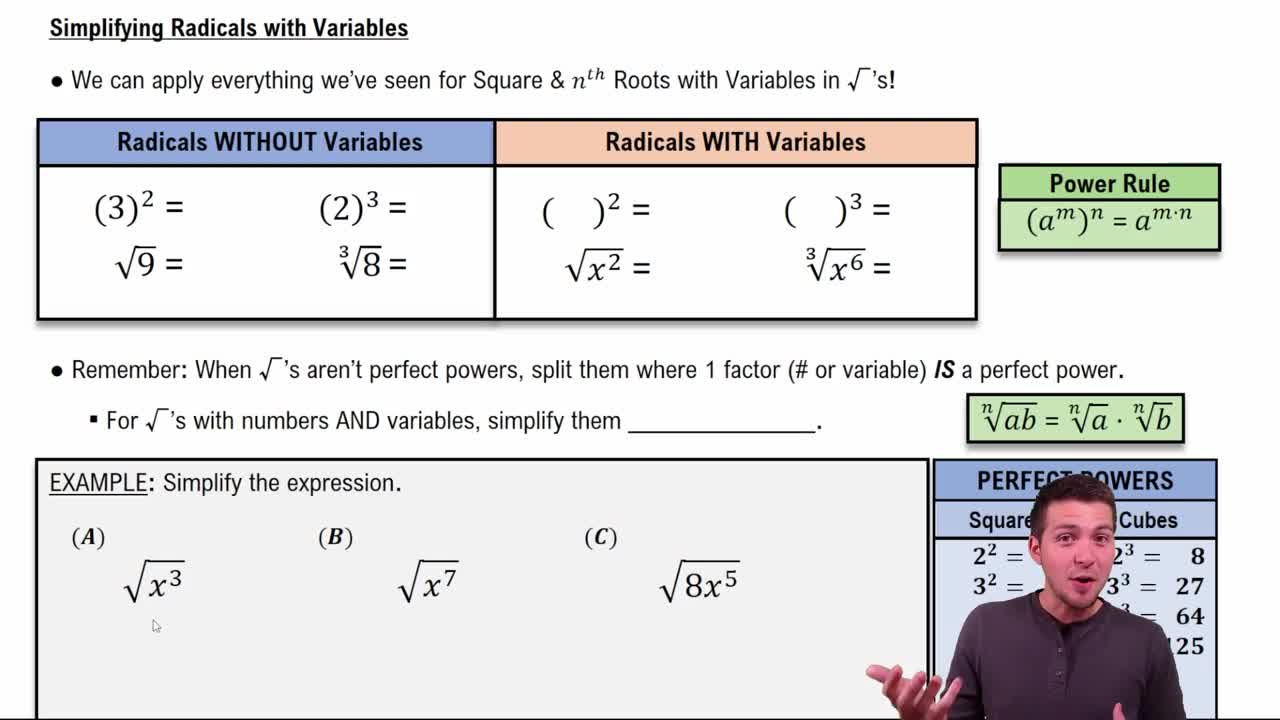
Radical Expressions with Variables