Force of Wind The force of the wind blowing on a vertical surface varies jointly as the area of the surface and the square of the velocity. If a wind of 40 mph exerts a force of 50 lb on a surface of 1/2 ft2, how much force will a wind of 80 mph place on a surface of 2 ft2?
Ch. 3 - Polynomial and Rational Functions

Chapter 4, Problem 41
Graph each polynomial function. Factor first if the polynomial is not in factored form. ƒ(x)=2x3(x2-4)(x-1)
Verified step by step guidance1
Identify the given polynomial function: \(f(x) = 2x^3(x^2 - 4)(x - 1)\).
Recognize that the polynomial is already partially factored, but \(x^2 - 4\) is a difference of squares and can be factored further as \(x^2 - 4 = (x - 2)(x + 2)\).
Rewrite the function with the fully factored form: \(f(x) = 2x^3 (x - 2)(x + 2)(x - 1)\).
Determine the zeros of the function by setting each factor equal to zero: \(x = 0\), \(x = 2\), \(x = -2\), and \(x = 1\). These are the x-intercepts of the graph.
Analyze the multiplicity of each zero: \(x=0\) has multiplicity 3 (since \(x^3\)), which affects the shape of the graph at that intercept, while the others have multiplicity 1. Use this information to sketch the graph, noting where the graph crosses or touches the x-axis.

Verified video answer for a similar problem:
This video solution was recommended by our tutors as helpful for the problem above.
Video duration:
9mWas this helpful?
Key Concepts
Here are the essential concepts you must grasp in order to answer the question correctly.
Polynomial Functions
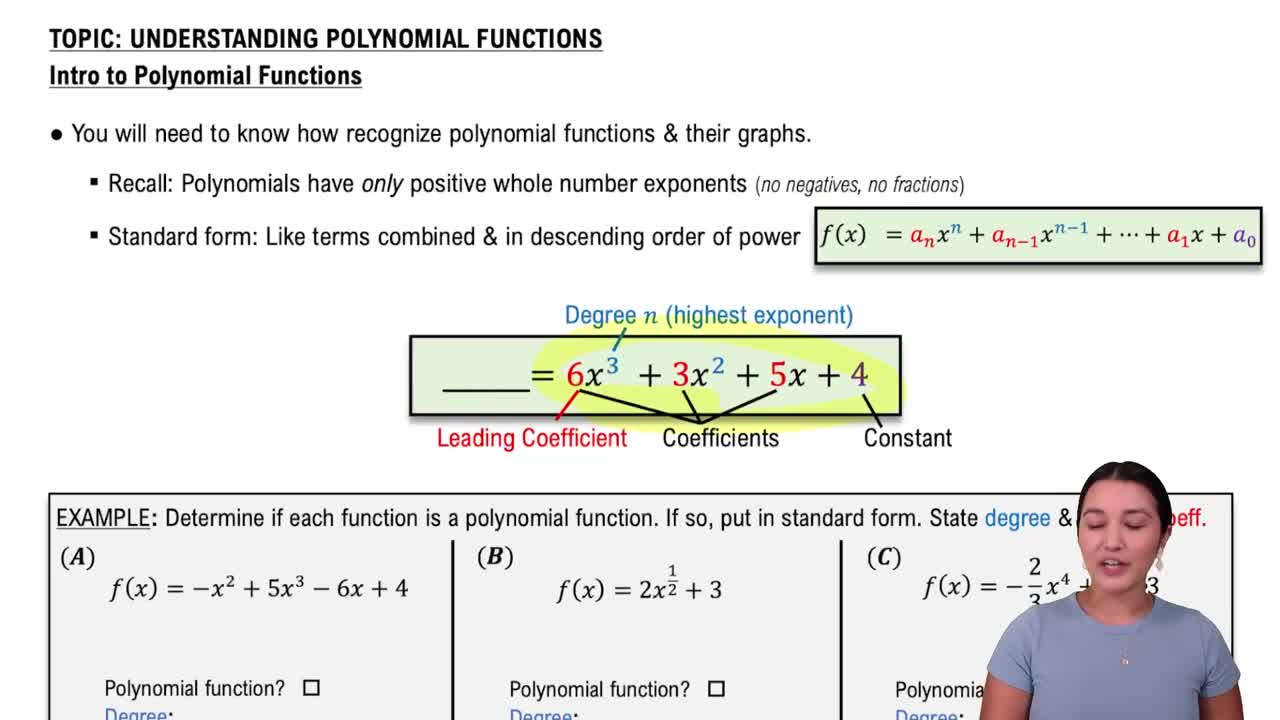
A polynomial function is an expression consisting of variables and coefficients combined using addition, subtraction, multiplication, and non-negative integer exponents. Understanding the degree and leading coefficient helps predict the general shape and end behavior of the graph.
Recommended video:
Introduction to Polynomial Functions
Factoring Polynomials
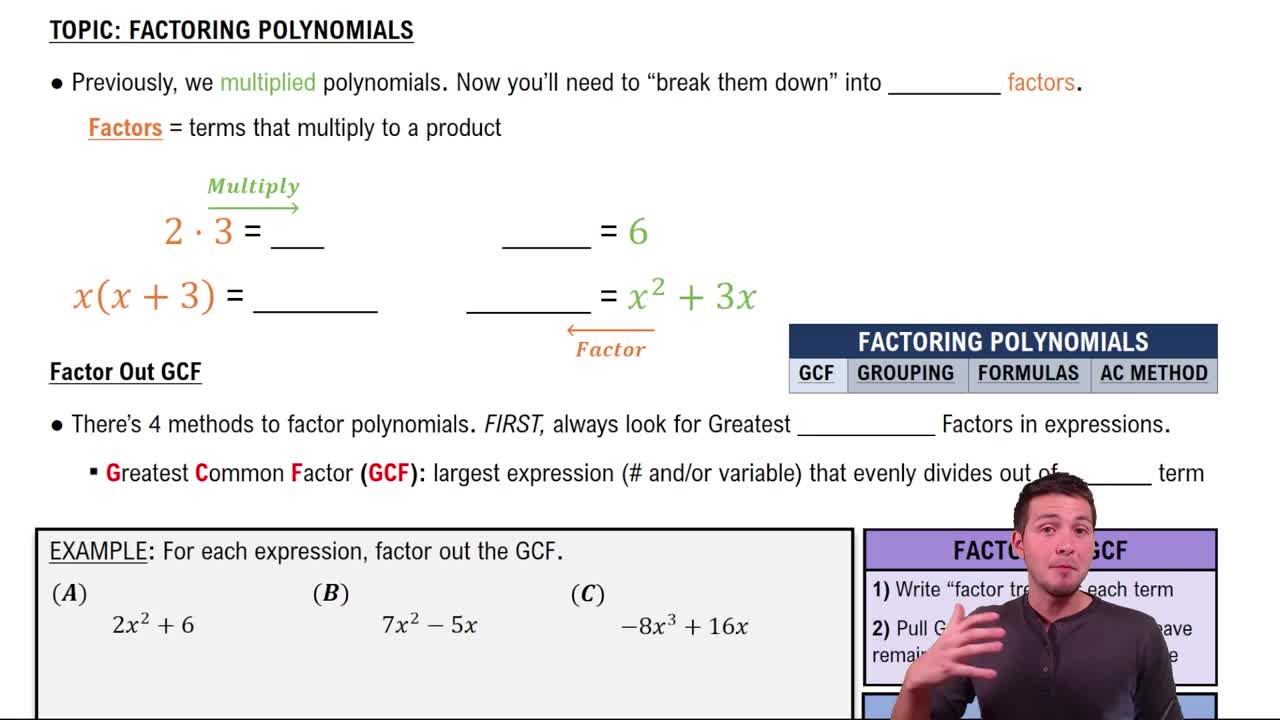
Factoring involves rewriting a polynomial as a product of simpler polynomials or factors. This process reveals the roots or zeros of the function, which correspond to the x-intercepts on the graph, making it easier to plot the function accurately.
Recommended video:
Guided course
Introduction to Factoring Polynomials
Graphing Polynomial Functions
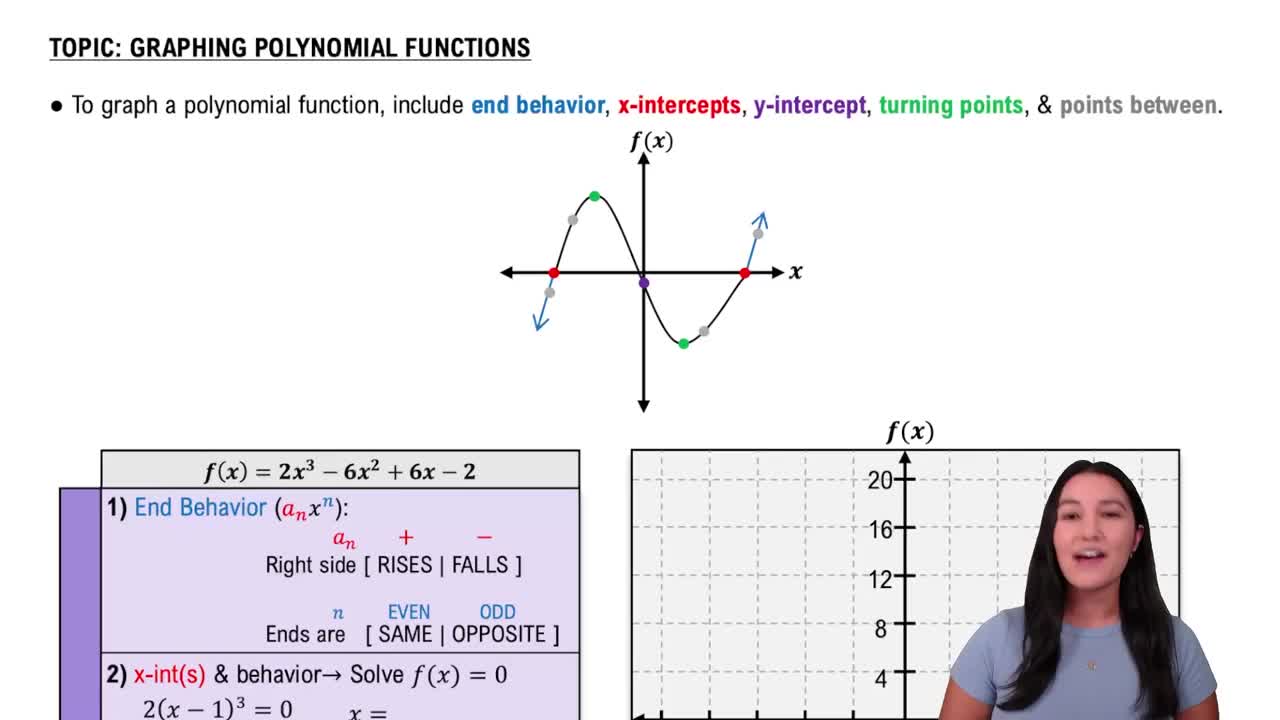
Graphing involves plotting key points such as zeros, intercepts, and analyzing end behavior based on the degree and leading coefficient. Factored form helps identify zeros and their multiplicities, which affect how the graph crosses or touches the x-axis.
Recommended video:
Graphing Polynomial Functions
Related Practice
Textbook Question
561
views
Textbook Question
Solve each polynomial inequality. Give the solution set in interval notation. x4 - x3 - 10x2 - 8x < 0
481
views
Textbook Question
For each polynomial function, use the remainder theorem to find ƒ(k). ƒ(x) = x2 + 4; k = 2i
614
views
Textbook Question
Give the equations of any vertical, horizontal, or oblique asymptotes for the graph of each rational function. See Example 4.
755
views
Textbook Question
Solve each problem. Give the maximum number of turning points of the graph of each function. ƒ(x)=4x^3-6x^2+2
580
views
Textbook Question
Graph each polynomial function. Factor first if the polynomial is not in factored form. ƒ(x)=2x3-5x2-x+6
995
views
