Use the various properties of exponential and logarithmic functions to evaluate the expressions in parts (a)–(c). Given ƒ(x) = 3x, find ƒ(log3 2)
Ch. 4 - Inverse, Exponential, and Logarithmic Functions

Chapter 5, Problem 95c
Use the various properties of exponential and logarithmic functions to evaluate the expressions in parts (a)–(c). Given g(x) = ex, find g(ln 1/e)
Verified step by step guidance1
Recall the given function: \(g(x) = e^x\).
Identify the input to the function: \(\ln \left( \frac{1}{e} \right)\).
Use the logarithmic property that \(\ln \left( \frac{1}{a} \right) = -\ln a\) to rewrite the input as \(-\ln e\).
Since \(\ln e = 1\), simplify the input to \(-1\).
Evaluate \(g(-1)\) by substituting into the function: \(g(-1) = e^{-1}\).

Verified video answer for a similar problem:
This video solution was recommended by our tutors as helpful for the problem above.
Video duration:
1mWas this helpful?
Key Concepts
Here are the essential concepts you must grasp in order to answer the question correctly.
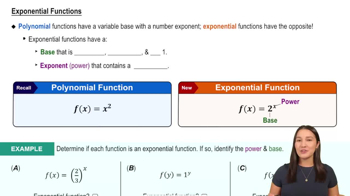
Exponential Functions
An exponential function has the form f(x) = a^x, where the base a is a positive constant. The function g(x) = e^x uses the natural base e (~2.718), which is fundamental in continuous growth and decay models. Understanding how to evaluate e raised to various powers is essential for solving the given problem.
Recommended video:
Exponential Functions
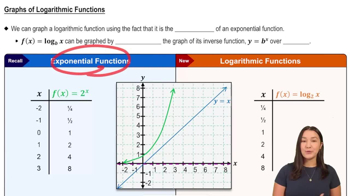
Logarithmic Functions and Natural Logarithm
A logarithmic function is the inverse of an exponential function. The natural logarithm, denoted ln(x), is the logarithm with base e. It satisfies the property ln(e^x) = x, which helps simplify expressions involving e and ln, such as ln(1/e).
Recommended video:
Graphs of Logarithmic Functions
Properties of Logarithms and Exponents
Key properties include ln(a/b) = ln(a) - ln(b), ln(e) = 1, and e^{ln(x)} = x for x > 0. These properties allow rewriting and simplifying expressions like ln(1/e) into manageable forms, enabling direct evaluation of functions like g(ln(1/e)).
Recommended video:
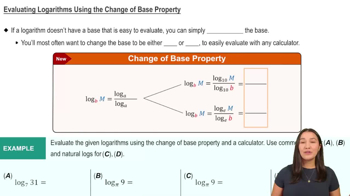
Change of Base Property
Related Practice
Textbook Question
775
views
Textbook Question
Use the various properties of exponential and logarithmic functions to evaluate the expressions in parts (a)–(c). Given g(x) = ex, find g(ln 4)
755
views
Textbook Question
Use the various properties of exponential and logarithmic functions to evaluate the expressions in parts (a)–(c). Given g(x) = ex, find g(ln ln 52)
689
views
Textbook Question
Solve each equation. See Examples 4–6. 1/27 = x-3
93
views
Textbook Question
Use the various properties of exponential and logarithmic functions to evaluate the expressions in parts (a)–(c). Given ƒ(x) = 3x, find ƒ(log3 (ln 3))
761
views
Textbook Question
Use the various properties of exponential and logarithmic functions to evaluate the expressions in parts (a)–(c). Given ƒ(x) = 3x, find ƒ(log3 (2 ln 3))
811
views