Ch. R - Review of Basic Concepts
Lial - College Algebra 13th Edition
Lial13th EditionCollege AlgebraISBN: 9780136881063Not the one you use?Change textbook
Chapter 1, Problem 20

Identify each expression as a polynomial or not a polynomial. For each polynomial, give the degree and identify it as a monomial, binomial, trinomial, or none of these. (2/3)t6+(3/t5)+1(2/3)t^6+(3/t^5)+1

Verified step by step guidance
1
First, write down the given expression clearly: \(\frac{2}{3}t^{6} + \frac{3}{t^{5}} + 1\).
Recall that a polynomial is an expression consisting of variables raised to non-negative integer exponents, combined using addition, subtraction, and multiplication by constants. Terms with variables in the denominator or with negative exponents are not allowed in polynomials.
Examine each term: The first term \(\frac{2}{3}t^{6}\) is a constant multiplied by \(t^{6}\), which is valid in a polynomial. The second term \(\frac{3}{t^{5}}\) can be rewritten as \$3t^{-5}$, which has a negative exponent, so this term is not allowed in a polynomial. The third term \(1\) is a constant term, which is allowed.
Since the expression contains a term with a negative exponent, the entire expression is not a polynomial.
Therefore, you do not need to determine the degree or classify it as monomial, binomial, or trinomial because the expression is not a polynomial.

Verified video answer for a similar problem:

This video solution was recommended by our tutors as helpful for the problem above.
Video duration:
1m
Was this helpful?

Key Concepts

Here are the essential concepts you must grasp in order to answer the question correctly.

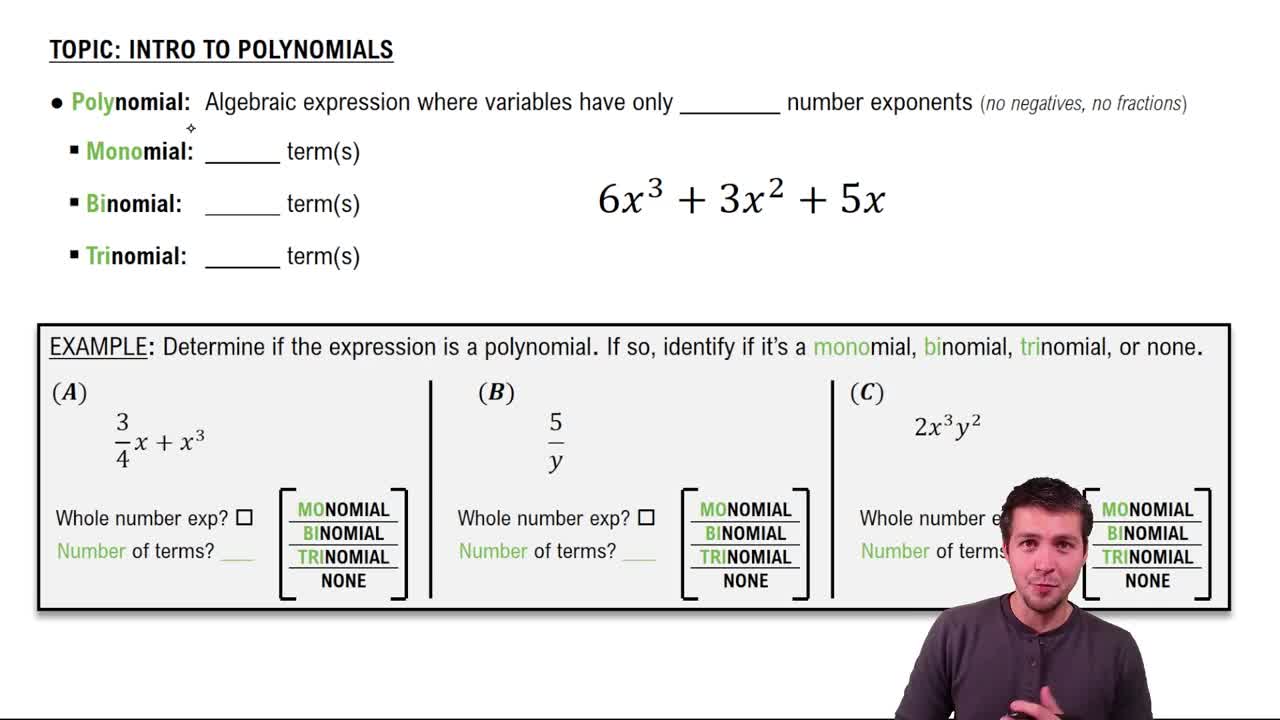
Definition of a Polynomial

A polynomial is an algebraic expression consisting of variables raised to non-negative integer exponents and coefficients, combined using addition, subtraction, and multiplication. Expressions with variables in denominators or with negative or fractional exponents are not polynomials.
Recommended video:
Guided course
05:13
Introduction to Polynomials

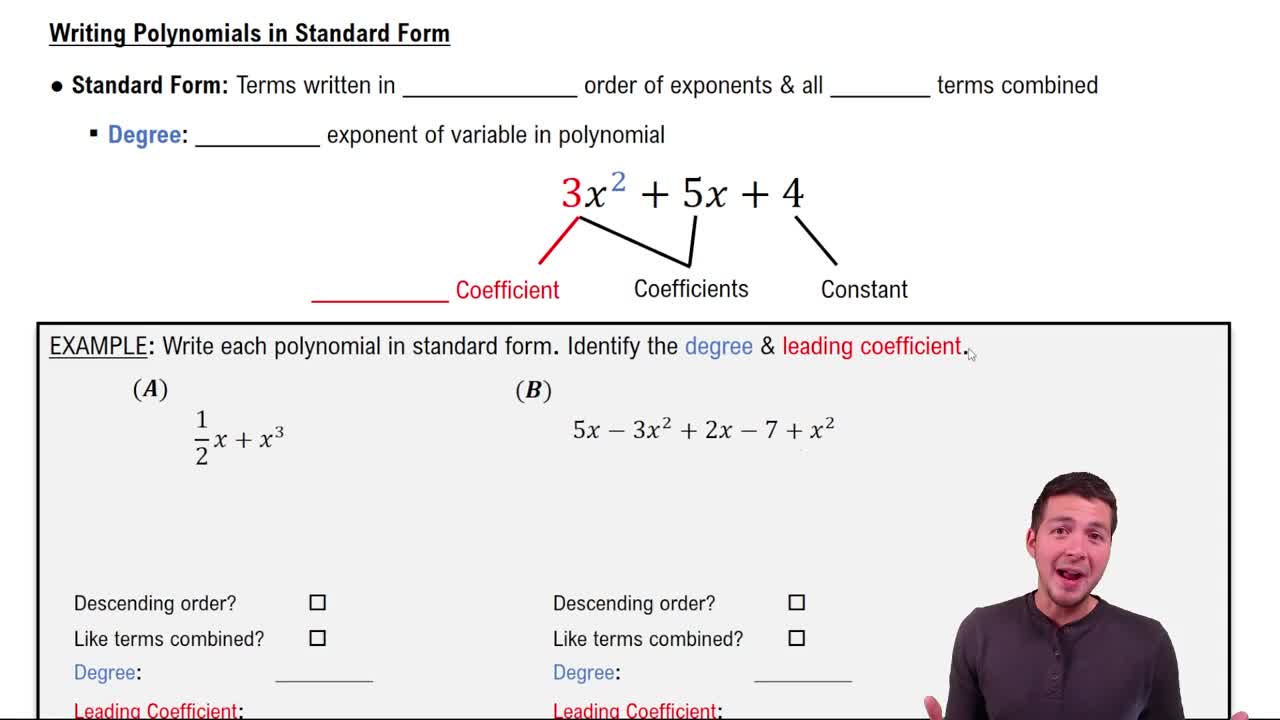
Degree of a Polynomial

The degree of a polynomial is the highest exponent of the variable in the expression. It indicates the polynomial's order and helps classify its behavior and graph shape. For example, in t^6 + 3t^2, the degree is 6.
Recommended video:
Guided course
05:16
Standard Form of Polynomials

Classification by Number of Terms

Polynomials are classified based on the number of terms: a monomial has one term, a binomial has two, and a trinomial has three. If there are more than three terms, it is simply called a polynomial without a special name.
Recommended video:
4:47
The Number e