Ch. 3 - Polynomial and Rational Functions
Lial - College Algebra 13th Edition
Lial13th EditionCollege AlgebraISBN: 9780136881063Not the one you use?Change textbook
Chapter 4, Problem 15

Use the factor theorem and synthetic division to determine whether the second polynomial is a factor of the first. 4x2+2x+54; x-4

Verified step by step guidance
1
Identify the polynomials involved: the first polynomial is \$4x^2 + 2x + 54\( and the second polynomial is \)x - 4$.
Use the Factor Theorem, which states that if \(x - c\) is a factor of a polynomial, then the polynomial evaluated at \(x = c\) equals zero. Here, set \(x = 4\) because the factor is \(x - 4\).
Evaluate the first polynomial at \(x = 4\) by substituting 4 into \$4x^2 + 2x + 54\(, which means calculating \)4(4)^2 + 2(4) + 54$.
Perform synthetic division by dividing the first polynomial by \(x - 4\). Set up synthetic division with 4 as the divisor and the coefficients of the first polynomial: 4, 2, and 54.
Analyze the remainder from synthetic division: if the remainder is zero, then \(x - 4\) is a factor of the first polynomial; if not, it is not a factor.

Verified video answer for a similar problem:

This video solution was recommended by our tutors as helpful for the problem above.
Video duration:
3m
Was this helpful?

Key Concepts

Here are the essential concepts you must grasp in order to answer the question correctly.

Factor Theorem

The Factor Theorem states that a polynomial f(x) has a factor (x - c) if and only if f(c) = 0. To use it, substitute c into the polynomial; if the result is zero, then (x - c) divides the polynomial exactly.
Recommended video:
Guided course
04:36
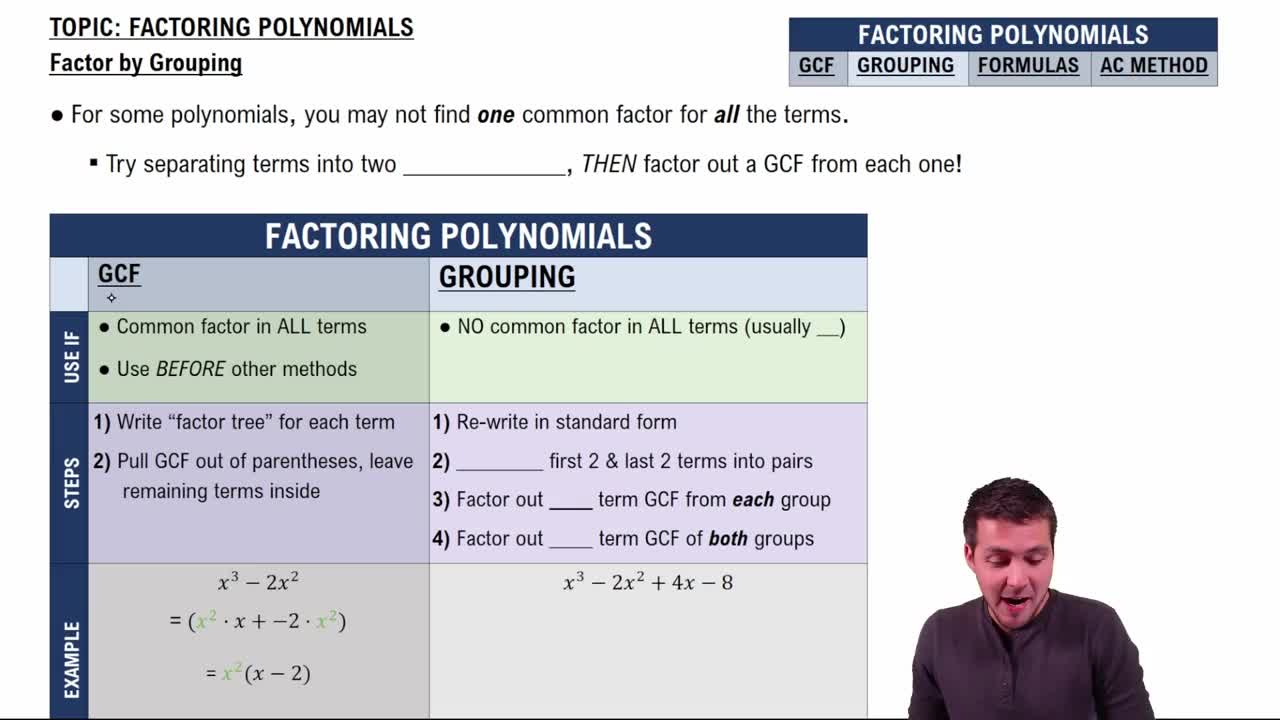
Factor by Grouping

Synthetic Division

Synthetic division is a shortcut method for dividing a polynomial by a linear factor of the form (x - c). It simplifies the division process by using only the coefficients, making it faster to find the quotient and remainder.
Recommended video:
05:10
Higher Powers of i

Polynomial Factorization

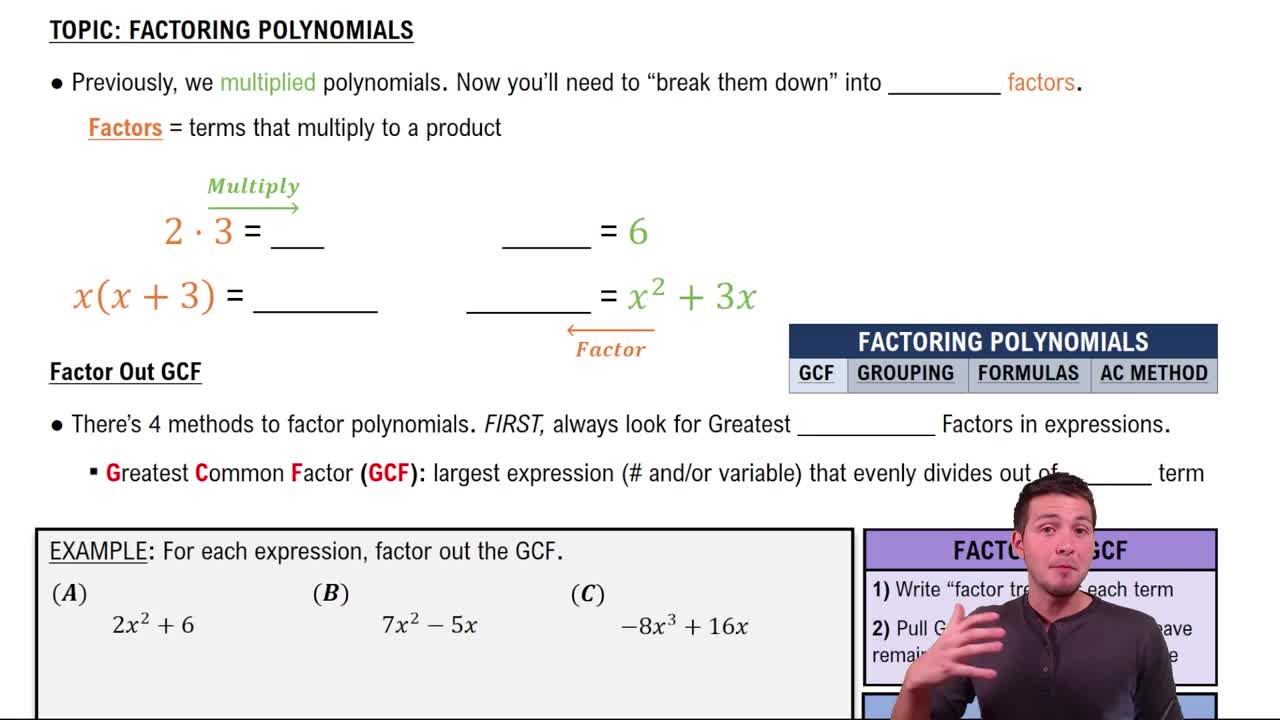
Polynomial factorization involves expressing a polynomial as a product of its factors. Determining if one polynomial is a factor of another helps simplify expressions and solve polynomial equations by breaking them into simpler components.
Recommended video:
Guided course
07:30
Introduction to Factoring Polynomials