Use the following facts. If x represents an integer, then x+1 represents the next consecutive integer. If x represents an even integer, then x+2 represents the next consecutive even integer. If x represents an odd integer, then x+2 represents the next consecutive odd integer. The difference of the squares of two positive consecutive odd integers is 32. Find the integers.
Ch. 1 - Equations and Inequalities

Chapter 2, Problem 17
Solve each equation. See Example 1. (2x+5)/2 - 3x/(x-2) = x
Verified step by step guidance1
Identify the equation to solve: \(\frac{2x+5}{2} - \frac{3x}{x-2} = x\).
Find the least common denominator (LCD) of the fractions, which is \(2(x-2)\), to eliminate the denominators by multiplying every term by this LCD.
Multiply each term by the LCD \(2(x-2)\) to clear the fractions: \(2(x-2) \times \frac{2x+5}{2} - 2(x-2) \times \frac{3x}{x-2} = 2(x-2) \times x\).
Simplify each term after multiplication: the first term simplifies to \((2x+5)(x-2)\), the second term simplifies to \(-6x\), and the right side becomes \(2x(x-2)\).
Expand all expressions and rearrange the equation to one side to form a polynomial equation, then solve for \(x\) using factoring or the quadratic formula.

Verified video answer for a similar problem:
This video solution was recommended by our tutors as helpful for the problem above.
Video duration:
2mWas this helpful?
Key Concepts
Here are the essential concepts you must grasp in order to answer the question correctly.
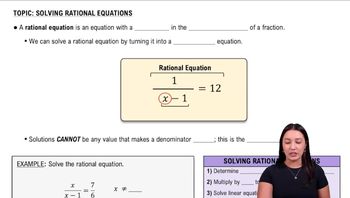
Solving Rational Equations
Rational equations involve expressions with variables in the denominator. To solve them, identify the least common denominator (LCD) to eliminate fractions by multiplying both sides, simplifying the equation to a polynomial form. Always check for restrictions where denominators become zero.
Recommended video:
Introduction to Rational Equations
Finding the Least Common Denominator (LCD)
The LCD is the smallest expression that all denominators divide into without remainder. It is used to clear fractions by multiplying each term, allowing the equation to be rewritten without denominators. For example, for denominators 2 and (x-2), the LCD is 2(x-2).
Recommended video:
Guided course
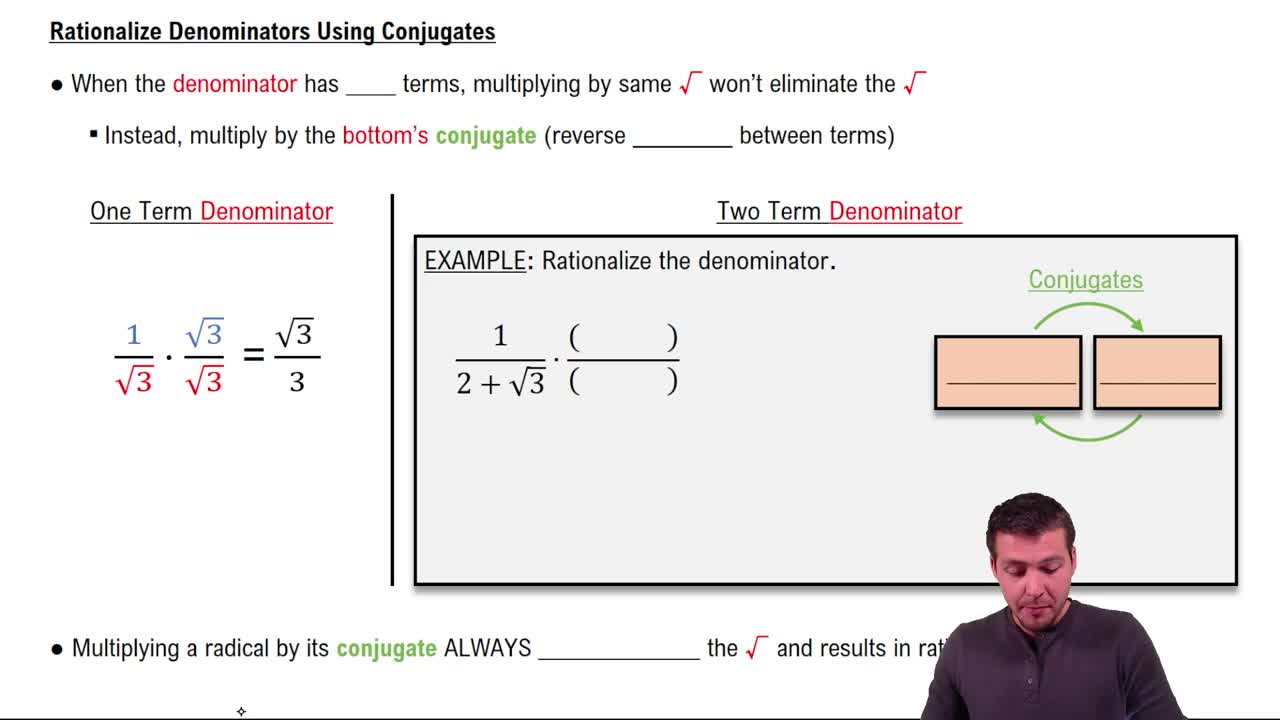
Rationalizing Denominators Using Conjugates
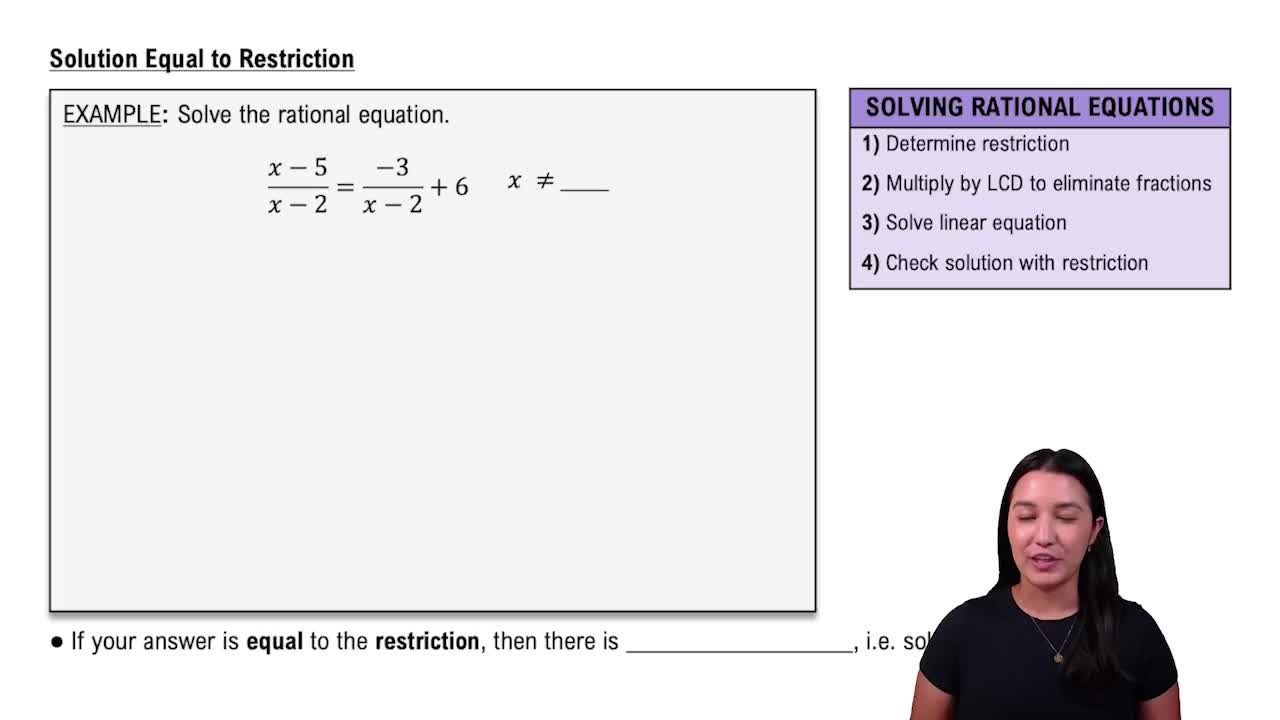
Checking for Extraneous Solutions
After solving the equation, substitute solutions back into the original denominators to ensure they do not make any denominator zero. Solutions that cause division by zero are extraneous and must be excluded from the final answer.
Recommended video:
Restrictions on Rational Equations
Related Practice
Textbook Question
841
views
Textbook Question
Solve each inequality. Give the solution set in interval notation. 3(x+5)+1≥5+3x
961
views
Textbook Question
Solve each equation. | (6x + 1)/ (x - 1) | = 3
550
views
Textbook Question
Solve each equation using the zero-factor property. -6x2 + 7x = -10
994
views
Textbook Question
Solve each equation. (4x+3)/4 - 2x/(x+1) = x
572
views
Textbook Question
Use the following facts. If x represents an integer, then x+1 represents the next consecutive integer. If x represents an even integer, then x+2 represents the next consecutive even integer. If x represents an odd integer, then x+2 represents the next consecutive odd integer. The difference of the squares of two positive consecutive even integers is 84. Find the integers.
853
views