Ch. 4 - Inverse, Exponential, and Logarithmic Functions
Lial - College Algebra 13th Edition
Lial13th EditionCollege AlgebraISBN: 9780136881063Not the one you use?Change textbook
Chapter 5, Problem 19

Find each value. If applicable, give an approximation to four decimal places. log(387 ×\(\times\) 23)

Verified step by step guidance
1
Recall the logarithm property that states \( \log(a \times b) = \log a + \log b \). This allows us to break down the logarithm of a product into the sum of logarithms.
Apply the property to the given expression: \( \log(387 \times 23) = \log 387 + \log 23 \).
Find the logarithm of each number separately: calculate \( \log 387 \) and \( \log 23 \). Depending on the base of the logarithm (commonly base 10), you can use a calculator or logarithm tables for these values.
Add the two logarithm values obtained in the previous step: \( \log 387 + \log 23 \).
If required, approximate the final sum to four decimal places to get the answer.

Verified video answer for a similar problem:

This video solution was recommended by our tutors as helpful for the problem above.
Video duration:
3m
Was this helpful?

Key Concepts

Here are the essential concepts you must grasp in order to answer the question correctly.

Properties of Logarithms

Logarithms have specific properties that simplify calculations, such as the product rule: log(a * b) = log(a) + log(b). This allows breaking down complex logarithmic expressions into sums of simpler logs, making evaluation easier.
Recommended video:
5:36
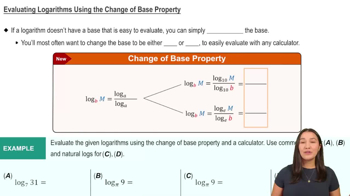
Change of Base Property

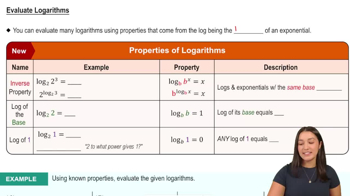
Evaluating Logarithms

Evaluating a logarithm means finding the exponent to which the base must be raised to get the given number. For common logarithms (base 10), this often involves using a calculator or logarithm tables to find approximate decimal values.
Recommended video:
5:14
Evaluate Logarithms

Rounding and Approximation

When exact values are not possible or practical, logarithmic results are approximated to a specified number of decimal places. Rounding to four decimal places means adjusting the number so that only four digits appear after the decimal point, ensuring clarity and precision.
Recommended video:
4:20
Graph Hyperbolas at the Origin