Ch. 4 - Inverse, Exponential, and Logarithmic Functions
Lial - College Algebra 13th Edition
Lial13th EditionCollege AlgebraISBN: 9780136881063Not the one you use?Change textbook
Chapter 5, Problem 56

Solve each equation. Give solutions in exact form. log5 [(3x + 5)(x + 1)] = 1

Verified step by step guidance
1
Recall the definition of logarithm: if \(\log_{a}(b) = c\), then it means \(a^{c} = b\). Here, the base is 5 and the logarithm equals 1, so rewrite the equation \(\log_{5} \left[(3x + 5)(x + 1)\right] = 1\) as an exponential equation: \$5^{1} = (3x + 5)(x + 1)$.
Simplify the right-hand side by expanding the product: multiply \((3x + 5)\) by \((x + 1)\) using the distributive property (FOIL method): \((3x)(x) + (3x)(1) + 5(x) + 5(1)\).
Write the expanded expression as a quadratic equation: \$3x^{2} + 3x + 5x + 5 = 5\(, then combine like terms to get \)3x^{2} + 8x + 5 = 5$.
Subtract 5 from both sides to set the quadratic equation equal to zero: \$3x^{2} + 8x + 5 - 5 = 0\(, which simplifies to \)3x^{2} + 8x = 0$.
Solve the quadratic equation \$3x^{2} + 8x = 0\( by factoring out the common factor \)x\(: \)x(3x + 8) = 0\(. Then set each factor equal to zero and solve for \)x$.

Verified video answer for a similar problem:

This video solution was recommended by our tutors as helpful for the problem above.
Video duration:
5m
Was this helpful?

Key Concepts

Here are the essential concepts you must grasp in order to answer the question correctly.

Properties of Logarithms

Understanding the properties of logarithms, such as the product rule log_b(MN) = log_b(M) + log_b(N), is essential. This allows the expression log_5[(3x + 5)(x + 1)] to be expanded or manipulated to simplify solving the equation.
Recommended video:
5:36
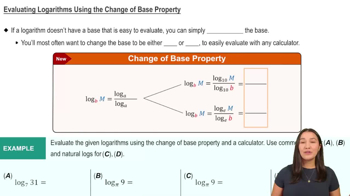
Change of Base Property

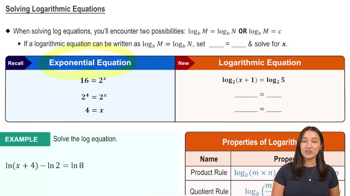
Definition of Logarithms and Exponentials

The definition log_b(A) = C means b^C = A. Applying this definition helps convert the logarithmic equation into an exponential form, making it easier to solve for x by removing the logarithm.
Recommended video:
5:02
Solving Logarithmic Equations

Solving Quadratic Equations

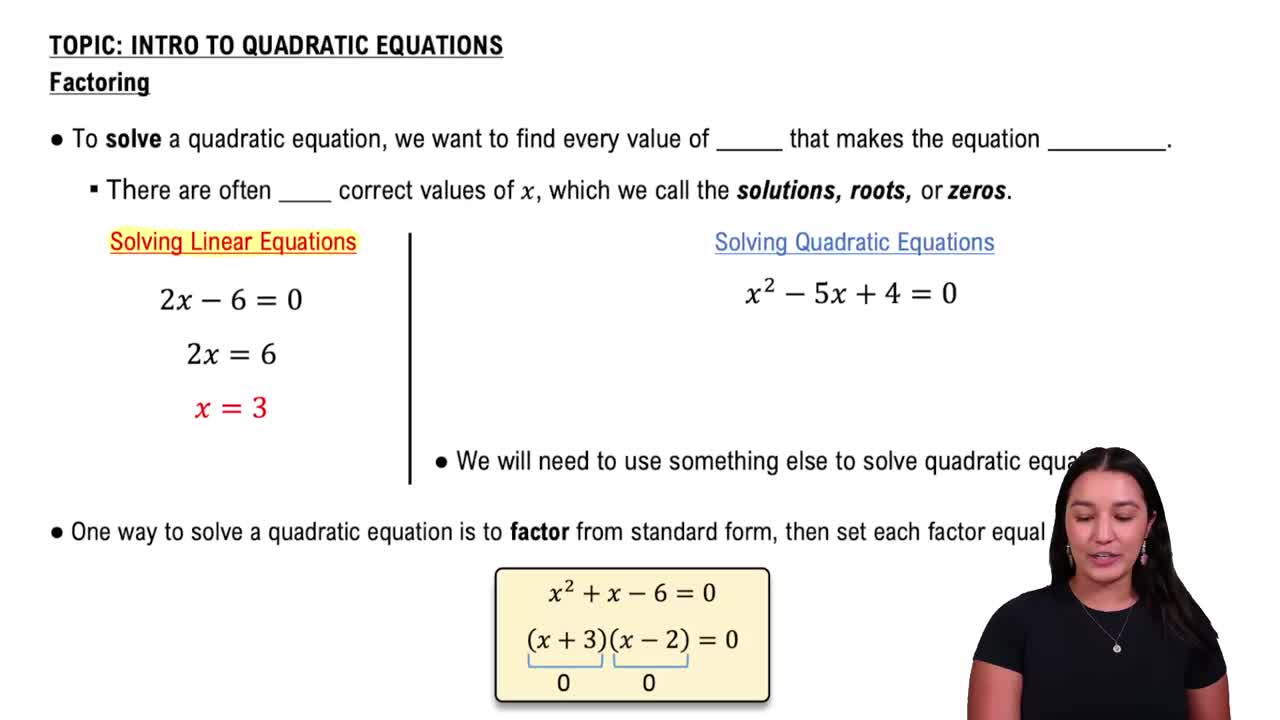
After rewriting the equation in polynomial form, solving the resulting quadratic equation is necessary. Techniques include factoring, completing the square, or using the quadratic formula to find exact solutions for x.
Recommended video:
06:08
Solving Quadratic Equations by Factoring