Ch. R - Review of Basic Concepts
Lial - College Algebra 13th Edition
Lial13th EditionCollege AlgebraISBN: 9780136881063Not the one you use?Change textbook
Chapter 1, Problem 55

Factor each trinomial, if possible. See Examples 3 and 4. 4x2y2+28xy+49

Verified step by step guidance
1
Identify the trinomial to factor: \$4x^{2}y^{2} + 28xy + 49$.
Recognize that this trinomial resembles a perfect square trinomial of the form \(a^{2} + 2ab + b^{2}\), where \(a\) and \(b\) are expressions.
Find \(a\) by taking the square root of the first term: \(\sqrt{4x^{2}y^{2}} = 2xy\).
Find \(b\) by taking the square root of the last term: \(\sqrt{49} = 7\).
Check if the middle term matches \$2ab\(: calculate \(2 \times 2xy \times 7 = 28xy\), which matches the middle term, confirming the trinomial factors as \)(2xy + 7)^{2}$.

Verified video answer for a similar problem:

This video solution was recommended by our tutors as helpful for the problem above.
Video duration:
2m
Was this helpful?

Key Concepts

Here are the essential concepts you must grasp in order to answer the question correctly.

Factoring Trinomials

Factoring trinomials involves rewriting a quadratic expression as a product of two binomials. This process often requires identifying two numbers that multiply to the constant term and add to the coefficient of the middle term. Recognizing patterns and applying factoring techniques simplifies expressions and solves equations.
Recommended video:
Guided course
6:29
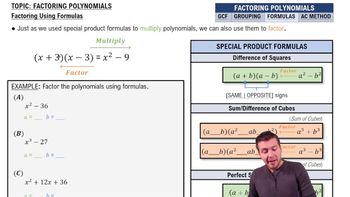
Factor Using Special Product Formulas

Greatest Common Factor (GCF)

The Greatest Common Factor is the largest factor shared by all terms in an expression. Factoring out the GCF first simplifies the trinomial, making it easier to factor further. In expressions with variables, the GCF includes the lowest powers of common variables.
Recommended video:
5:57
Graphs of Common Functions

Perfect Square Trinomials

A perfect square trinomial is a quadratic expression that can be written as the square of a binomial, typically in the form a² + 2ab + b². Recognizing this pattern allows quick factoring into (a + b)² or (a - b)². This is useful when the first and last terms are perfect squares and the middle term is twice the product of their roots.
Recommended video:
06:24
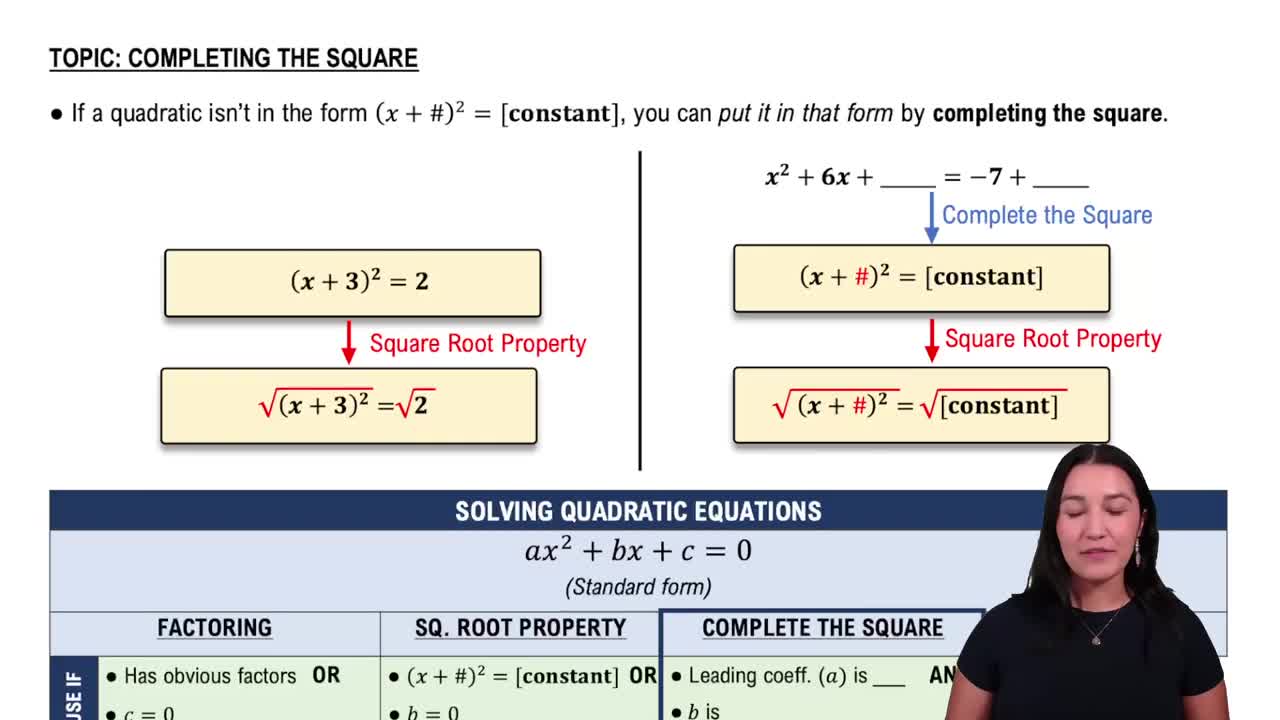
Solving Quadratic Equations by Completing the Square