Ch. 4 - Inverse, Exponential, and Logarithmic Functions
Lial - College Algebra 13th Edition
Lial13th EditionCollege AlgebraISBN: 9780136881063Not the one you use?Change textbook
Chapter 5, Problem 43

Solve each equation. Give solutions in exact form. ln 4x = 1.5

Verified step by step guidance
1
Identify the given equation: \(\ln 4x = 1.5\). This means the natural logarithm of \$4x$ equals \(1.5\).
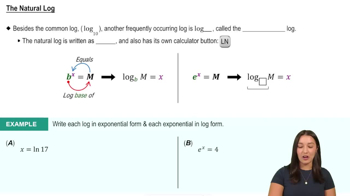
Recall that the natural logarithm function \(\ln y\) is the inverse of the exponential function \(e^y\). To solve for \(x\), rewrite the equation in exponential form: \$4x = e^{1.5}$.
Isolate \(x\) by dividing both sides of the equation by 4: \(x = \frac{e^{1.5}}{4}\).
Express the solution in exact form, which involves leaving the answer in terms of \(e\) without approximating the value of \(e^{1.5}\).
Check the solution by substituting \(x\) back into the original equation to ensure the equality holds true.

Verified video answer for a similar problem:

This video solution was recommended by our tutors as helpful for the problem above.
Video duration:
3m
Was this helpful?

Key Concepts

Here are the essential concepts you must grasp in order to answer the question correctly.

Natural Logarithm (ln) Function

The natural logarithm, denoted as ln, is the inverse of the exponential function with base e. It answers the question: to what power must e be raised to get a given number? For example, ln(4x) = 1.5 means e raised to 1.5 equals 4x.
Recommended video:
2:51
The Natural Log

Solving Exponential and Logarithmic Equations

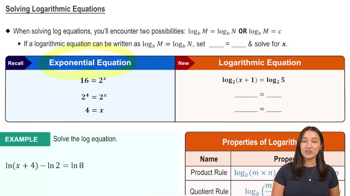
To solve equations involving logarithms, rewrite the equation in exponential form to isolate the variable. For ln(4x) = 1.5, rewrite as 4x = e^{1.5}, then solve for x by dividing both sides by 4.
Recommended video:
5:02
Solving Logarithmic Equations

Exact Form Solutions

An exact form solution expresses the answer without decimal approximations, often using constants like e or π. Here, the solution should be left as x = e^{1.5} / 4 rather than a decimal, preserving mathematical precision.
Recommended video:
04:34
Converting Standard Form to Vertex Form