Ch. R - Review of Basic Concepts
Lial - College Algebra 13th Edition
Lial13th EditionCollege AlgebraISBN: 9780136881063Not the one you use?Change textbook
Chapter 1, Problem 77

Determine whether each statement is true or false. {1, 2, 4} ∪ {1, 2, 4} = {1, 2, 4}

Verified step by step guidance
1
Recall the definition of the union of two sets: The union of sets A and B, denoted by \(A \cup B\), is the set containing all elements that are in A, or in B, or in both.
Identify the two sets given: Both sets are \(\{1, 2, 4\}\) and \(\{1, 2, 4\}\).
Apply the union operation: Since both sets are identical, their union will include all elements from either set, which are \(1\), \(2\), and \(4\).
Write the union explicitly: \(\{1, 2, 4\} \cup \{1, 2, 4\} = \{1, 2, 4\}\).
Conclude whether the statement is true or false based on the union result matching the given set.

Verified video answer for a similar problem:

This video solution was recommended by our tutors as helpful for the problem above.
Video duration:
1m
Was this helpful?

Key Concepts

Here are the essential concepts you must grasp in order to answer the question correctly.

Set Union

The union of two sets combines all unique elements from both sets into one set. If an element appears in either set, it is included in the union. For example, the union of {1, 2} and {2, 3} is {1, 2, 3}.
Recommended video:
5:10
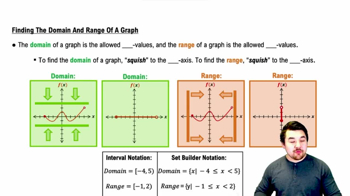
Finding the Domain and Range of a Graph

Set Equality

Two sets are equal if they contain exactly the same elements, regardless of order or repetition. For instance, {1, 2, 3} equals {3, 2, 1} because they have identical members.
Recommended video:
05:18
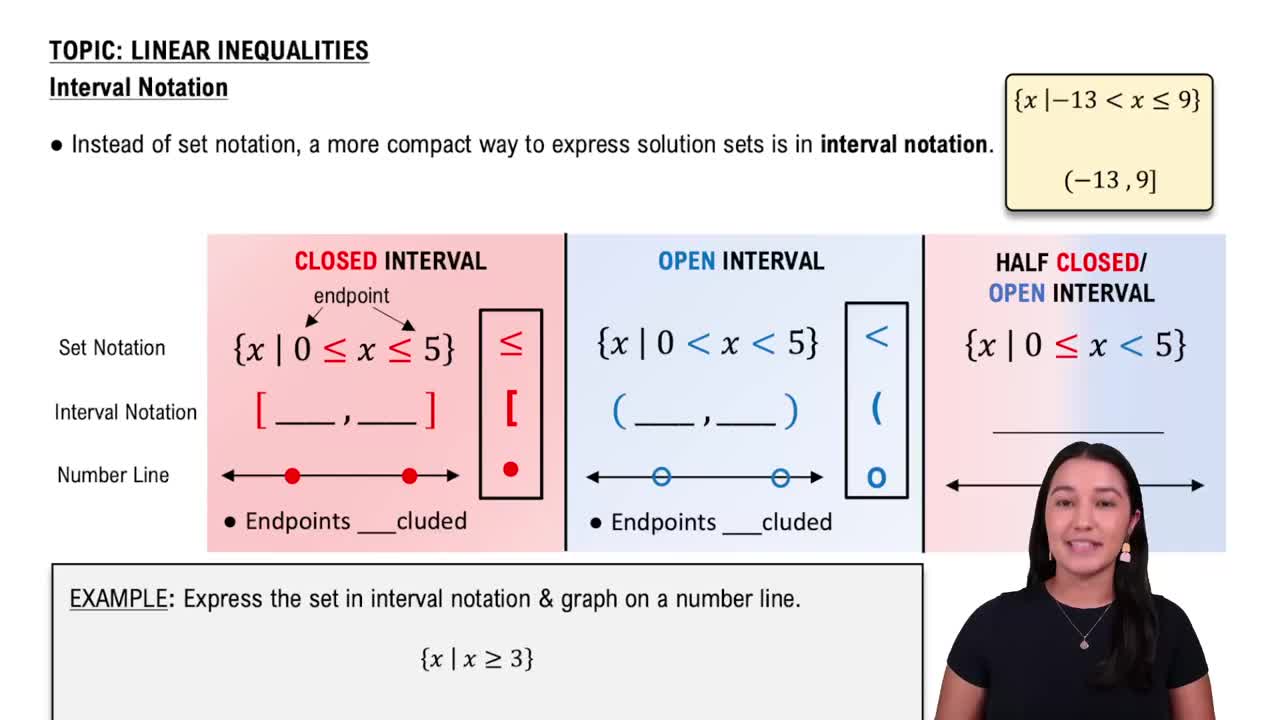
Interval Notation

Idempotent Law of Union

The idempotent law states that the union of a set with itself is the set itself. Formally, A ∪ A = A. This means combining a set with itself does not add new elements.
Recommended video:
5:10
Finding the Domain and Range of a Graph