Ch. 4 - Inverse, Exponential, and Logarithmic Functions
Lial - College Algebra 13th Edition
Lial13th EditionCollege AlgebraISBN: 9780136881063Not the one you use?Change textbook
Chapter 5, Problem 83

Solve each equation. Give solutions in exact form. log x2 = (log x)2

Verified step by step guidance
1
Rewrite the given equation \(\log x^2 = (\log x)^2\) using logarithm properties. Recall that \(\log x^2\) can be rewritten as \(2 \log x\), so the equation becomes \(2 \log x = (\log x)^2\).
Introduce a substitution to simplify the equation. Let \(y = \log x\). Then the equation becomes \$2y = y^2$.
Rewrite the equation in standard quadratic form: \(y^2 - 2y = 0\).
Factor the quadratic equation: \(y(y - 2) = 0\). This gives two possible solutions for \(y\): \(y = 0\) or \(y = 2\).
Recall the substitution \(y = \log x\). Solve for \(x\) by rewriting each solution: For \(y = 0\), \(\log x = 0\) implies \(x = 10^0\); for \(y = 2\), \(\log x = 2\) implies \(x = 10^2\). Remember to check that these values satisfy the original equation and the domain restrictions of the logarithm.

Verified video answer for a similar problem:

This video solution was recommended by our tutors as helpful for the problem above.
Video duration:
6m
Was this helpful?

Key Concepts

Here are the essential concepts you must grasp in order to answer the question correctly.

Properties of Logarithms

Understanding the properties of logarithms is essential, including how to simplify expressions like log(x^2) = 2 log(x). These properties allow manipulation of logarithmic equations to isolate variables or rewrite terms for easier solving.
Recommended video:
5:36
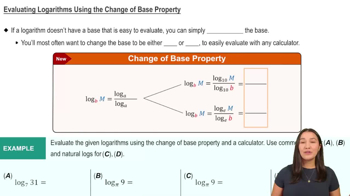
Change of Base Property

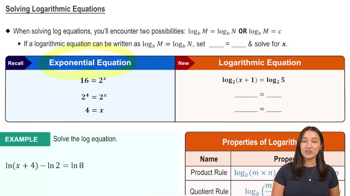
Solving Logarithmic Equations

Solving logarithmic equations involves rewriting the equation using log properties, then converting to exponential form if needed. It also requires checking for extraneous solutions since the domain of logarithms is restricted to positive arguments.
Recommended video:
5:02
Solving Logarithmic Equations

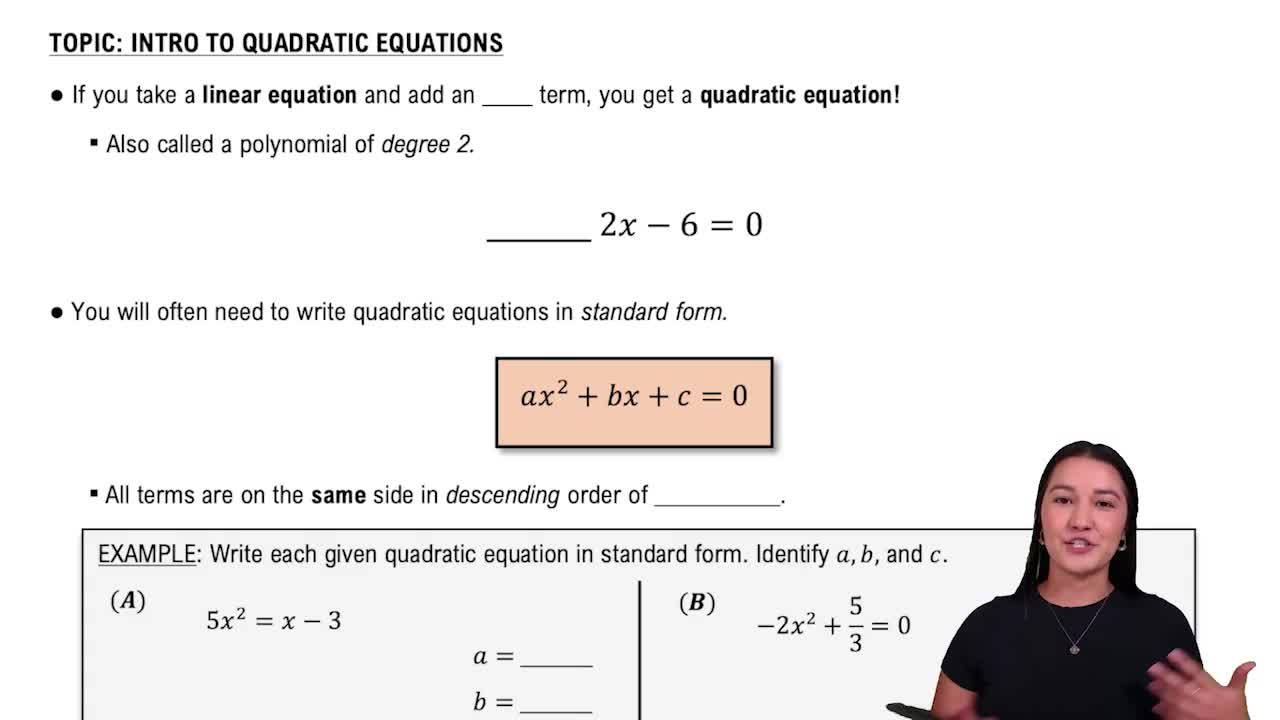
Quadratic Equations

When logarithmic expressions are squared or rearranged, the resulting equation may be quadratic in form. Recognizing and solving quadratic equations using factoring, completing the square, or the quadratic formula is crucial to find all possible solutions.
Recommended video:
05:35
Introduction to Quadratic Equations