
Textbook Question
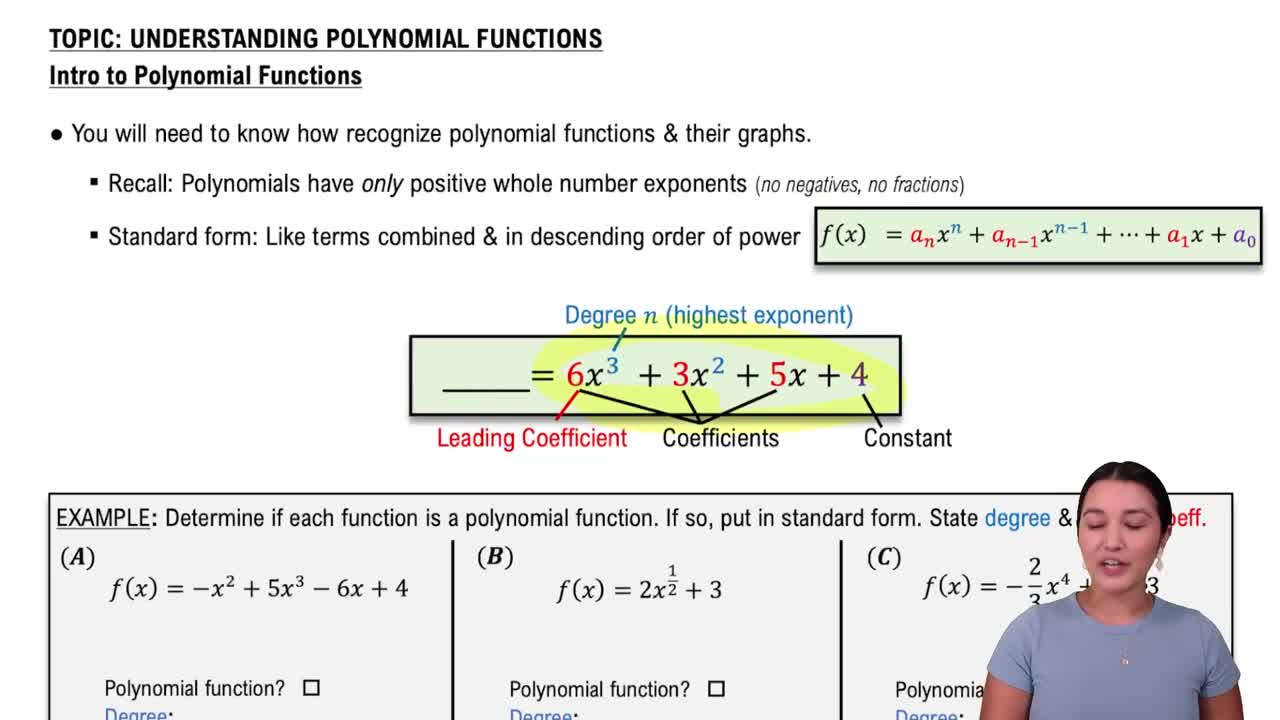
For each polynomial function, use the remainder theorem to find ƒ(k). ƒ(x) = x3 - 4x2 + 2x+1; k = -1
357
views

 Verified step by step guidance
 06:04
06:04
 07:30
07:30 05:25
05:25For each polynomial function, use the remainder theorem to find ƒ(k). ƒ(x) = x3 - 4x2 + 2x+1; k = -1
Solve each polynomial inequality. Give the solution set in interval notation. 2x3 - 7x2 ≥ 3 - 8x
Current Flow In electric current flow, it is found that the resistance offered by a fixed length of wire of a given material varies inversely as the square of the diameter of the wire. If a wire 0.01 in. in diameter has a resistance of 0.4 ohm, what is the resistance of a wire of the same length and material with diameter 0.03 in., to the nearest ten-thousandth of an ohm?
Determine the largest open interval of the domain (a) over which the function is increasing and (b) over which it is decreasing. ƒ(x) = (x + 3)2
Graph each polynomial function. Factor first if the polynomial is not in factored form. See Examples 3 and 4.
Give the equations of any vertical, horizontal, or oblique asymptotes for the graph of each rational function. ƒ(x)=3/(x-5)