Determine whether each statement is true or false. If false, explain why. The graph of y = x2 + 2 has no x-intercepts.
Ch. 2 - Graphs and Functions

Chapter 3, Problem 9
Without actually graphing, identify the type of graph that each equation has.
Verified step by step guidance1
Recognize the standard form of the equation: The given equation is \(x^2 + y^2 = 144\). This is a form of the equation \(x^2 + y^2 = r^2\), which is the standard form of a circle centered at the origin.
Identify the components of the equation: In the equation \(x^2 + y^2 = 144\), the terms \(x^2\) and \(y^2\) indicate that both variables are squared and have the same coefficient, which is 1 in this case.
Determine the radius of the circle: The equation \(x^2 + y^2 = r^2\) represents a circle with radius \(r\). Here, \(r^2 = 144\), so the radius \(r\) is the square root of 144.
Calculate the radius: The square root of 144 is 12, so the radius of the circle is 12.
Conclude the type of graph: Since the equation is in the form \(x^2 + y^2 = r^2\) and represents a circle with a radius of 12, the graph of this equation is a circle centered at the origin with a radius of 12.

Verified video answer for a similar problem:
This video solution was recommended by our tutors as helpful for the problem above.
Video duration:
2mWas this helpful?
Key Concepts
Here are the essential concepts you must grasp in order to answer the question correctly.
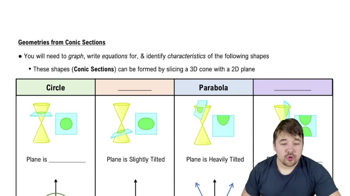
Conic Sections
Conic sections are the curves obtained by intersecting a plane with a double-napped cone. The main types include circles, ellipses, parabolas, and hyperbolas. Each type has a distinct equation and geometric properties. Understanding these shapes is crucial for identifying the type of graph represented by a given equation.
Recommended video:
Geometries from Conic Sections
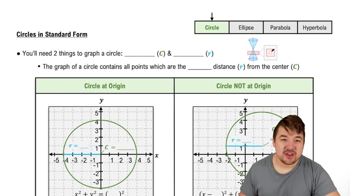
Standard Form of a Circle
The standard form of a circle's equation is given by (x - h)² + (y - k)² = r², where (h, k) is the center and r is the radius. In the equation x² + y² = 144, it can be rewritten as (x - 0)² + (y - 0)² = 12², indicating a circle centered at the origin with a radius of 12. Recognizing this form is essential for identifying circular graphs.
Recommended video:
Circles in Standard Form
Graphing Techniques
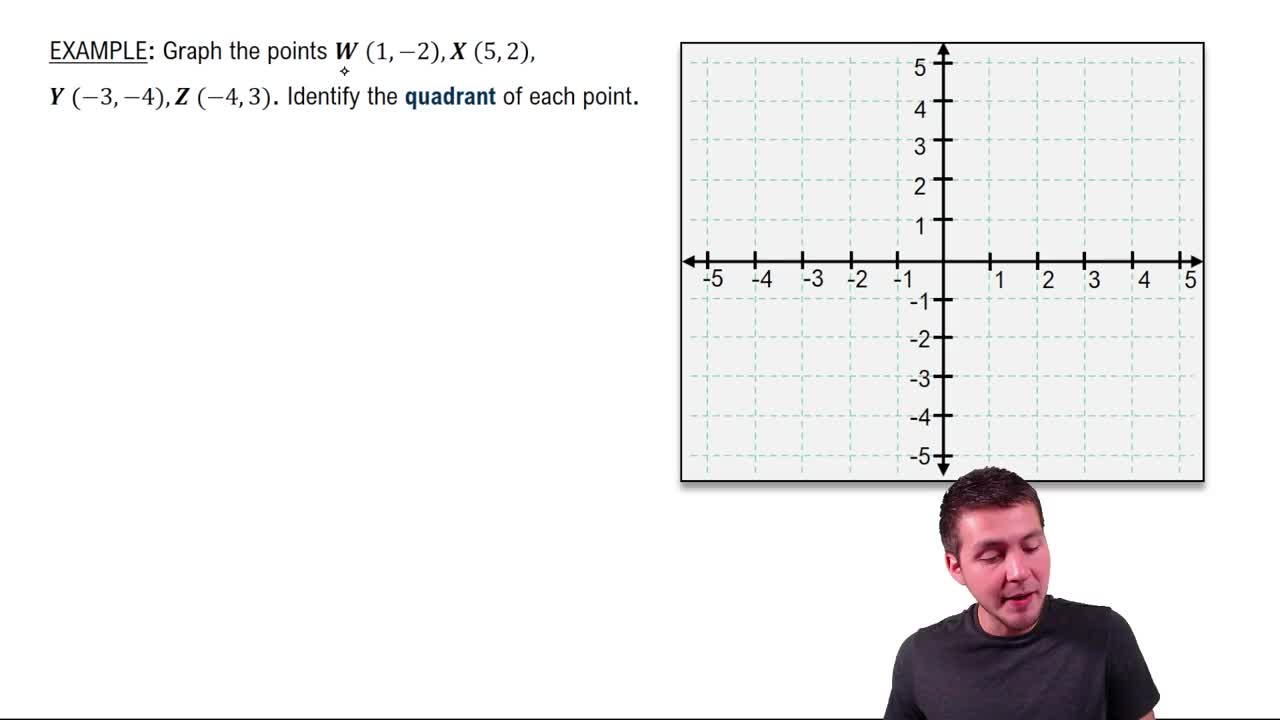
Graphing techniques involve understanding how to represent equations visually on a coordinate plane. This includes knowing how to plot points, identify key features like intercepts and vertices, and recognize symmetry. For equations like x² + y² = 144, these techniques help in visualizing the graph's shape and position without needing to plot every point.
Recommended video:
Guided course
Graphs and Coordinates - Example
Related Practice
Textbook Question
853
views
Textbook Question
In the following exercises, (a) find the center-radius form of the equation of each circle described, and (b) graph it. center (0, 0), radius 6
1075
views
Textbook Question
To answer each question, refer to the following basic graphs. Which one is the graph of ƒ(x)=√x? What is its domain?
732
views
Textbook Question
Determine whether each statement is true or false. If false, explain why. The midpoint of the segment joining (0, 0) and (4, 4) is 2.
835
views
Textbook Question
Determine whether each relation defines a function. {(5,1),(3,2),(4,9),(7,8)}
839
views
Textbook Question
Write an equation for each line described. Give answers in standard form for Exercises 11–20 and in slope-intercept form (if possible) for Exercises 21–32. through (1,3), m = -2
847
views