Resistance of a Wire The resistance in ohms of a platinum wire temperature sensor varies directly as the temperature in kelvins (K). If the resistance is 646 ohms at a temperature of 190 K, find the resistance at a temperature of 250 K.
Ch. 3 - Polynomial and Rational Functions

Chapter 4, Problem 30
Graph each quadratic function. Give the (a) vertex, (b) axis, (c) domain, and (d) range. ƒ(x) = x2 + 6x + 5
Verified step by step guidance1
Identify the quadratic function given: \(f(x) = x^2 + 6x + 5\).
Rewrite the quadratic function in vertex form by completing the square: Start with \(f(x) = x^2 + 6x + 5\). To complete the square, take half of the coefficient of \(x\) (which is 6), divide by 2 to get 3, then square it to get 9. Add and subtract 9 inside the function to maintain equality.
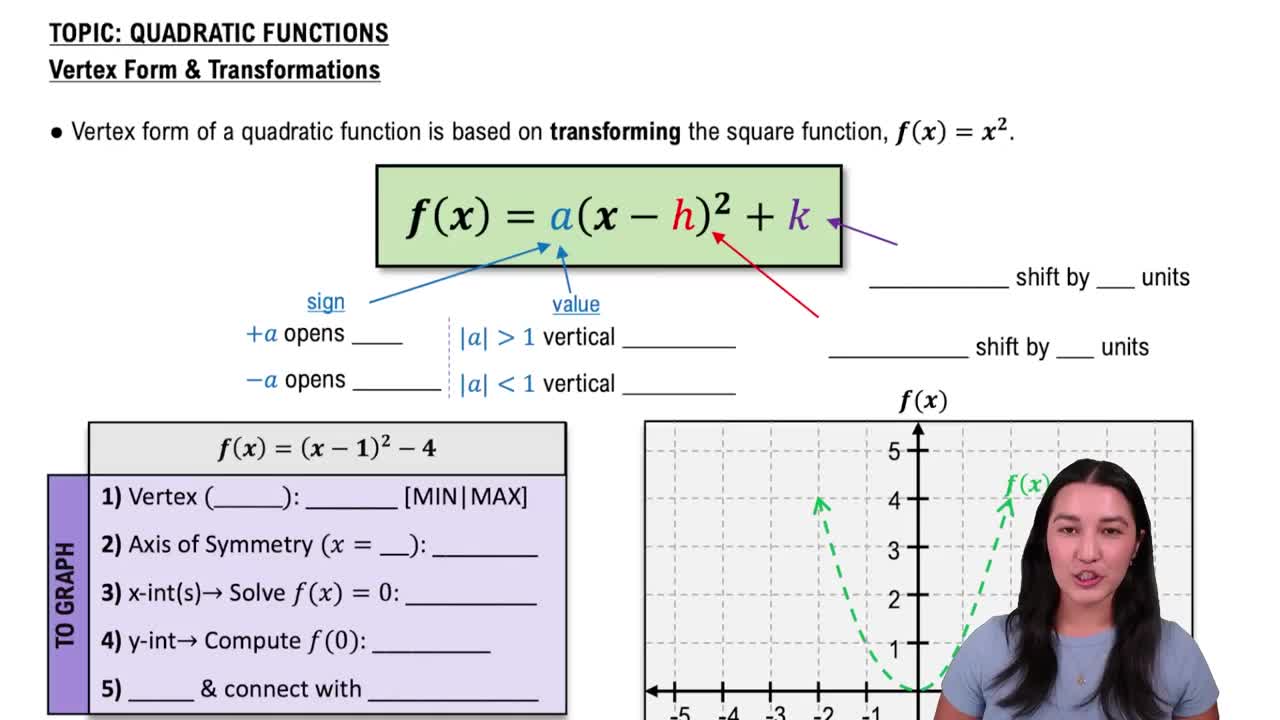
Express the function as \(f(x) = (x^2 + 6x + 9) + 5 - 9\), which simplifies to \(f(x) = (x + 3)^2 - 4\). This form reveals the vertex clearly.
From the vertex form \(f(x) = (x + 3)^2 - 4\), identify the vertex as \((-3, -4)\) and the axis of symmetry as the vertical line \(x = -3\).
Determine the domain and range: The domain of any quadratic function is all real numbers, so \((-\infty, \infty)\). Since the parabola opens upward (coefficient of \(x^2\) is positive), the range is \([-4, \infty)\), starting from the vertex's \(y\)-value.

Verified video answer for a similar problem:
This video solution was recommended by our tutors as helpful for the problem above.
Video duration:
5mWas this helpful?
Key Concepts
Here are the essential concepts you must grasp in order to answer the question correctly.
Vertex of a Quadratic Function
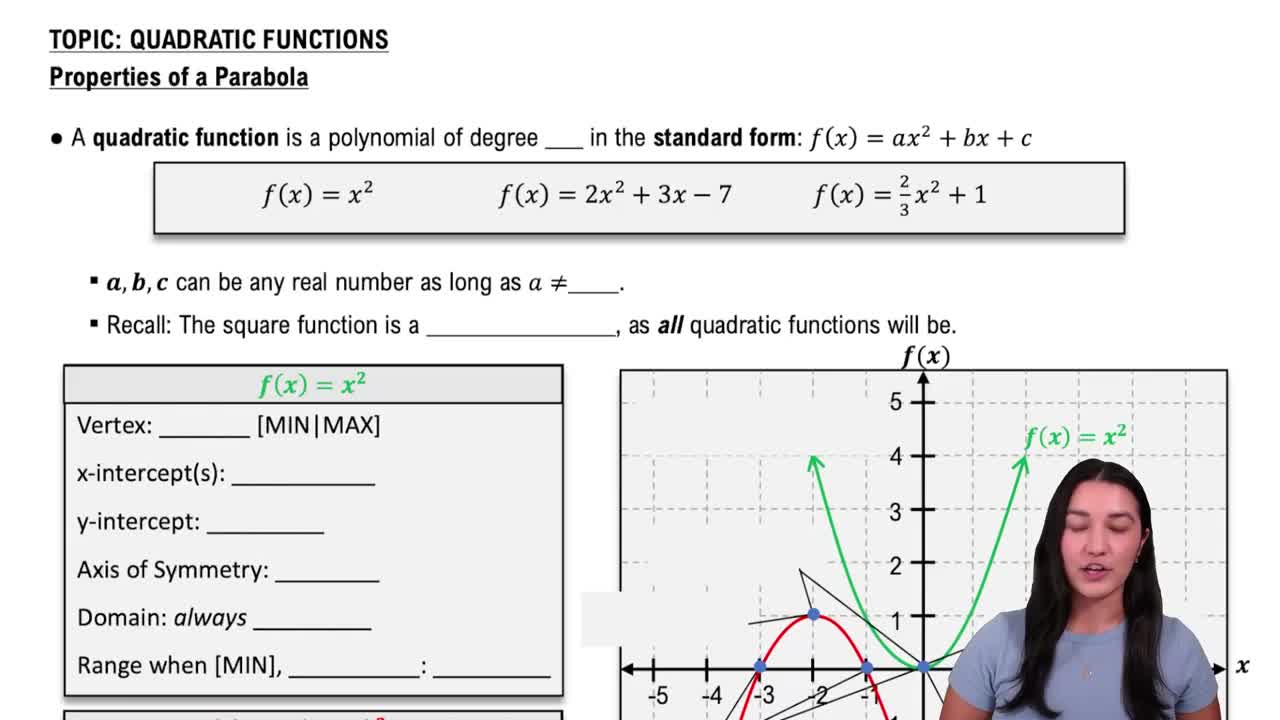
The vertex is the highest or lowest point on the graph of a quadratic function, representing its maximum or minimum value. It can be found using the formula (-b/2a, f(-b/2a)) when the function is in standard form f(x) = ax^2 + bx + c. The vertex helps in graphing and understanding the function's behavior.
Recommended video:
Vertex Form
Axis of Symmetry
The axis of symmetry is a vertical line that passes through the vertex and divides the parabola into two mirror-image halves. Its equation is x = -b/(2a) for a quadratic function in standard form. This line is crucial for graphing and analyzing the symmetry of the parabola.
Recommended video:
Properties of Parabolas
Domain and Range of Quadratic Functions
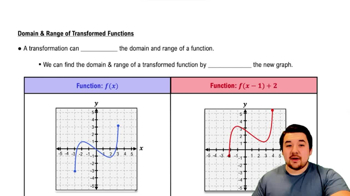
The domain of any quadratic function is all real numbers since x can take any value. The range depends on the vertex: if the parabola opens upward (a > 0), the range is all values greater than or equal to the vertex's y-coordinate; if it opens downward (a < 0), the range is all values less than or equal to the vertex's y-coordinate.
Recommended video:
Domain & Range of Transformed Functions
Related Practice
Textbook Question
496
views
Textbook Question
Graph each polynomial function. Factor first if the polynomial is not in factored form. ƒ(x)=-2x(x-3)(x+2)
1221
views
Textbook Question
Use synthetic division to divide ƒ(x) by x-k for the given value of k. Then express ƒ(x) in the form ƒ(x) = (x-k) q(x) + r. ƒ(x) = 3x4 + 4x3 - 10x2 + 15; k = -1
679
views
1
rank
Textbook Question
Match the rational function in Column I with the appropriate description in Column II. Choices in Column II can be used only once.
762
views
Textbook Question
Find all rational zeros of each function.
387
views
Textbook Question
Solve each polynomial inequality. Give the solution set in interval notation. -(x - 3)(x - 4)2 (x - 5) > 0
475
views
