Graph each polynomial function. Factor first if the polynomial is not in factored form. See Examples 3 and 4.
Verified step by step guidance
1
Identify the given polynomial function: \(f(x) = -3x^4 - 5x^3 + 2x^2\).
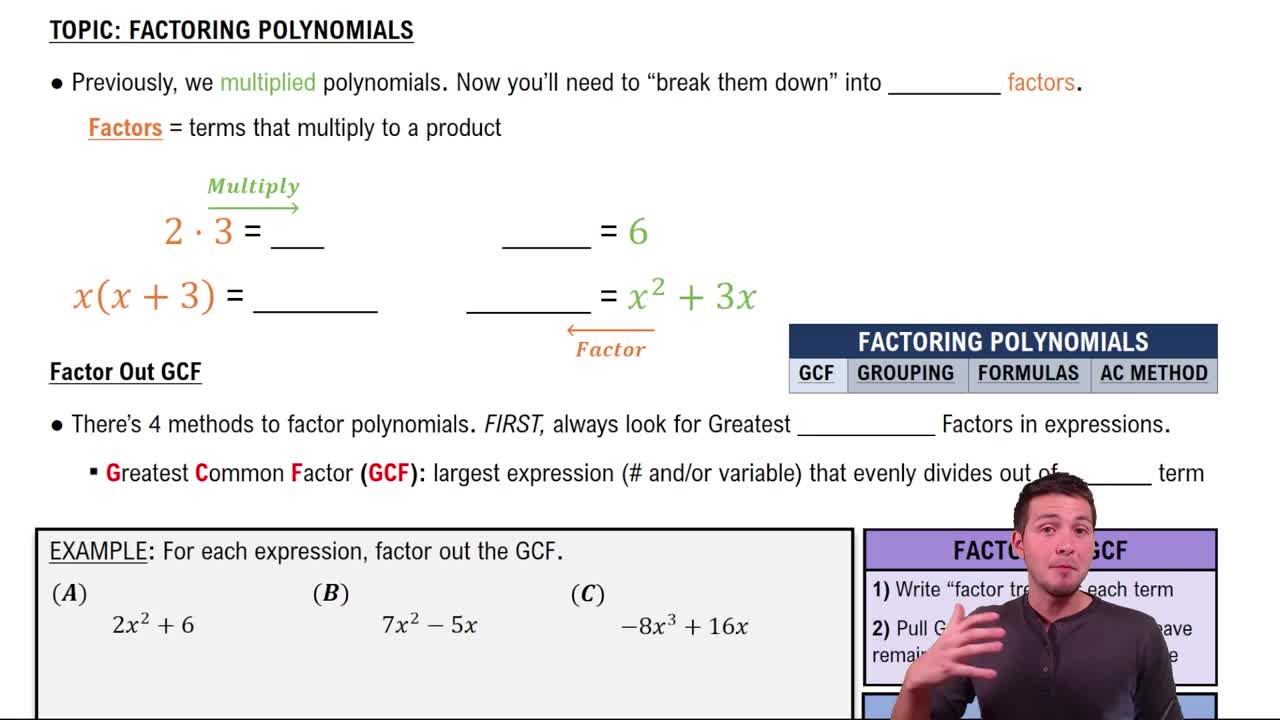
Factor out the greatest common factor (GCF) from all terms. In this case, the GCF is \(-x^2\), so rewrite the function as \(f(x) = -x^2(3x^2 + 5x - 2)\).
Focus on factoring the quadratic expression inside the parentheses: \$3x^2 + 5x - 2$. Use methods such as factoring by grouping or the AC method to factor this quadratic.
Once factored, express the entire function as a product of factors, for example, \(f(x) = -x^2 (ax + b)(cx + d)\), where \(a\), \(b\), \(c\), and \(d\) are constants found from factoring the quadratic.
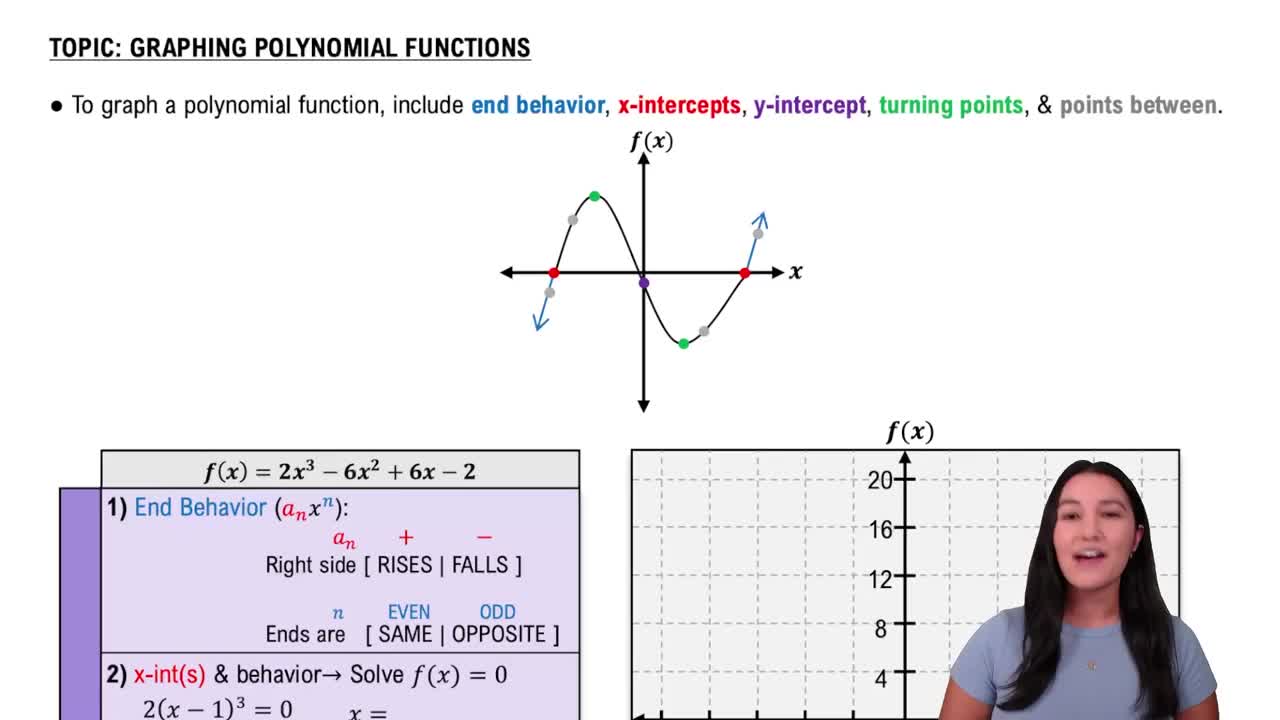
Use the factored form to identify the roots (zeros) of the function by setting each factor equal to zero, then plot these roots on the x-axis. Also, analyze the end behavior and shape of the graph based on the degree and leading coefficient.
Verified video answer for a similar problem:
This video solution was recommended by our tutors as helpful for the problem above
Video duration:
8m
Play a video:
0 Comments
Key Concepts
Here are the essential concepts you must grasp in order to answer the question correctly.
Polynomial Functions
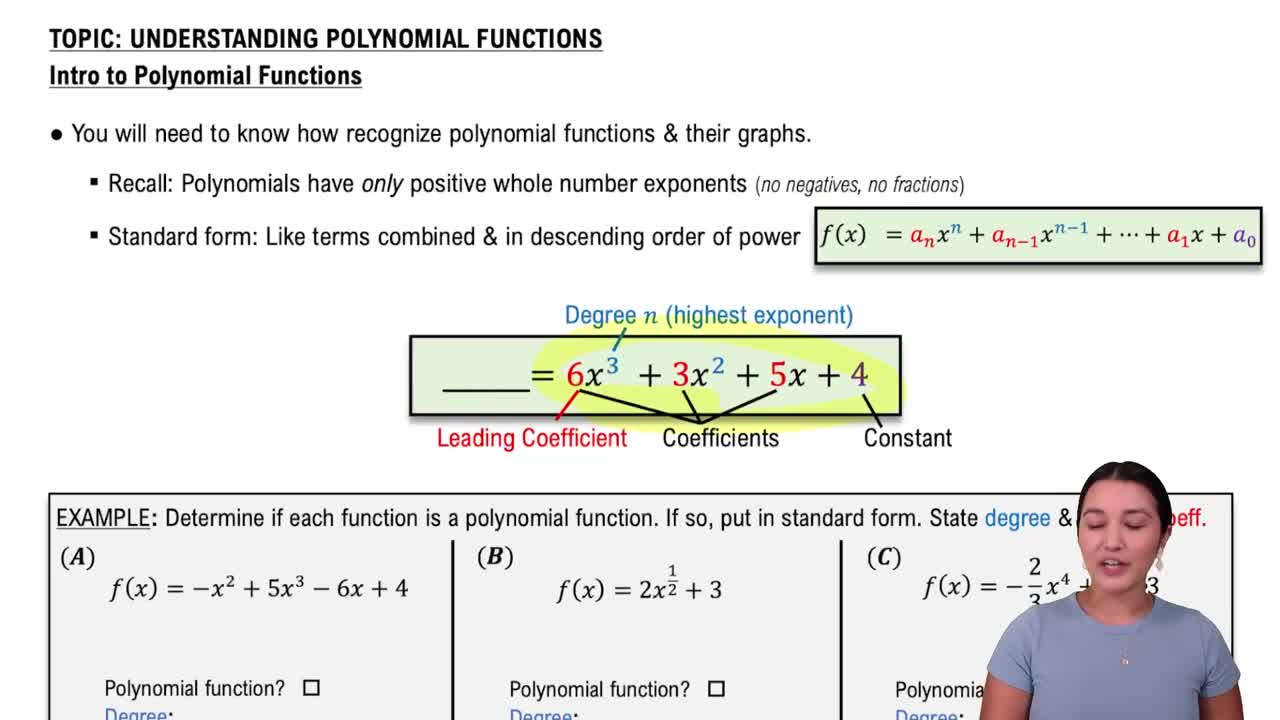
A polynomial function is an expression consisting of variables raised to whole-number exponents and coefficients combined using addition, subtraction, and multiplication. Understanding the degree and leading coefficient helps predict the general shape and end behavior of the graph.
Factoring involves rewriting a polynomial as a product of simpler polynomials or factors. This process helps identify the roots or zeros of the function, which are critical points where the graph crosses or touches the x-axis.
Graphing a polynomial requires plotting its zeros, analyzing end behavior based on degree and leading coefficient, and determining the shape between zeros. Factoring simplifies finding zeros, and understanding multiplicity helps predict whether the graph crosses or touches the x-axis at those points.

 8:03 minutes
 Verified step by step guidance
 06:04
06:04