Ch. 4 - Inverse, Exponential, and Logarithmic Functions
Lial - College Algebra 13th Edition
Lial13th EditionCollege AlgebraISBN: 9780136881063Not the one you use?Change textbook
Chapter 5, Problem 34

Graph each function. ƒ(x)=(1/6)xƒ(x)=(1/6)^{-x}

Verified step by step guidance
1
Recognize that the function is given by \(f(x) = \left(\frac{1}{6}\right)^{-x}\). The negative exponent means you can rewrite the function using the property of exponents: \(a^{-x} = \frac{1}{a^x}\).
Rewrite the function as \(f(x) = \left(\frac{1}{6}\right)^{-x} = 6^x\). This simplifies the function to an exponential function with base 6.
Identify key points to plot by choosing values for \(x\), such as \(x = -2, -1, 0, 1, 2\), and calculate the corresponding \(f(x)\) values using \(f(x) = 6^x\).
Plot the points on the coordinate plane and observe the shape of the graph. Since the base 6 is greater than 1, the graph will show exponential growth, increasing rapidly as \(x\) increases.
Draw the curve through the plotted points, noting that the graph passes through \((0,1)\) because any nonzero number raised to the zero power is 1, and the graph approaches the x-axis but never touches it (asymptote at \(y=0\)).

Verified video answer for a similar problem:

This video solution was recommended by our tutors as helpful for the problem above.
Video duration:
5m
Was this helpful?

Key Concepts

Here are the essential concepts you must grasp in order to answer the question correctly.

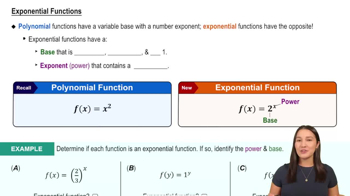
Exponential Functions

An exponential function has the form f(x) = a^x, where the base a is a positive real number not equal to 1. These functions model growth or decay processes and have distinctive graphs that either increase or decrease rapidly depending on the base and exponent.
Recommended video:
6:13
Exponential Functions

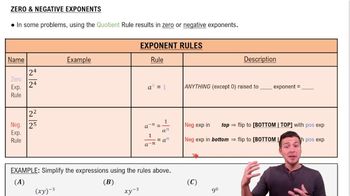
Negative Exponents

A negative exponent indicates the reciprocal of the base raised to the corresponding positive exponent, i.e., a^{-x} = 1 / a^x. Understanding this helps rewrite and simplify expressions, which is essential for graphing functions like f(x) = (1/6)^{-x}.
Recommended video:
Guided course
6:37
Zero and Negative Rules

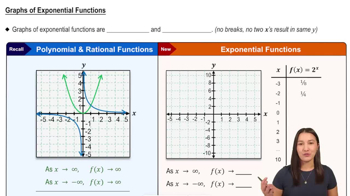
Graphing Exponential Functions

Graphing involves plotting points by substituting values of x and understanding the behavior of the function, such as asymptotes and intercepts. For f(x) = (1/6)^{-x}, recognizing it as (6)^x helps predict an increasing exponential graph with a horizontal asymptote at y=0.
Recommended video:
5:46
Graphs of Exponential Functions