Use the intermediate value theorem to show that each polynomial function has a real zero between the numbers given. ƒ(x)=x4-4x3-x+3; 0.5 and 1
Ch. 3 - Polynomial and Rational Functions

Chapter 4, Problem 52
Graph each polynomial function. ƒ(x)=-2x4+7x3-4x2-4x
Verified step by step guidance1
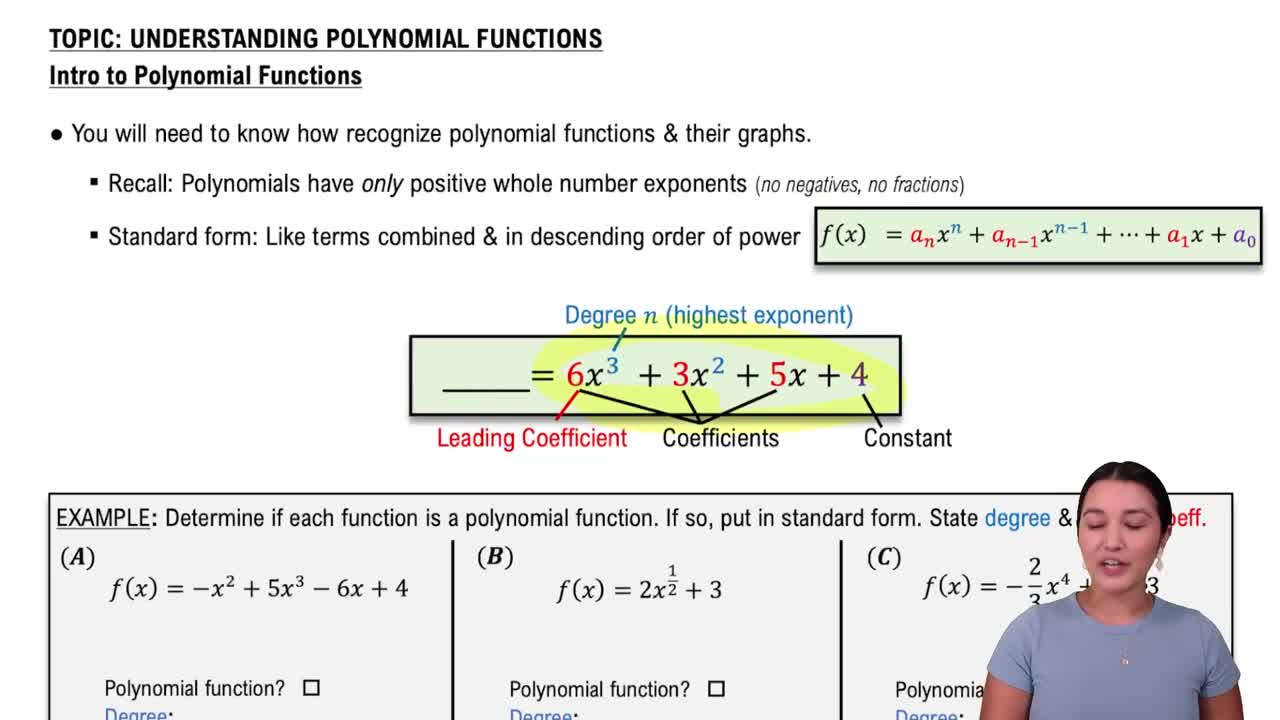
Identify the degree and leading coefficient of the polynomial function \(f(x) = -2x^4 + 7x^3 - 4x^2 - 4x\). The degree is 4 (since the highest power of \(x\) is 4), and the leading coefficient is \(-2\).
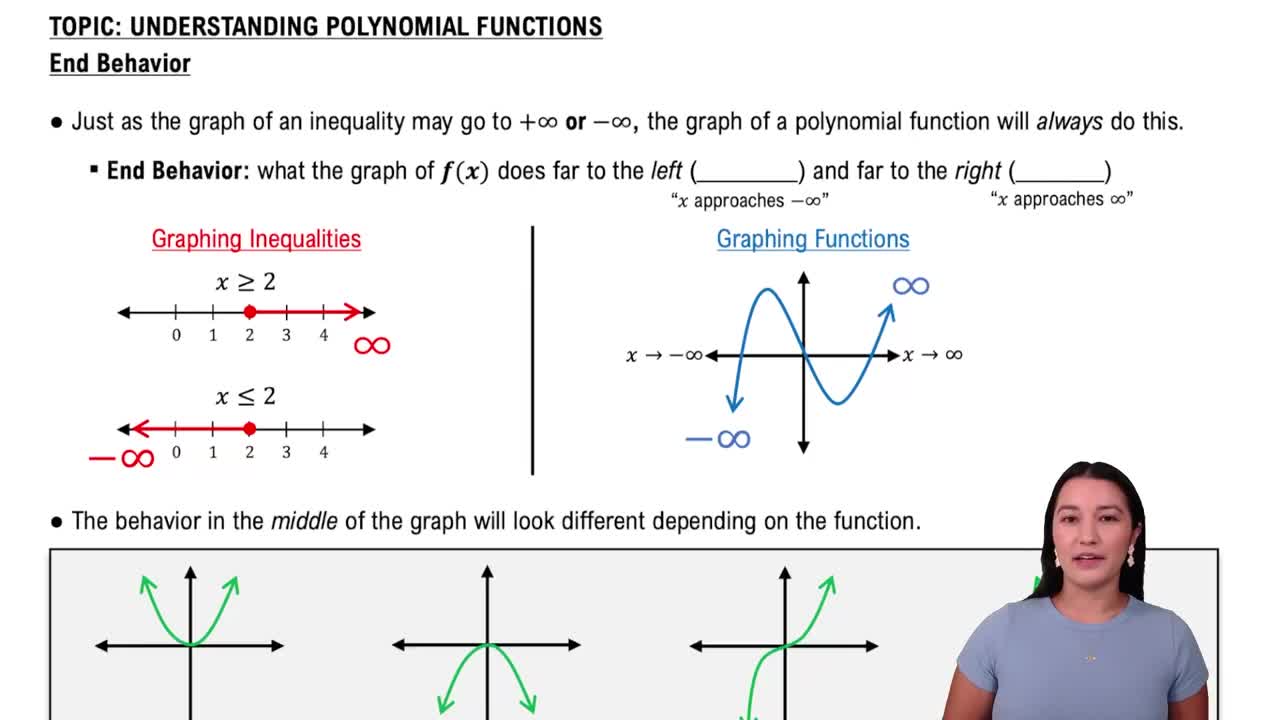
Determine the end behavior of the graph based on the degree and leading coefficient. Since the degree is even and the leading coefficient is negative, both ends of the graph will point downwards as \(x\) approaches \(\pm \infty\).
Find the \(x\)-intercepts by solving the equation \(f(x) = 0\), which means solving \(-2x^4 + 7x^3 - 4x^2 - 4x = 0\). Start by factoring out the greatest common factor if possible.
Calculate the \(y\)-intercept by evaluating \(f(0)\). This gives the point where the graph crosses the \(y\)-axis.
Use the information from the intercepts and end behavior to sketch the graph, and consider testing additional points or using the first and second derivatives to find critical points and inflection points for a more accurate graph.

Verified video answer for a similar problem:
This video solution was recommended by our tutors as helpful for the problem above.
Video duration:
10mWas this helpful?
Key Concepts
Here are the essential concepts you must grasp in order to answer the question correctly.
Polynomial Functions
A polynomial function is an expression consisting of variables raised to whole-number exponents and coefficients combined using addition, subtraction, and multiplication. Understanding the degree and leading coefficient helps predict the general shape and end behavior of the graph.
Recommended video:
Introduction to Polynomial Functions
End Behavior of Polynomial Graphs
The end behavior describes how the graph behaves as x approaches positive or negative infinity. It depends on the degree and leading coefficient: for even-degree polynomials with a negative leading coefficient, both ends of the graph point downward.
Recommended video:
End Behavior of Polynomial Functions
Finding Critical Points and Shape
Critical points occur where the derivative is zero or undefined, indicating potential maxima, minima, or inflection points. Identifying these points helps in sketching the graph accurately by showing where the function changes direction.
Recommended video:
Guided course
Finding Equations of Lines Given Two Points
Related Practice
Textbook Question
777
views
Textbook Question
Use synthetic division to determine whether the given number k is a zero of the polynomial function. If it is not, give the value of ƒ(k). ƒ(x) = 2x3 - 6x2 -9x + 4; k=1
389
views
Textbook Question
Solve each rational inequality. Give the solution set in interval notation. (x - 1)/(x - 4) > 0
579
views
Textbook Question
Work each problem. Which function has a graph that does not have a vertical asymptote?
A. ƒ(x)=1/(x2+2)
B. ƒ(x)=1/(x2-2)
C. ƒ(x)=3/x2
D. ƒ(x)=(2x+1)/(x-8)
638
views
Textbook Question
For each polynomial function, find all zeros and their multiplicities.
660
views
Textbook Question
Work each problem. Which function has a graph that does not have a horizontal asymptote?
A. ƒ(x)=(2x-7)/(x+3)
B. ƒ(x)=3x/(x2-9)
C. ƒ(x)=(x2-9)/(x+3)
D. ƒ(x)=(x+5)/(x+2)(x-3)
719
views