Ch. 2 - Graphs and Functions
Lial - College Algebra 13th Edition
Lial13th EditionCollege AlgebraISBN: 9780136881063Not the one you use?Change textbook
Chapter 3, Problem 30

Graph each piecewise-defined function.
f(x)={x3+5if x0x2if x>0f(x) =\(\begin{cases}\)x^3 + 5 & \(\text{if }\) x \(\leq\) 0 \\-x^2 & \(\text{if }\) x > 0\(\end{cases}\)

Verified step by step guidance
1
First, carefully read the piecewise function and identify the domain for each piece. The function is given as: \[f(x) = \begin{cases} x^3 + 5 & \text{if } x \leq 0 \\ -x^2 & \text{if } x < 0 \end{cases}\] Notice the domains: the first piece applies when \(x \leq 0\), and the second piece applies when \(x < 0\).
Next, observe that the domains of the two pieces overlap for \(x < 0\). This means for values less than zero, both expressions are defined, so you need to clarify which expression to use for \(x < 0\). Usually, piecewise functions have non-overlapping domains, so check if there might be a typo or if the problem expects you to graph both expressions on \(x < 0\).
Assuming the problem intends the first piece for \(x \leq 0\) and the second piece for \(x > 0\) (a common scenario), rewrite the function as: \[f(x) = \begin{cases} x^3 + 5 & \text{if } x \leq 0 \\ -x^2 & \text{if } x > 0 \end{cases}\] This will help in graphing each piece clearly.
To graph the first piece \(f(x) = x^3 + 5\) for \(x \leq 0\), create a table of values for several \(x\) values less than or equal to zero, calculate corresponding \(f(x)\) values, and plot these points. Remember that \(x^3\) is a cubic function shifted up by 5 units.
For the second piece \(f(x) = -x^2\) for \(x > 0\), similarly create a table of values for positive \(x\) values, calculate \(f(x)\), and plot these points. This is a downward-opening parabola starting from zero (since at \(x=0\), \(f(x) = 0\)). Finally, combine both graphs, making sure to use a closed dot at \(x=0\) for the first piece (since it includes \(x=0\)) and an open dot for the second piece at \(x=0\) (since it does not include \(x=0\)).

Verified video answer for a similar problem:

This video solution was recommended by our tutors as helpful for the problem above.
Video duration:
5m
Was this helpful?

Key Concepts

Here are the essential concepts you must grasp in order to answer the question correctly.

Piecewise-Defined Functions

A piecewise-defined function is a function composed of different expressions, each applying to a specific interval of the domain. Understanding how to interpret and graph each piece separately is essential, as the function's rule changes depending on the input value.
Recommended video:
3:51
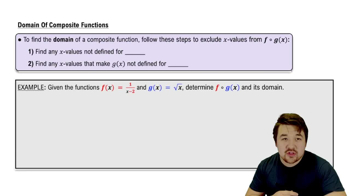
Domain Restrictions of Composed Functions

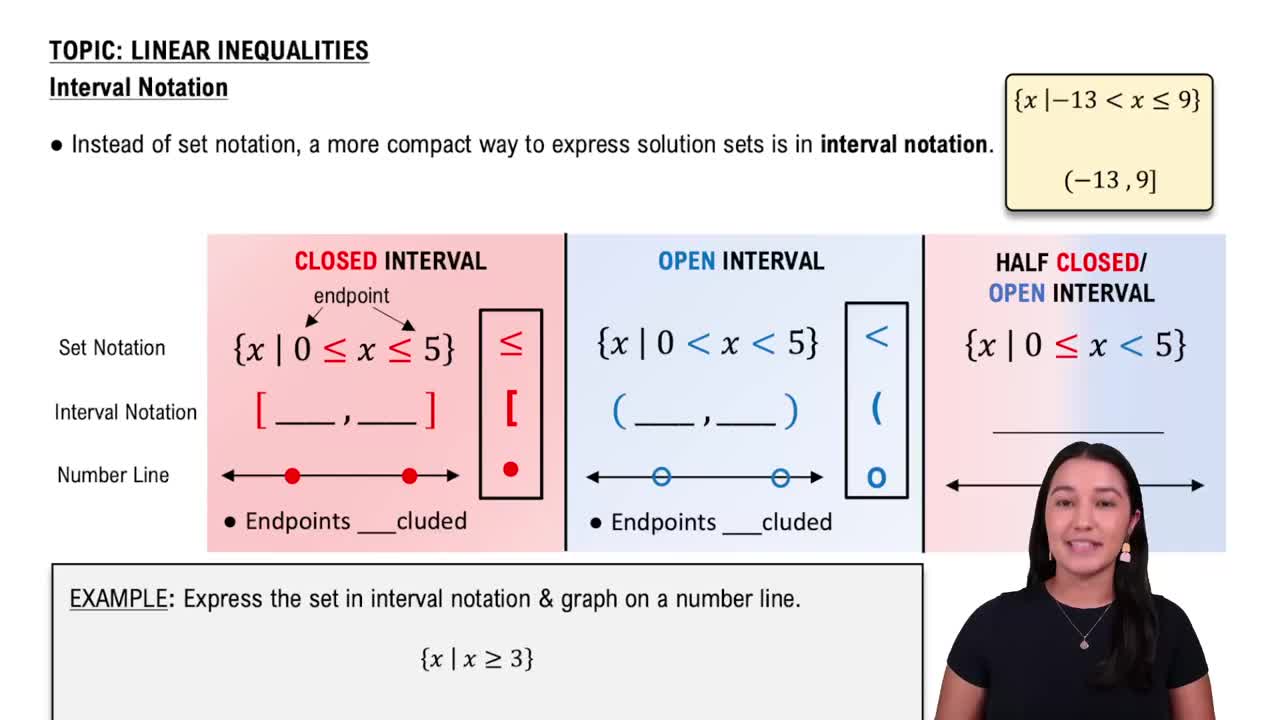
Domain and Inequality Notation

The domain restrictions (like x ≤ 0 or x < 0) specify where each piece of the function applies. Correctly interpreting these inequalities ensures that each part of the function is graphed only on its intended interval, avoiding overlap or gaps.
Recommended video:
05:18
Interval Notation

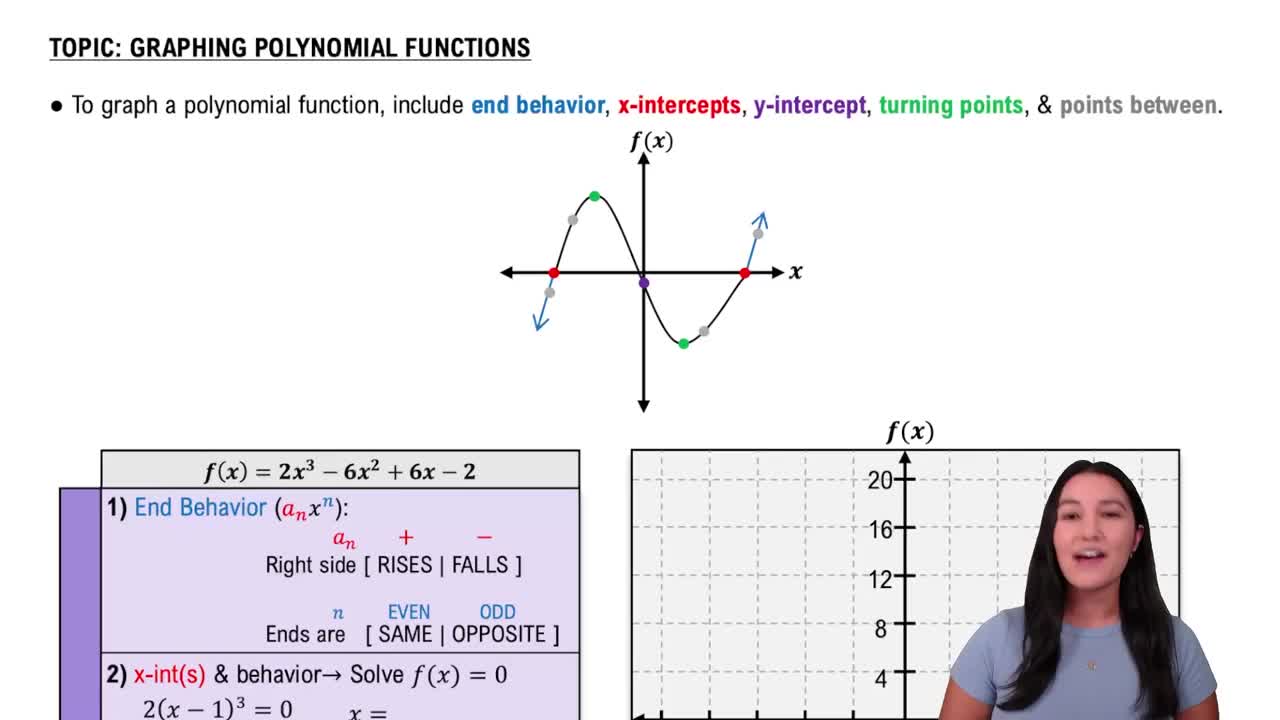
Graphing Polynomial Functions

Each piece of the function involves polynomial expressions (like x³ + 5 or -x²). Knowing how to graph cubic and quadratic functions, including their shapes and key points, helps in accurately plotting each segment of the piecewise function.
Recommended video:
05:25
Graphing Polynomial Functions