Ch. 2 - Graphs and Functions
Lial - College Algebra 13th Edition
Lial13th EditionCollege AlgebraISBN: 9780136881063Not the one you use?Change textbook
Chapter 3, Problem 54

Graph each function. Give the domain and range. ƒ(x)=-[[x]]

Verified step by step guidance
1
Identify the function given: \(f(x) = -\lfloor x \rfloor\), where \(\lfloor x \rfloor\) denotes the greatest integer less than or equal to \(x\) (the floor function).
Understand the behavior of the floor function: for any real number \(x\), \(\lfloor x \rfloor\) is an integer that steps up by 1 at each integer value of \(x\). Since the function is \(-\lfloor x \rfloor\), the graph will reflect the floor function values across the x-axis (negated).
To graph the function, plot points for several values of \(x\), especially around integers. For example, for \(x\) in the interval \([0,1)\), \(\lfloor x \rfloor = 0\), so \(f(x) = 0\). For \(x\) in \([1,2)\), \(\lfloor x \rfloor = 1\), so \(f(x) = -1\), and so on. Connect these points as step segments that jump at integer values of \(x\).
Determine the domain: since the floor function is defined for all real numbers, the domain of \(f(x)\) is all real numbers, expressed as \((-\infty, \infty)\).
Determine the range: because \(\lfloor x \rfloor\) takes all integer values from \(-\infty\) to \(\infty\), and \(f(x) = -\lfloor x \rfloor\), the range is also all integers but negated, which is still all integers \((-\infty, \infty)\).

Verified video answer for a similar problem:

This video solution was recommended by our tutors as helpful for the problem above.
Video duration:
15m
Was this helpful?

Key Concepts

Here are the essential concepts you must grasp in order to answer the question correctly.

Greatest Integer Function (Floor Function)

The greatest integer function, denoted by [[x]] or ⌊x⌋, assigns to each real number x the greatest integer less than or equal to x. It creates a step-like graph where the function value jumps at integer points. Understanding this function is essential to graphing ƒ(x) = -[[x]].
Recommended video:
4:56
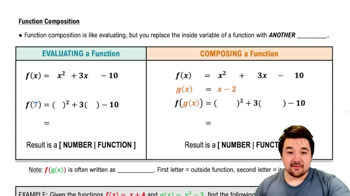
Function Composition

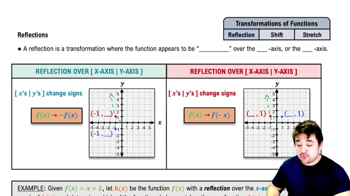
Function Transformation (Reflection)

Multiplying the greatest integer function by -1 reflects its graph across the x-axis. This changes the sign of all output values, flipping the step pattern downward. Recognizing this transformation helps in accurately sketching the graph of ƒ(x) = -[[x]].
Recommended video:
5:00
Reflections of Functions

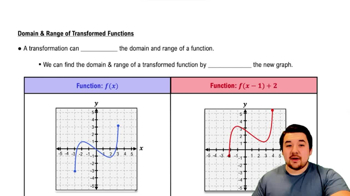
Domain and Range of Step Functions

The domain of the greatest integer function is all real numbers, while its range is all integers. After applying the negative sign, the range becomes all non-positive integers (including zero). Identifying domain and range is crucial for fully describing the function.
Recommended video:
4:22
Domain & Range of Transformed Functions