Ch. R - Review of Basic Concepts
Lial - College Algebra 13th Edition
Lial13th EditionCollege AlgebraISBN: 9780136881063Not the one you use?Change textbook
Chapter 1, Problem 76

Simplify each radical. Assume all variables represent positive real numbers. - ∜243

Verified step by step guidance
1
Recognize that the symbol \( \sqrt[4]{\cdot} \) represents the fourth root, which means we are looking for a number that, when raised to the power of 4, equals the radicand (the number inside the radical).
Express the radicand 243 as a product of its prime factors. Since 243 is a power of 3, write it as \( 243 = 3^5 \).
Rewrite the fourth root of 243 using the prime factorization: \( \sqrt[4]{243} = \sqrt[4]{3^5} \).
Apply the property of radicals that \( \sqrt[n]{a^m} = a^{\frac{m}{n}} \), so \( \sqrt[4]{3^5} = 3^{\frac{5}{4}} \).
Separate the exponent into an integer and fractional part: \( 3^{\frac{5}{4}} = 3^{1 + \frac{1}{4}} = 3^1 \times 3^{\frac{1}{4}} = 3 \times \sqrt[4]{3} \). This is the simplified form of the original radical.

Verified video answer for a similar problem:

This video solution was recommended by our tutors as helpful for the problem above.
Video duration:
1m
Was this helpful?

Key Concepts

Here are the essential concepts you must grasp in order to answer the question correctly.

Understanding Radicals and Roots

A radical expression involves roots, such as square roots or fourth roots. The symbol ∜ represents the fourth root, meaning you are looking for a number that, when raised to the power of 4, equals the given value. Recognizing the type of root is essential for simplification.
Recommended video:
02:20
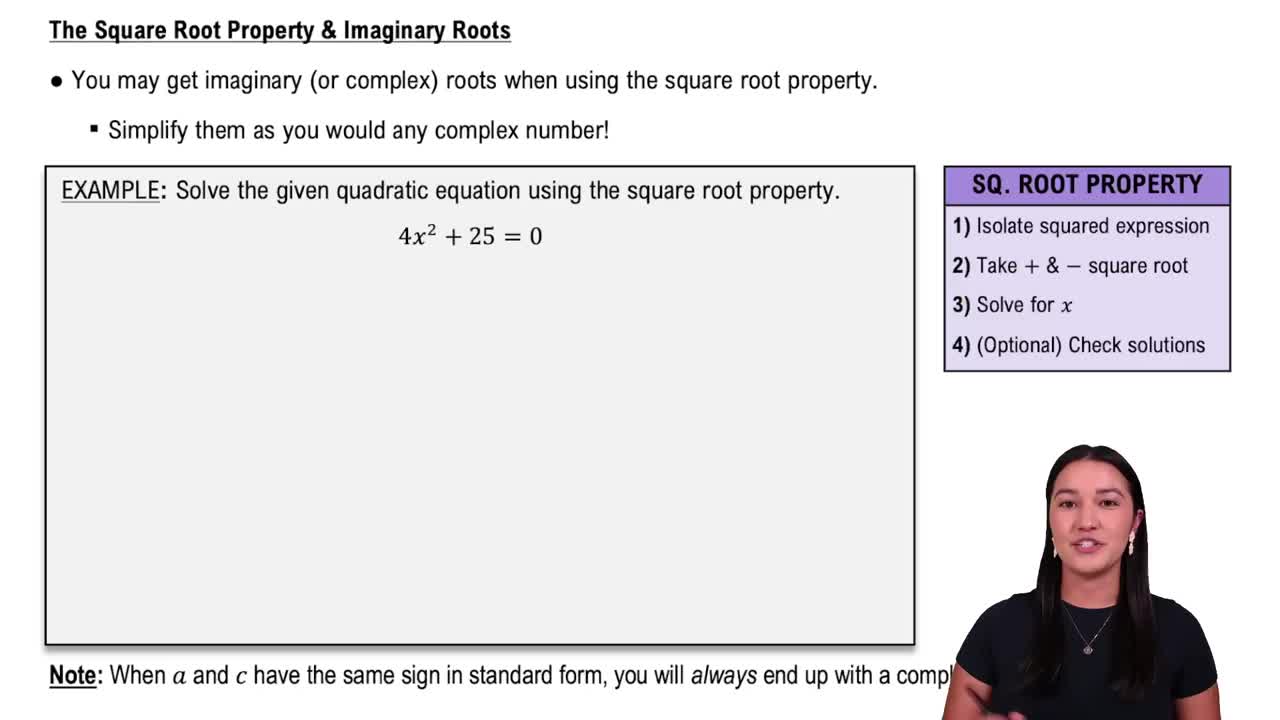
Imaginary Roots with the Square Root Property

Prime Factorization

Prime factorization breaks down a number into its prime factors. For simplifying radicals, expressing the radicand (the number inside the root) as a product of prime factors helps identify perfect powers that can be taken out of the root easily.
Recommended video:
Guided course
07:30
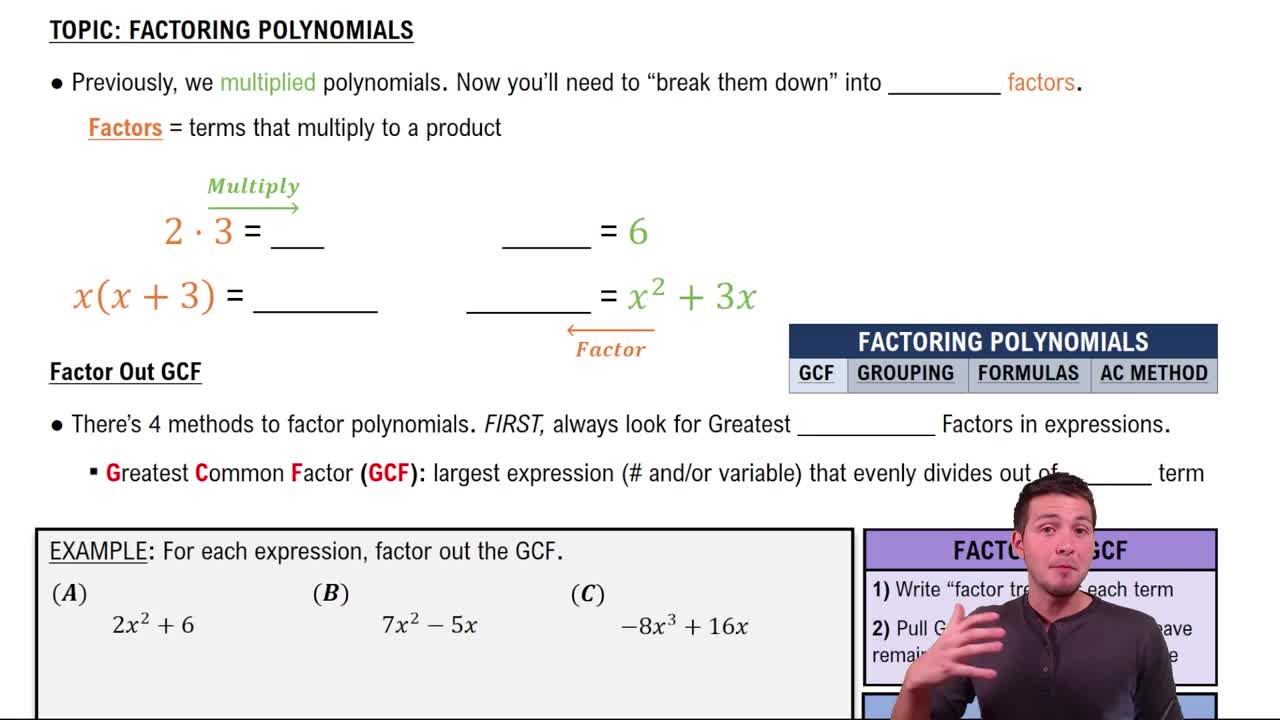
Introduction to Factoring Polynomials

Properties of Exponents and Roots

Roots can be expressed as fractional exponents, where the nth root of a number is the same as raising that number to the 1/n power. Using exponent rules allows you to simplify radicals by extracting factors raised to powers divisible by the root's index.
Recommended video:
02:20
Imaginary Roots with the Square Root Property