Ch. 2 - Graphs and Functions
Lial - College Algebra 13th Edition
Lial13th EditionCollege AlgebraISBN: 9780136881063Not the one you use?Change textbook
Chapter 3, Problem 5

Without using paper and pencil, evaluate each expression given the following functions. ƒ(x)=x+1ƒ(x)=x+1 and g(x)=x2g(x)=x^2
(ƒg)(2)(ƒ∘g)(2)

Verified step by step guidance
1
Understand that the notation \((\f\circ g)(2)\) means the composition of the functions \(f\) and \(g\) evaluated at \(x=2\). This is written as \(f(g(2))\), which means you first find \(g(2)\) and then plug that result into \(f\).
Start by evaluating \(g(2)\). Since \(g(x) = x^2\), substitute \(2\) for \(x\) to get \(g(2) = 2^2\).
Calculate \$2^2\( to find the value of \)g(2)$. This gives you the input for the next step.
Next, substitute the value of \(g(2)\) into the function \(f(x) = x + 1\). So, you will compute \(f(g(2)) = f(\text{value from previous step}) = \text{value} + 1\).
Finally, add 1 to the value obtained from \(g(2)\) to complete the evaluation of \((f \circ g)(2)\).

Verified video answer for a similar problem:

This video solution was recommended by our tutors as helpful for the problem above.
Video duration:
2m
Was this helpful?

Key Concepts

Here are the essential concepts you must grasp in order to answer the question correctly.

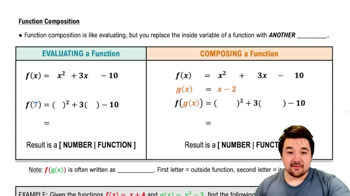
Function Composition

Function composition involves applying one function to the result of another, denoted as (f∘g)(x) = f(g(x)). It means you first evaluate g at x, then use that output as the input for f. Understanding this process is essential to correctly evaluate composite functions.
Recommended video:
4:56
Function Composition

Evaluating Functions

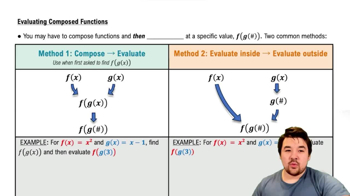
Evaluating a function means substituting the input value into the function's formula and simplifying. For example, if f(x) = x + 1, then f(3) = 3 + 1 = 4. This skill is necessary to find the value of functions at specific points.
Recommended video:
4:26
Evaluating Composed Functions

Order of Operations

The order of operations dictates the sequence in which mathematical operations are performed, typically parentheses, exponents, multiplication/division, and addition/subtraction. Correctly applying this order ensures accurate evaluation of expressions like g(2) = 2^2 before applying f.
Recommended video:
Guided course
8:38
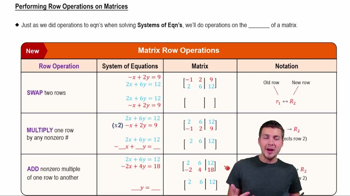
Performing Row Operations on Matrices