Ch. 1 - Equations and Inequalities
Lial - College Algebra 13th Edition
Lial13th EditionCollege AlgebraISBN: 9780136881063Not the one you use?Change textbook
Chapter 2, Problem 14

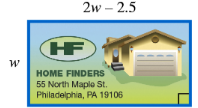
Solve each problem. See Example 1. The length of a rectangular label is 2.5 cm less than twice the width. The perimeter is 40.6 cm. Find the width.
A rectangular label with width w and length 2w minus 2.5, showing a house and address.

Verified step by step guidance
1
Define the variables: let the width of the rectangle be \(w\) cm, and the length be \(l\) cm.
Translate the problem statement into an equation for the length: \(l = 2 \times w - 2.5\).
Recall the formula for the perimeter of a rectangle: \(P = 2l + 2w\).
Substitute the given perimeter and the expression for \(l\) into the perimeter formula: \$40.6 = 2(2w - 2.5) + 2w$.
Simplify and solve the resulting equation for \(w\) to find the width.

Verified video answer for a similar problem:

This video solution was recommended by our tutors as helpful for the problem above.
Video duration:
4m
Was this helpful?

Key Concepts

Here are the essential concepts you must grasp in order to answer the question correctly.

Formulating Algebraic Expressions from Word Problems

This involves translating verbal descriptions into mathematical expressions or equations. For example, 'the length is 2.5 cm less than twice the width' can be written as L = 2W - 2.5. Understanding how to represent relationships with variables is essential for solving the problem.
Recommended video:
Guided course
05:09
Introduction to Algebraic Expressions

Perimeter of a Rectangle

The perimeter of a rectangle is the total distance around it, calculated as P = 2(length + width). Knowing this formula allows you to set up an equation using the given perimeter and expressions for length and width to find unknown dimensions.

Solving Linear Equations

Once the problem is expressed as an equation, solving for the unknown variable involves isolating it using algebraic operations. This includes combining like terms, adding or subtracting terms on both sides, and dividing or multiplying to find the value of the width.
Recommended video:
04:02
Solving Linear Equations with Fractions