Ch. 1 - Equations and Inequalities
Lial - College Algebra 13th Edition
Lial13th EditionCollege AlgebraISBN: 9780136881063Not the one you use?Change textbook
Chapter 2, Problem 77

Solve each equation for the specified variable. (Assume no denominators are 0.) See Example 8.
h=16t2+v0t+s0h = -16t^2+v_0t+s_0, for t

Verified step by step guidance
1
Start with the given equation: \(h = -16t^2 + v_0 t + s_0\).
Rearrange the equation to set it equal to zero by subtracting \(h\) from both sides: \$0 = -16t^2 + v_0 t + s_0 - h$.
Rewrite the equation in standard quadratic form: \(-16t^2 + v_0 t + (s_0 - h) = 0\).
Identify the coefficients for the quadratic formula: \(a = -16\), \(b = v_0\), and \(c = s_0 - h\).
Use the quadratic formula to solve for \(t\): \(t = \frac{-b \pm \sqrt{b^2 - 4ac}}{2a}\), substituting the values of \(a\), \(b\), and \(c\).

Verified video answer for a similar problem:

This video solution was recommended by our tutors as helpful for the problem above.
Video duration:
3m
Was this helpful?

Key Concepts

Here are the essential concepts you must grasp in order to answer the question correctly.

Solving Quadratic Equations

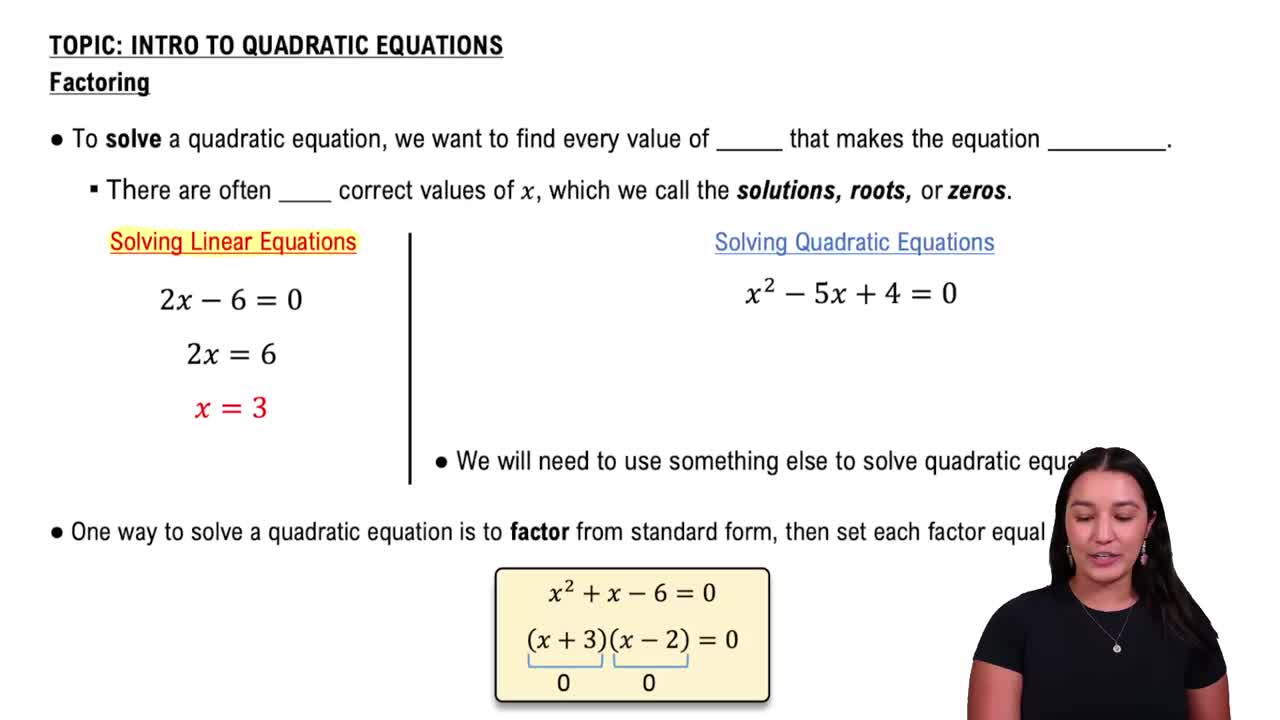
A quadratic equation is a polynomial equation of degree two, typically in the form ax^2 + bx + c = 0. To solve for the variable, methods such as factoring, completing the square, or using the quadratic formula can be applied. Recognizing the equation's structure is essential for choosing the appropriate method.
Recommended video:
06:08
Solving Quadratic Equations by Factoring

Isolating the Variable

Isolating the variable means manipulating the equation to express the variable explicitly on one side. This often involves algebraic operations like addition, subtraction, multiplication, division, and factoring. The goal is to rewrite the equation so the variable is alone, making it easier to solve.
Recommended video:
Guided course
05:28
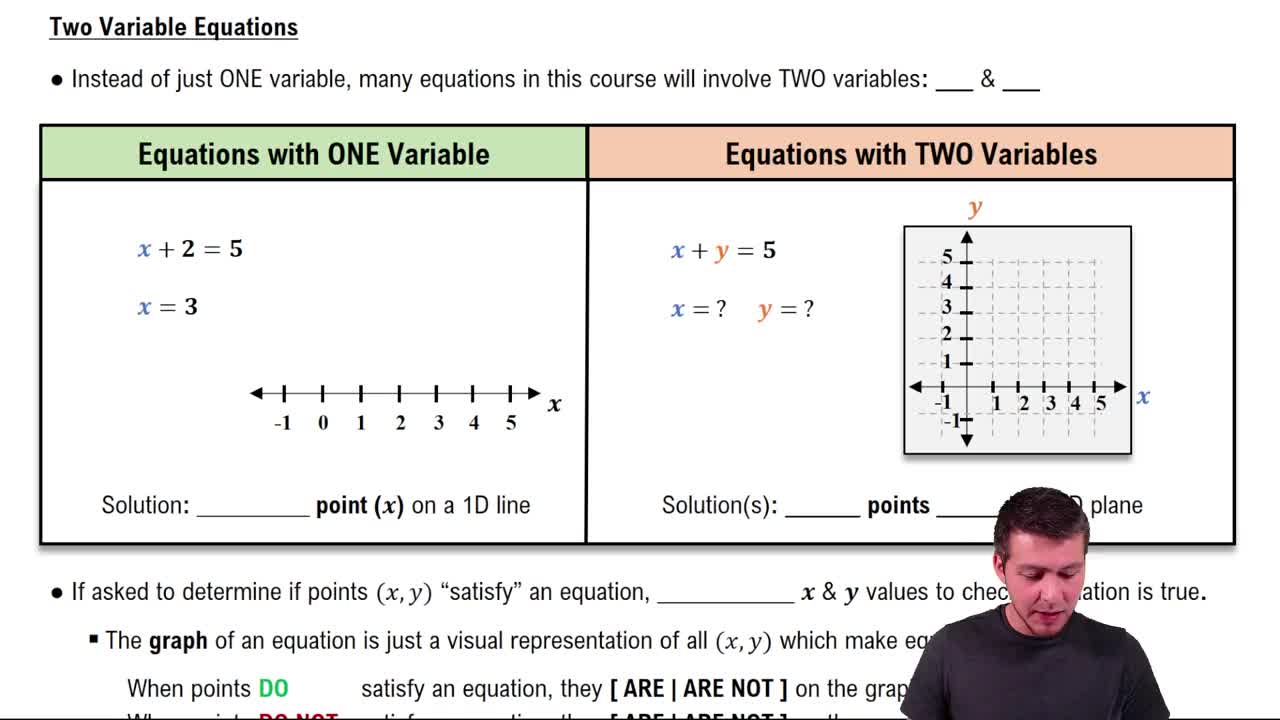
Equations with Two Variables

Understanding the Context of the Equation

The given equation h = -16t^2 + v_0t + s_0 models the height of an object under gravity over time. Recognizing that t represents time and that the equation is quadratic helps in interpreting solutions physically, such as identifying valid time values and excluding non-physical results like negative time.
Recommended video:
06:00
Categorizing Linear Equations