Ch. 4 - Inverse, Exponential, and Logarithmic Functions
Lial - College Algebra 13th Edition
Lial13th EditionCollege AlgebraISBN: 9780136881063Not the one you use?Change textbook
Chapter 5, Problem 57

Graph each function. ƒ(x) = log1/2 (x+3) - 2

Verified step by step guidance
1
Identify the base of the logarithm and the argument inside the function. Here, the function is given as \(f(x) = \log_{\frac{1}{2}}(x+3) - 2\), where the base is \(\frac{1}{2}\) and the argument is \((x+3)\).
Determine the domain of the function by setting the argument greater than zero: \(x + 3 > 0\). Solve this inequality to find the domain of \(f(x)\).
Find the vertical asymptote by setting the argument equal to zero: \(x + 3 = 0\). This vertical line will be an asymptote of the graph.
Understand the effect of the base \(\frac{1}{2}\) on the graph. Since the base is between 0 and 1, the logarithmic function is decreasing. Also, the \(-2\) outside the logarithm shifts the graph down by 2 units.
Plot key points such as when the argument equals 1 (i.e., \(x + 3 = 1\)) to find \(f(x)\) at that point, and use the vertical asymptote and the general shape of a decreasing logarithmic function to sketch the graph.

Verified video answer for a similar problem:

This video solution was recommended by our tutors as helpful for the problem above.
Video duration:
3m
Was this helpful?

Key Concepts

Here are the essential concepts you must grasp in order to answer the question correctly.

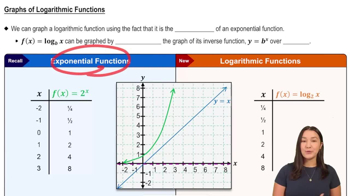
Logarithmic Functions

A logarithmic function is the inverse of an exponential function and is written as f(x) = log_b(x), where b is the base. It answers the question: to what power must the base be raised to produce x? Understanding the properties of logarithms is essential for graphing and interpreting these functions.
Recommended video:
5:26
Graphs of Logarithmic Functions

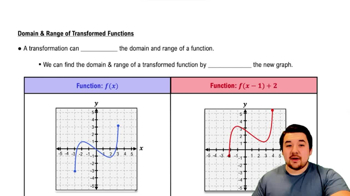
Transformations of Functions

Function transformations include shifts, stretches, and reflections that alter the graph's position or shape. For f(x) = log_{1/2}(x+3) - 2, the '+3' inside the log shifts the graph horizontally left by 3 units, and the '-2' shifts it vertically down by 2 units. Recognizing these helps in accurately sketching the graph.
Recommended video:
4:22
Domain & Range of Transformed Functions

Logarithms with Bases Between 0 and 1

When the base of a logarithm is between 0 and 1, such as 1/2, the function is decreasing rather than increasing. This means the graph slopes downward as x increases, which is the opposite behavior compared to bases greater than 1. This affects the shape and direction of the graph.
Recommended video:
7:30
Logarithms Introduction