Ch. 4 - Inverse, Exponential, and Logarithmic Functions
Lial - College Algebra 13th Edition
Lial13th EditionCollege AlgebraISBN: 9780136881063Not the one you use?Change textbook
Chapter 5, Problem 63

Graph each function. Give the domain and range. ƒ(x) = log1/2 (x-2)

Verified step by step guidance
1
Identify the base of the logarithm function, which is \( \frac{1}{2} \), and note that since \( 0 < \frac{1}{2} < 1 \), the logarithmic function is decreasing.
Determine the domain by setting the argument of the logarithm greater than zero: \( x - 2 > 0 \). Solve this inequality to find \( x > 2 \). So, the domain is \( (2, \infty) \).
Understand that the range of any logarithmic function is all real numbers, so the range is \( (-\infty, \infty) \).
Find key points to plot the graph, such as the vertical asymptote at \( x = 2 \) and the point where the argument equals 1, i.e., \( x - 2 = 1 \) which gives \( x = 3 \). At this point, \( f(3) = \log_{\frac{1}{2}}(1) = 0 \).
Sketch the graph showing the vertical asymptote at \( x = 2 \), the point \( (3, 0) \), and the decreasing nature of the function as \( x \) increases beyond 2.

Verified video answer for a similar problem:

This video solution was recommended by our tutors as helpful for the problem above.
Video duration:
9m
Was this helpful?

Key Concepts

Here are the essential concepts you must grasp in order to answer the question correctly.

Logarithmic Functions

A logarithmic function is the inverse of an exponential function and is written as f(x) = log_b(x), where b is the base. It answers the question: to what power must the base be raised to get x? Understanding how the base affects the graph's shape and behavior is essential, especially when the base is between 0 and 1, which causes the graph to decrease.
Recommended video:
5:26
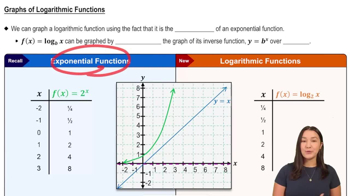
Graphs of Logarithmic Functions

Domain of Logarithmic Functions

The domain of a logarithmic function includes all x-values for which the argument inside the log is positive. For f(x) = log_b(x - 2), the expression x - 2 must be greater than 0, so the domain is x > 2. Recognizing this restriction is crucial for correctly graphing the function and determining valid input values.
Recommended video:
5:26
Graphs of Logarithmic Functions

Range of Logarithmic Functions

The range of any logarithmic function is all real numbers, since logarithms can produce any real output as the input approaches positive infinity or values close to zero from the right. This means the graph extends infinitely in the vertical direction, which is important when describing the function's behavior and sketching its graph.
Recommended video:
5:26
Graphs of Logarithmic Functions