Ch. 2 - Graphs and Functions
Lial - College Algebra 13th Edition
Lial13th EditionCollege AlgebraISBN: 9780136881063Not the one you use?Change textbook
Chapter 3, Problem 1

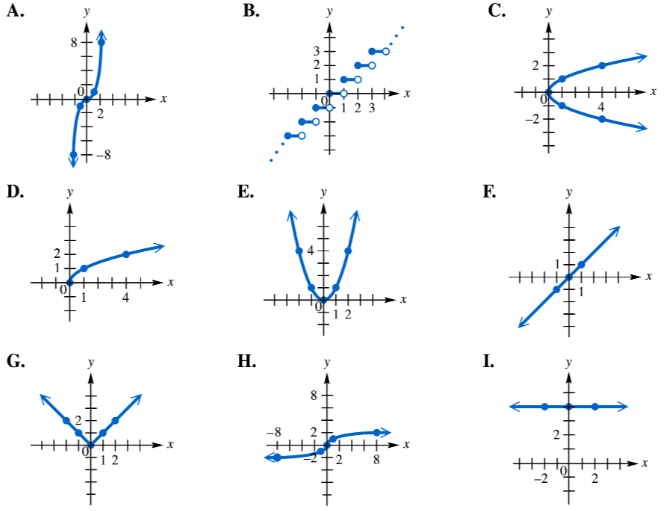
To answer each question, refer to the following basic graphs. Which one is the graph of ƒ(x)=x2? What is its domain?
Nine coordinate plane graphs labeled A to I showing various functions, including a parabola opening upward at E.

Verified step by step guidance
1
Identify the function given: ƒ(x) = x^2 is a quadratic function, which graphs as a parabola opening upwards.
Recall the shape of the graph of ƒ(x) = x^2: it is a U-shaped curve with its vertex at the origin (0,0).
Look at the provided basic graphs and select the one that matches this U-shaped parabola with vertex at the origin.
Determine the domain of ƒ(x) = x^2: since you can input any real number for x and get a real output, the domain is all real numbers.
Express the domain in interval notation as \((-\infty, \infty)\), meaning x can be any real number.

Verified video answer for a similar problem:

This video solution was recommended by our tutors as helpful for the problem above.
Video duration:
2m
Was this helpful?

Key Concepts

Here are the essential concepts you must grasp in order to answer the question correctly.

Quadratic Functions

A quadratic function is a polynomial function of degree two, typically written as f(x) = x². Its graph is a parabola that opens upwards, symmetric about the y-axis, with the vertex at the origin (0,0). Recognizing this shape helps identify the graph of f(x) = x².
Recommended video:
06:36
Solving Quadratic Equations Using The Quadratic Formula

Graph Interpretation

Graph interpretation involves analyzing the shape, position, and key features of a graph to match it with a given function. For f(x) = x², the graph is a U-shaped curve, and understanding these visual cues is essential to correctly identify the function's graph.
Recommended video:
Guided course
02:16
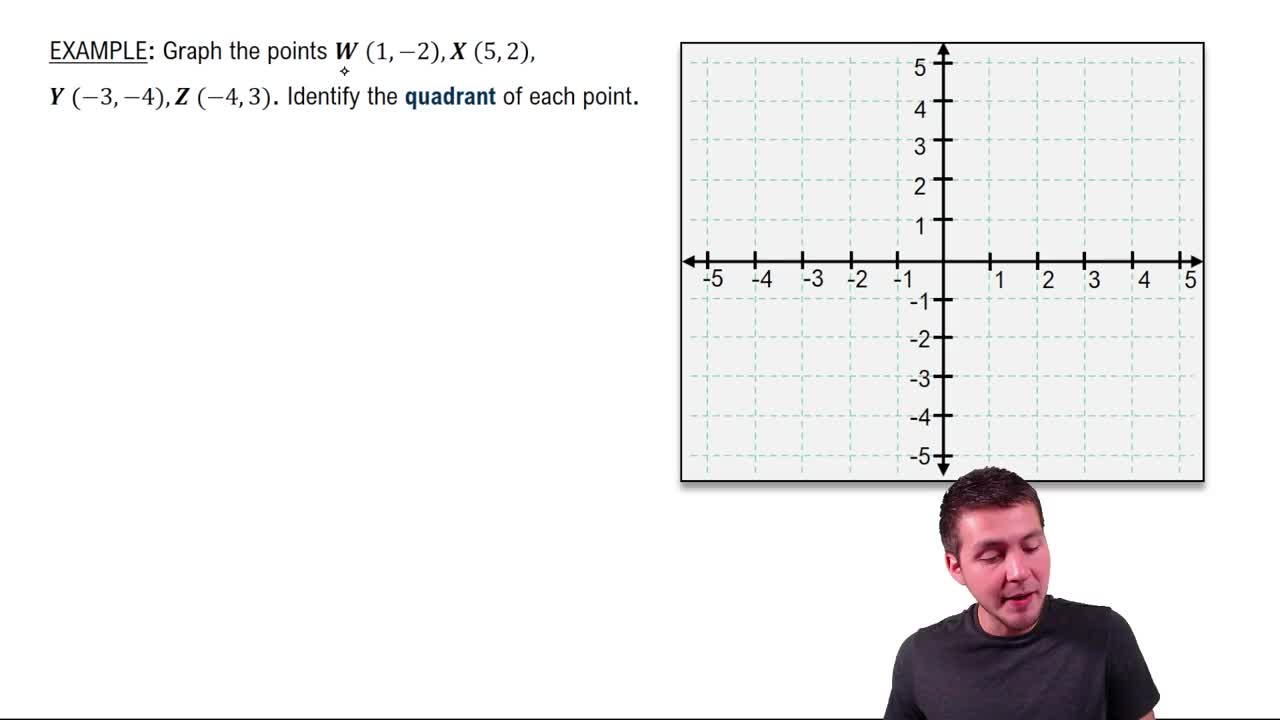
Graphs and Coordinates - Example

Domain of a Function

The domain of a function is the set of all possible input values (x-values) for which the function is defined. For f(x) = x², the domain is all real numbers since any real number can be squared without restriction.
Recommended video:
3:51
Domain Restrictions of Composed Functions