Ch. R - Review of Basic Concepts
Lial - College Algebra 13th Edition
Lial13th EditionCollege AlgebraISBN: 9780136881063Not the one you use?Change textbook
Chapter 1, Problem 81

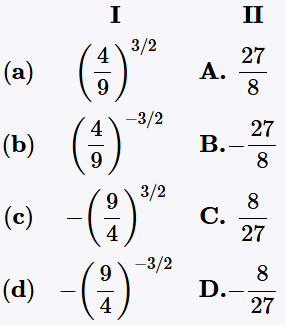
Match each expression in Column I with its equivalent expression in Column II.

Verified step by step guidance
1
Step 1: Understand that expressions with fractional exponents like \(a^{m/n}\) can be rewritten as \(\left(\sqrt[n]{a}\right)^m\) or \(\sqrt[n]{a^m}\). This helps simplify the expressions.
Step 2: For each expression in Column I, rewrite the base and exponent to identify its simplified form. For example, \((4/9)^{3/2}\) can be seen as \(\left(\sqrt{4/9}\right)^3\).
Step 3: Calculate the square root of the base inside the parentheses. For \((4/9)\), \(\sqrt{4/9} = 2/3\). Then raise this result to the power of 3: \((2/3)^3\).
Step 4: For negative exponents like \((4/9)^{-3/2}\), recall that \(a^{-m} = \frac{1}{a^m}\). So rewrite the expression as the reciprocal of the positive exponent form.
Step 5: Pay attention to the negative signs outside the expressions in parts c and d, which will affect the final sign of the simplified value. After simplifying the magnitude, apply the negative sign accordingly.

Verified video answer for a similar problem:

This video solution was recommended by our tutors as helpful for the problem above.
Video duration:
13m
Was this helpful?

Key Concepts

Here are the essential concepts you must grasp in order to answer the question correctly.

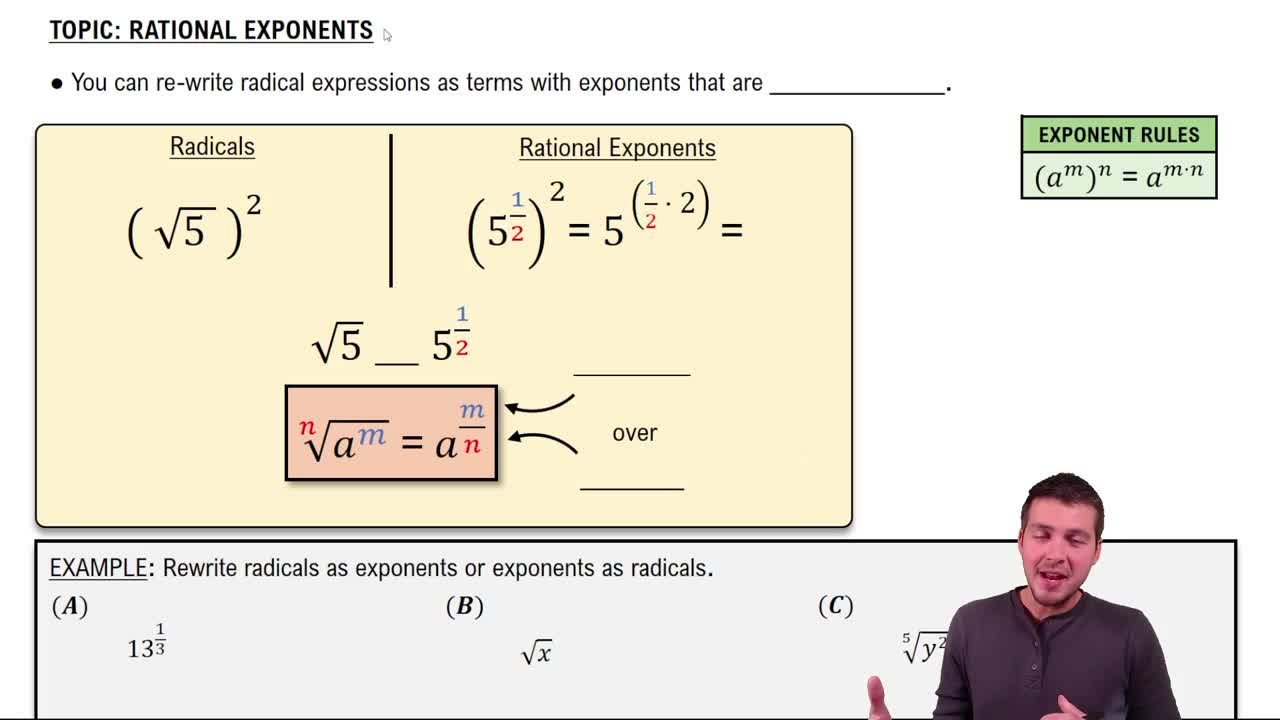
Rational Exponents

Rational exponents represent roots and powers simultaneously. For example, a^(m/n) means the nth root of a raised to the mth power. Understanding how to simplify expressions with fractional exponents is essential for matching equivalent forms.
Recommended video:
Guided course
04:06
Rational Exponents

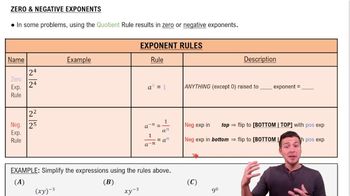
Negative Exponents

A negative exponent indicates the reciprocal of the base raised to the corresponding positive exponent. For instance, a^(-m) = 1/(a^m). Recognizing this helps convert expressions with negative exponents into more familiar fractional forms.
Recommended video:
Guided course
6:37
Zero and Negative Rules

Properties of Exponents and Simplification

Applying exponent rules, such as (a/b)^m = a^m / b^m, allows simplification of complex expressions. Combining these with sign considerations (positive or negative) is crucial to correctly match expressions with their equivalents.
Recommended video:
Guided course
04:06
Rational Exponents