Ch. R - Review of Basic Concepts
Lial - College Algebra 13th Edition
Lial13th EditionCollege AlgebraISBN: 9780136881063Not the one you use?Change textbook
Chapter 1, Problem 124

Identify the property illustrated in each statement. Assume all variables represent real numbers. 5๐œ‹ is a real number.

Verified step by step guidance
1
Understand that the problem asks to identify the algebraic property illustrated by the statement involving 5๐œ‹, where ๐œ‹ is a real number.
Recall common algebraic properties such as the Commutative Property, Associative Property, Distributive Property, Identity Property, and Inverse Property, which apply to real numbers.
Analyze the given expression or statement involving 5๐œ‹ to see which property it demonstrates. For example, if the statement shows multiplication of 5 and ๐œ‹, it might illustrate the Commutative Property of Multiplication, which states that \$a \(\times\) b = b \(\times\) a\$.
Check if the statement involves addition or multiplication and whether it rearranges terms or groups them differently, which helps identify the property.
Summarize the property by matching the observed behavior in the statement to the formal definition of the property.

Verified video answer for a similar problem:

This video solution was recommended by our tutors as helpful for the problem above.
Video duration:
1m
Was this helpful?

Key Concepts

Here are the essential concepts you must grasp in order to answer the question correctly.

Properties of Real Numbers

Real numbers include all rational and irrational numbers, encompassing integers, fractions, and decimals. Understanding their properties, such as closure, commutativity, associativity, identity, and distributivity, is essential for identifying how numbers behave under various operations.
Recommended video:
03:31
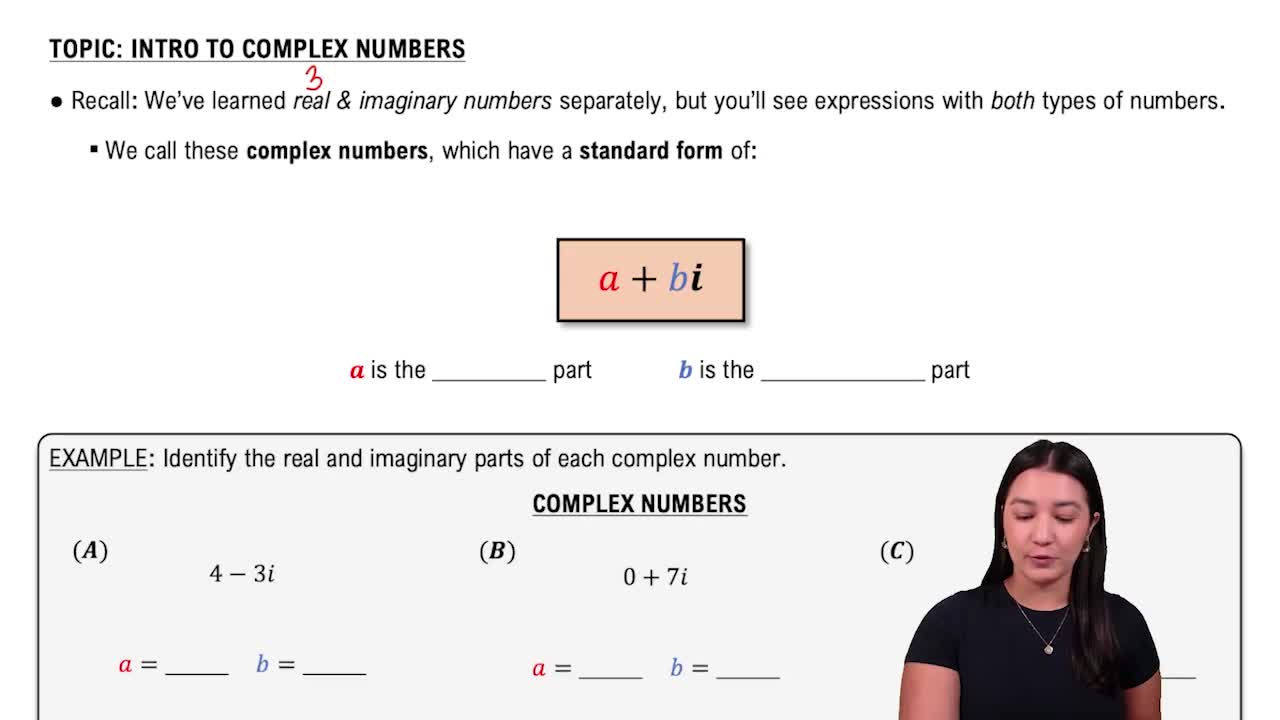
Introduction to Complex Numbers

Closure Property

The closure property states that performing an operation (addition, subtraction, multiplication, or division, except by zero) on any two real numbers results in another real number. For example, multiplying 5 by ฯ€ (an irrational real number) yields a real number, illustrating closure under multiplication.
Recommended video:
5:36
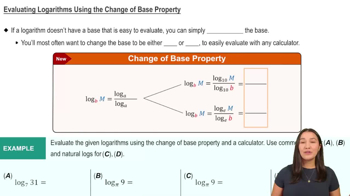
Change of Base Property

Multiplication of Real Numbers

Multiplying real numbers follows specific rules, including the closure property and the existence of multiplicative identity (1). Recognizing that 5ฯ€ is a product of two real numbers helps confirm it remains within the set of real numbers, reinforcing the concept of multiplication within real numbers.
Recommended video:
03:31
Introduction to Complex Numbers