Ch. 2 - Graphs and Functions
Lial - College Algebra 13th Edition
Lial13th EditionCollege AlgebraISBN: 9780136881063Not the one you use?Change textbook
Chapter 3, Problem 56

Write an equation (a) in standard form and (b) in slope-intercept form for each line described. through (-2, -2), parallel to y=3

Verified step by step guidance
1
Identify the given information: the line passes through the point (-2, -2) and is parallel to the line y = 3.
Recall that the line y = 3 is a horizontal line, which means its slope is 0. Since the new line is parallel to y = 3, it also has a slope of 0.
Write the equation of the line in slope-intercept form, which is \(y = mx + b\). Since the slope \(m = 0\), the equation simplifies to \(y = b\).
Use the point (-2, -2) to find \(b\) by substituting \(x = -2\) and \(y = -2\) into the equation \(y = b\). This gives \(-2 = b\).
Write the final equations: (a) in standard form, which for a horizontal line is \(y = -2\), and (b) in slope-intercept form, which is also \(y = -2\).

Verified video answer for a similar problem:

This video solution was recommended by our tutors as helpful for the problem above.
Video duration:
2m
Was this helpful?

Key Concepts

Here are the essential concepts you must grasp in order to answer the question correctly.

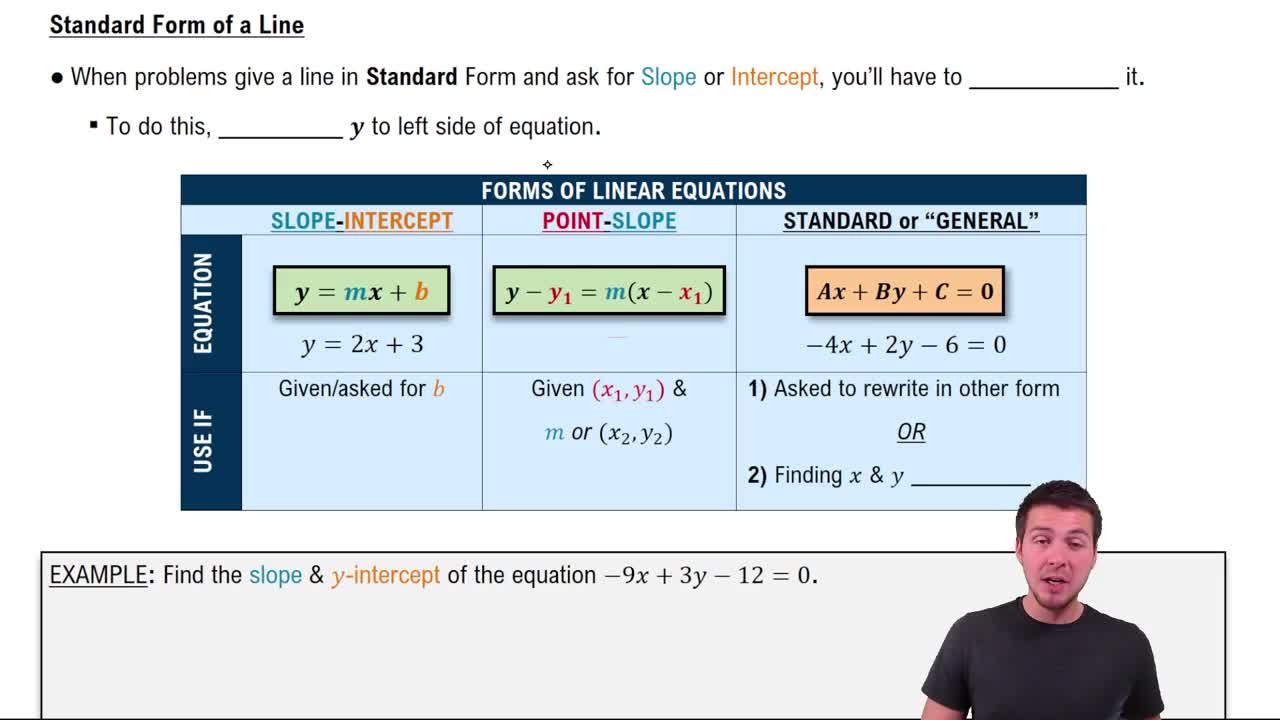
Equation of a Horizontal Line

A horizontal line has a constant y-value for all x-values, meaning its slope is zero. Its equation is written as y = k, where k is the y-coordinate of any point on the line. For example, y = 3 is a horizontal line passing through all points with y-coordinate 3.
Recommended video:
Guided course
05:39
Standard Form of Line Equations

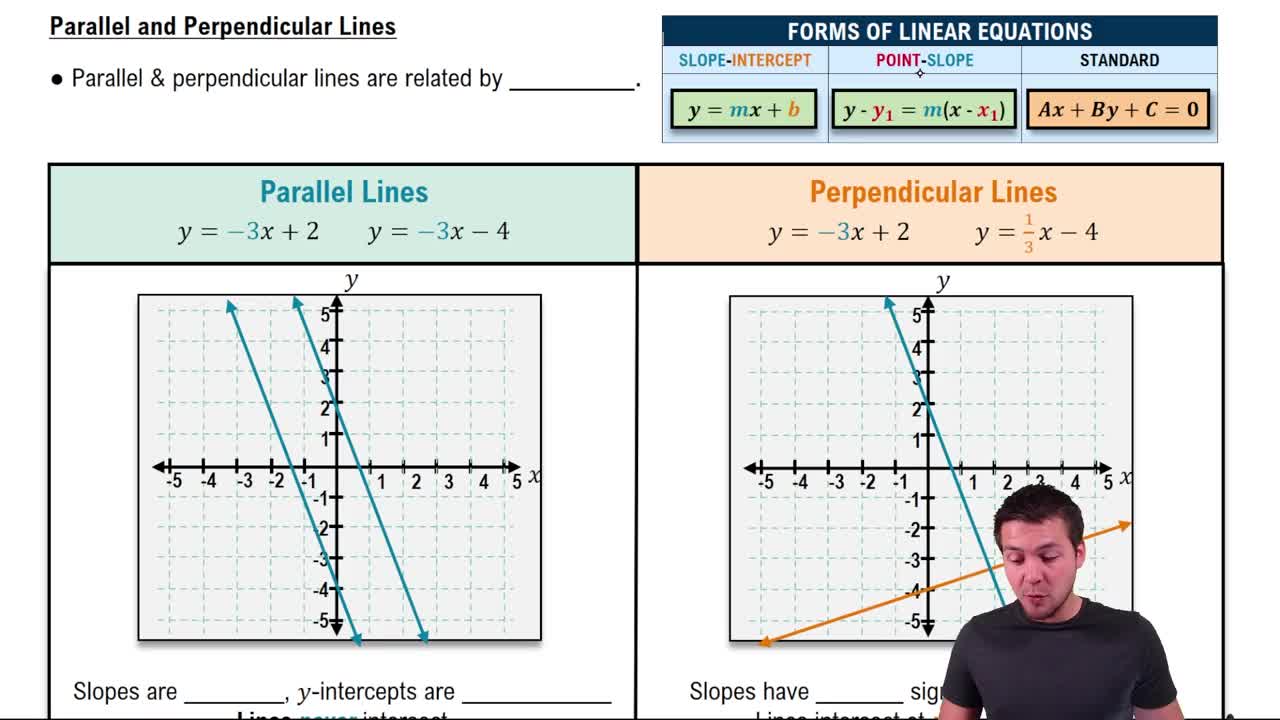
Parallel Lines

Parallel lines have the same slope but different y-intercepts, so they never intersect. If a line is parallel to y = 3, which is horizontal, it must also be horizontal with slope zero. Therefore, the new line will have the form y = k, where k is determined by the given point.
Recommended video:
Guided course
07:52
Parallel & Perpendicular Lines

Forms of Linear Equations

Linear equations can be expressed in different forms. The standard form is Ax + By = C, where A, B, and C are constants. The slope-intercept form is y = mx + b, where m is the slope and b is the y-intercept. Converting between these forms helps in graphing and understanding line properties.
Recommended video:
06:00
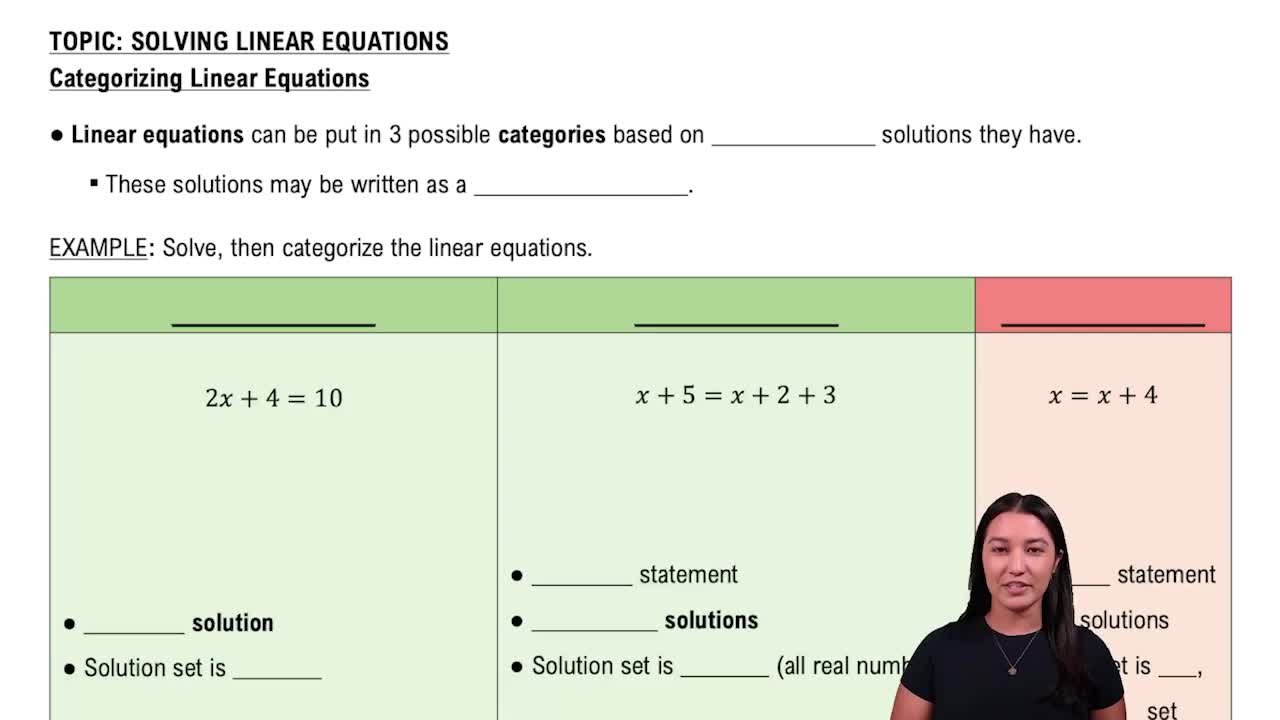
Categorizing Linear Equations