Solve each cubic equation using factoring and the quadratic formula. See Example 7.
Verified step by step guidance
1
Rewrite the equation \(x^3 + 64 = 0\) as \(x^3 = -64\) to isolate the cubic term.
Recognize that \(64\) is a perfect cube since \$64 = 4^3\(, so the equation can be seen as \)x^3 + 4^3 = 0$.
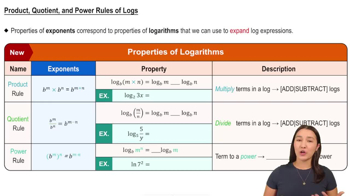
Use the sum of cubes factoring formula: \(a^3 + b^3 = (a + b)(a^2 - ab + b^2)\), where \(a = x\) and \(b = 4\).
Apply the formula to factor the equation as \((x + 4)(x^2 - 4x + 16) = 0\).
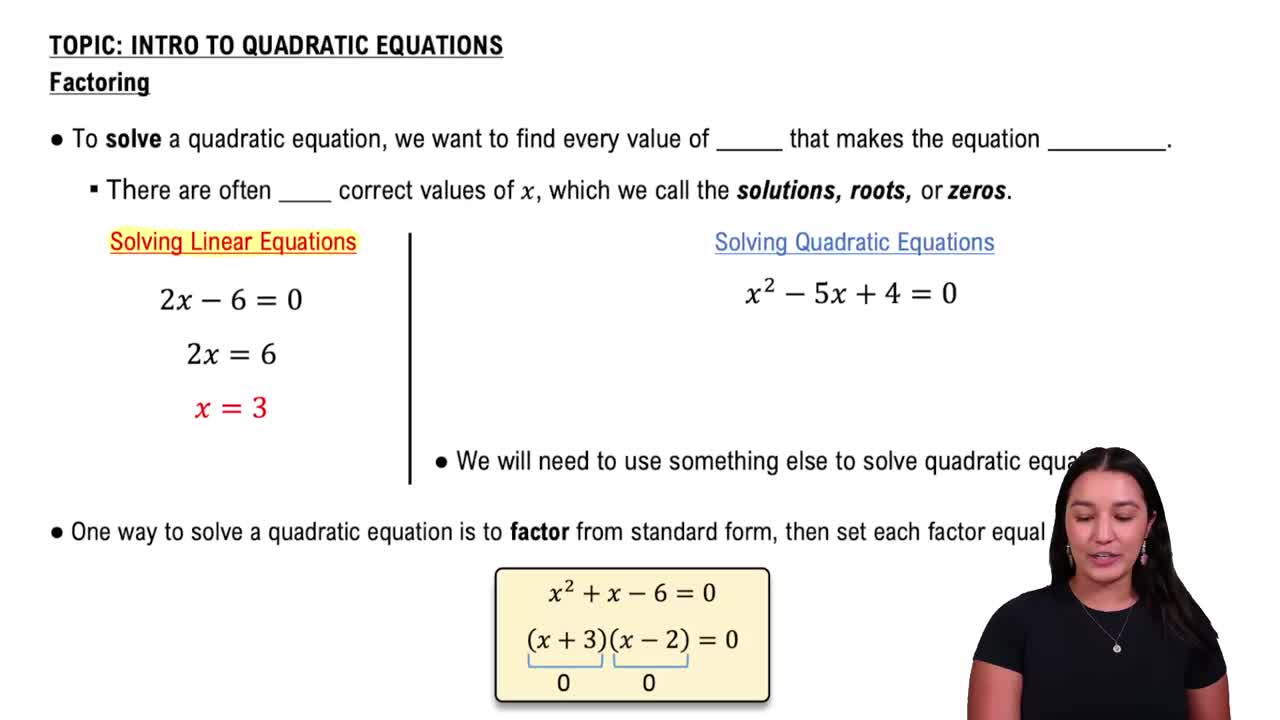
Set each factor equal to zero: \(x + 4 = 0\) and \(x^2 - 4x + 16 = 0\). Solve the linear equation directly and use the quadratic formula for the quadratic equation.
Verified video answer for a similar problem:
This video solution was recommended by our tutors as helpful for the problem above
Video duration:
7m
Play a video:
0 Comments
Key Concepts
Here are the essential concepts you must grasp in order to answer the question correctly.
Factoring Sum of Cubes
The expression x^3 + 64 is a sum of cubes since 64 = 4^3. The sum of cubes can be factored using the formula a^3 + b^3 = (a + b)(a^2 - ab + b^2). Factoring helps break down the cubic equation into simpler polynomial factors.
After factoring the cubic into a linear and a quadratic factor, the quadratic equation can be solved using the quadratic formula. The quadratic formula x = (-b ± √(b^2 - 4ac)) / 2a finds roots of any quadratic equation ax^2 + bx + c = 0.
Once the cubic is factored into products of polynomials, the zero product property states that if a product equals zero, then at least one factor must be zero. This allows setting each factor equal to zero to find all possible solutions.

 7:48 minutes
 Verified step by step guidance
 04:36
04:36