Solve each cubic equation using factoring and the quadratic formula. See Example 7.
Verified step by step guidance
1
Recognize that the equation \(x^3 - 27 = 0\) is a difference of cubes, since \(27\) can be written as \$3^3$.
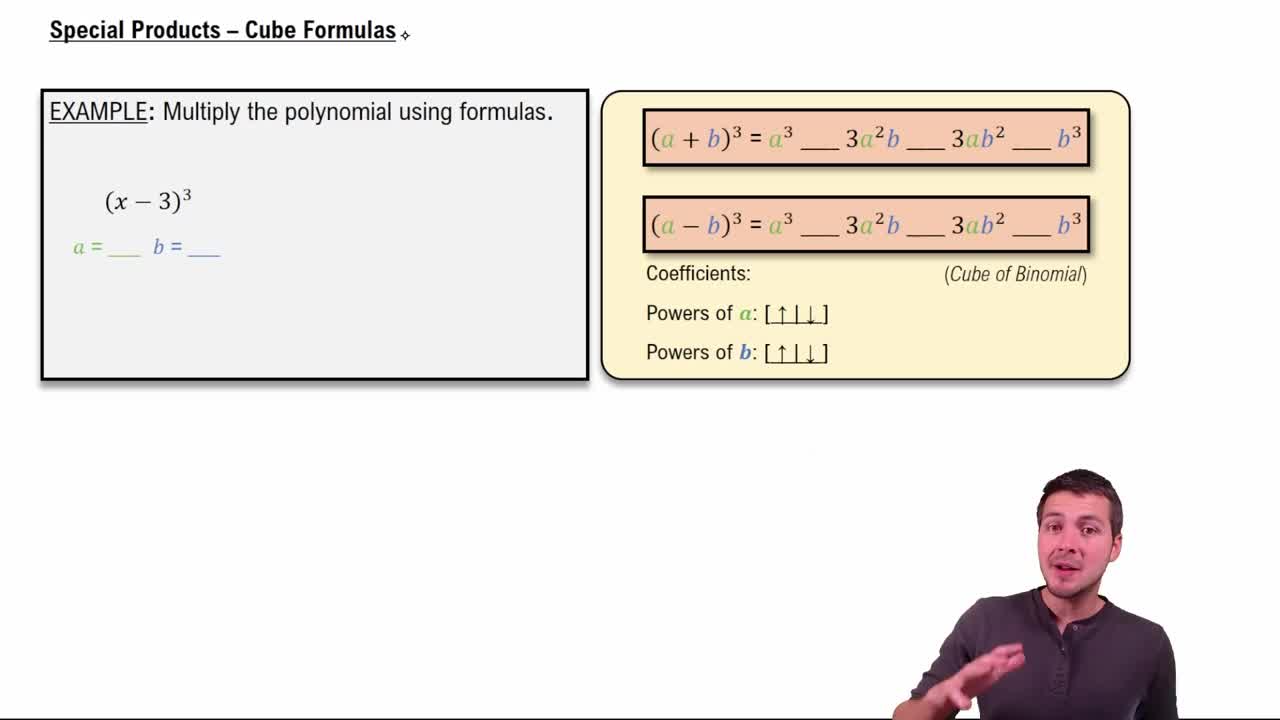
Recall the difference of cubes factoring formula: \(a^3 - b^3 = (a - b)(a^2 + ab + b^2)\).
Apply the formula with \(a = x\) and \(b = 3\) to factor the equation as \((x - 3)(x^2 + 3x + 9) = 0\).
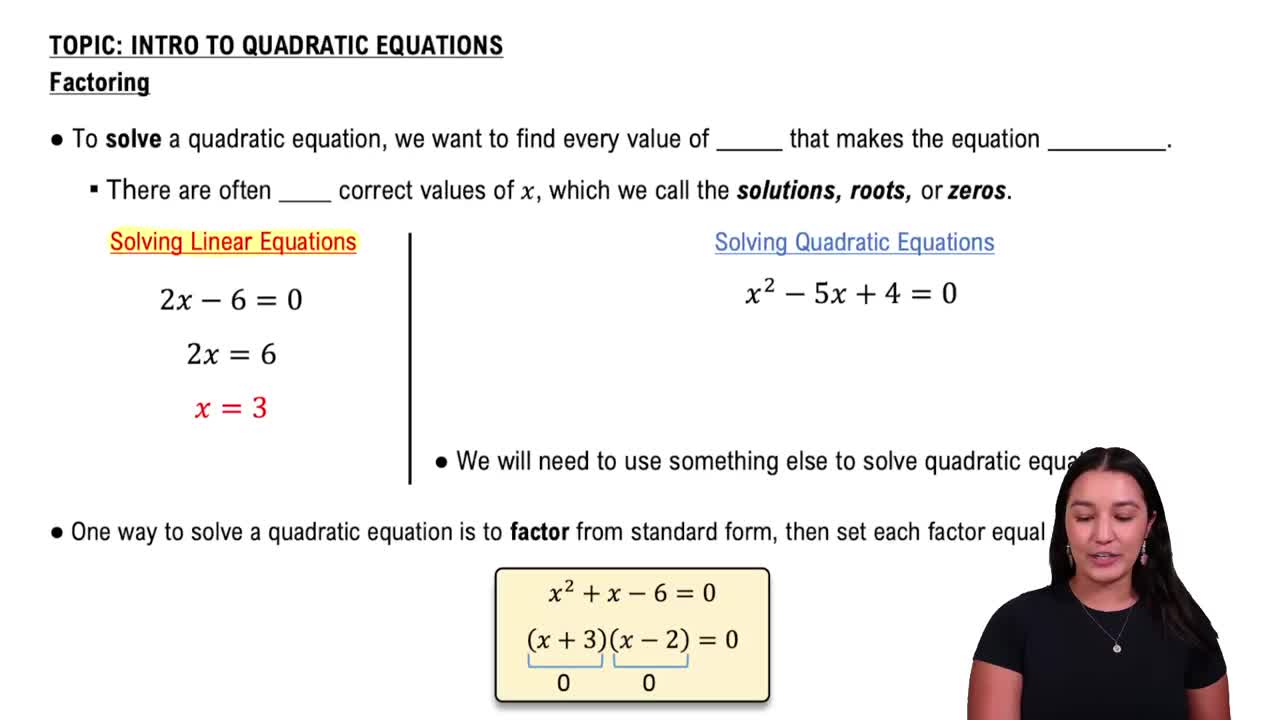
Set each factor equal to zero: \(x - 3 = 0\) and \(x^2 + 3x + 9 = 0\).
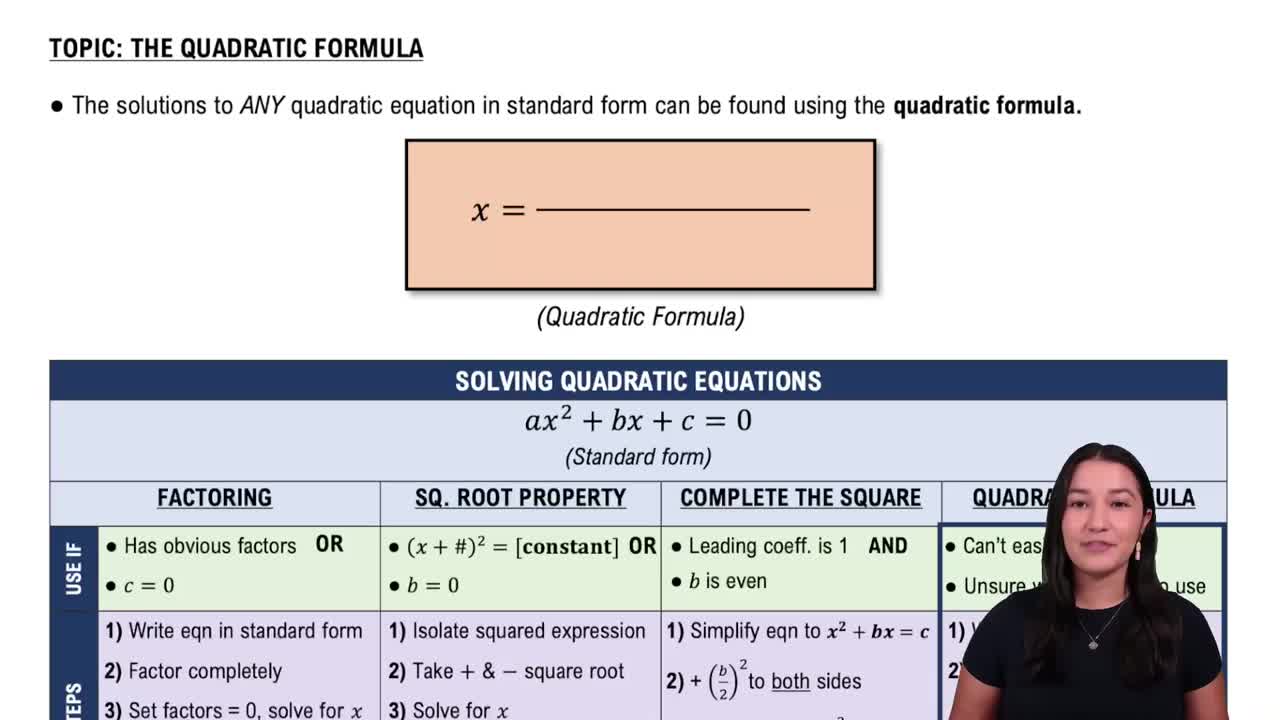
Solve the linear equation \(x - 3 = 0\) for \(x\), and then solve the quadratic equation \(x^2 + 3x + 9 = 0\) using the quadratic formula \(x = \frac{-b \pm \sqrt{b^2 - 4ac}}{2a}\) where \(a=1\), \(b=3\), and \(c=9\).
Verified video answer for a similar problem:
This video solution was recommended by our tutors as helpful for the problem above
Video duration:
7m
Play a video:
0 Comments
Key Concepts
Here are the essential concepts you must grasp in order to answer the question correctly.
Factoring Cubic Equations
Factoring cubic equations involves expressing the cubic polynomial as a product of simpler polynomials, often starting with recognizing special forms like the difference of cubes. For example, x³ - 27 can be factored using the formula a³ - b³ = (a - b)(a² + ab + b²). This step simplifies solving the equation by breaking it into lower-degree factors.
The difference of cubes formula states that a³ - b³ = (a - b)(a² + ab + b²). This identity helps factor expressions like x³ - 27 by identifying a = x and b = 3. Applying this formula transforms the cubic into a linear factor and a quadratic factor, making it easier to find all roots of the equation.
The quadratic formula, x = [-b ± √(b² - 4ac)] / (2a), is used to solve quadratic equations that cannot be factored easily. After factoring the cubic into a linear and quadratic factor, the quadratic formula helps find the roots of the quadratic part, ensuring all solutions to the original cubic equation are found.

 7:55 minutes
 Verified step by step guidance
 06:08
06:08