Ch. 4 - Inverse, Exponential, and Logarithmic Functions
Lial - College Algebra 13th Edition
Lial13th EditionCollege AlgebraISBN: 9780136881063Not the one you use?Change textbook
Chapter 5, Problem 35

Solve each equation. In Exercises 11–34, give irrational solutions as decimals correct to the nearest thousandth. In Exercises 35-40, give solutions in exact form. e2x - 6ex + 8 = 0

Verified step by step guidance
1
Recognize that the equation involves exponential expressions with the same base \(e\). To simplify, let \(y = e^{x}\). Then, \(e^{2x} = (e^{x})^2 = y^2\).
Rewrite the original equation \(e^{2x} - 6e^{x} + 8 = 0\) in terms of \(y\) as \(y^2 - 6y + 8 = 0\).
Solve the quadratic equation \(y^2 - 6y + 8 = 0\) using factoring or the quadratic formula. This will give you the possible values for \(y\).
Recall that \(y = e^{x}\), so for each solution \(y_i\), solve the equation \(e^{x} = y_i\) by taking the natural logarithm of both sides: \(x = \ln(y_i)\).
Evaluate the logarithms to find the values of \(x\). Since the problem asks for decimal answers correct to the nearest thousandth, approximate the logarithms accordingly.

Verified video answer for a similar problem:

This video solution was recommended by our tutors as helpful for the problem above.
Video duration:
6m
Was this helpful?

Key Concepts

Here are the essential concepts you must grasp in order to answer the question correctly.

Exponential Equations

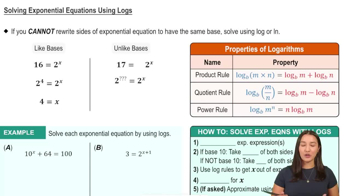
Exponential equations involve variables in the exponent, such as e^x. Solving these requires understanding how to manipulate and isolate the exponential expression, often by substitution or applying logarithms.
Recommended video:
5:47
Solving Exponential Equations Using Logs

Substitution Method for Quadratic Form

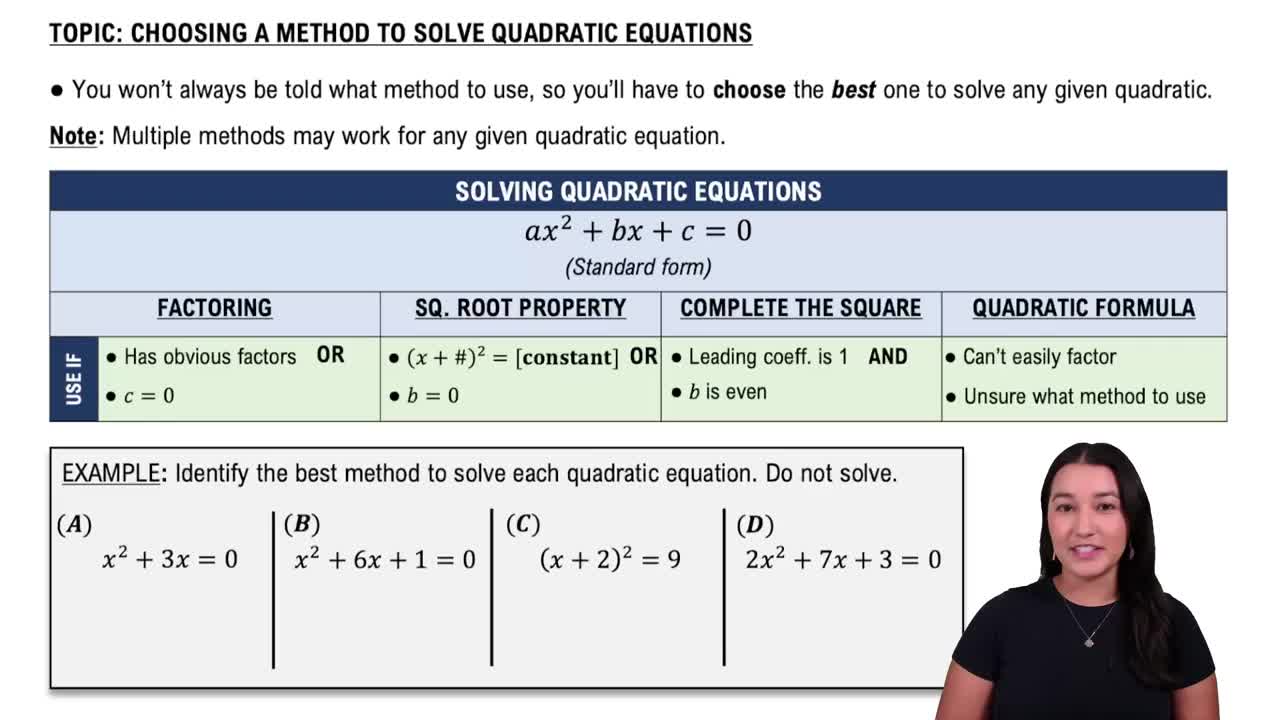
When an equation contains terms like e^{2x} and e^x, it can be treated as a quadratic by substituting u = e^x. This transforms the equation into a quadratic form, which can be solved using factoring or the quadratic formula.
Recommended video:
04:03
Choosing a Method to Solve Quadratics

Exact vs. Approximate Solutions

Exact solutions are expressed in terms of constants and variables without rounding, while approximate solutions are numerical values rounded to a specified decimal place. Understanding when to use each is important for interpreting answers correctly.
Recommended video:
3:18
Permutations vs. Combinations