Use the method described in Exercises 83–86, if applicable, and properties of absolute value to solve each equation or inequality. (Hint: Exercises 99 and 100 can be solved by inspection.) | 3x2 - 14x | = 5
Ch. 1 - Equations and Inequalities

Chapter 2, Problem 89a
Simplify each power of i. i25
Verified step by step guidance1
Recall that the imaginary unit \(i\) is defined such that \(i^2 = -1\).
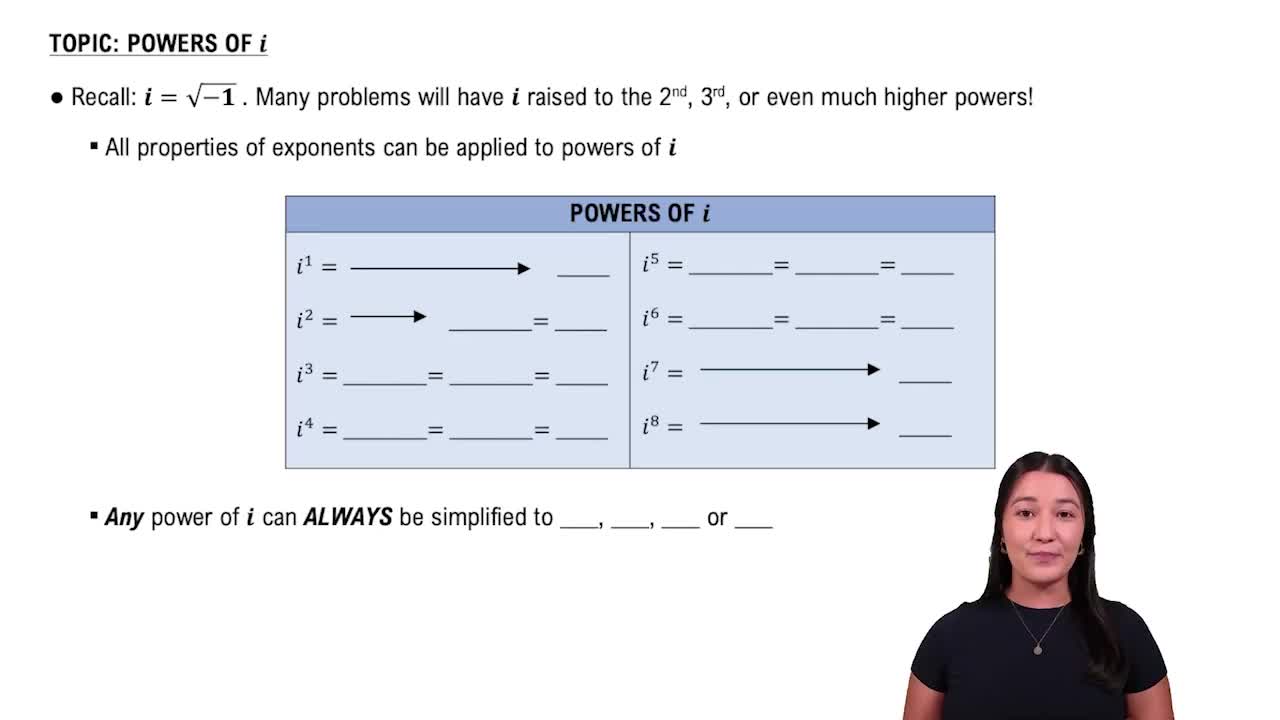
Recognize that powers of \(i\) repeat in a cycle of 4: \(i^1 = i\), \(i^2 = -1\), \(i^3 = -i\), and \(i^4 = 1\).
To simplify \(i^{25}\), find the remainder when 25 is divided by 4, since the powers repeat every 4.
Calculate \(25 \div 4\) which gives a quotient of 6 and a remainder of 1, so \(i^{25} = i^{4 \cdot 6 + 1} = (i^4)^6 \cdot i^1\).
Use the fact that \((i^4)^6 = 1^6 = 1\), so \(i^{25} = 1 \cdot i = i\).

Verified video answer for a similar problem:
This video solution was recommended by our tutors as helpful for the problem above.
Video duration:
1mWas this helpful?
Key Concepts
Here are the essential concepts you must grasp in order to answer the question correctly.
Imaginary Unit (i)
The imaginary unit i is defined as the square root of -1, satisfying i² = -1. It is the fundamental unit used to extend the real number system to complex numbers, allowing for the representation of numbers involving the square roots of negative values.
Recommended video:
Powers of i
Powers of i and Their Cyclic Pattern
Powers of i repeat in a cycle of four: i¹ = i, i² = -1, i³ = -i, and i⁴ = 1. This pattern repeats for higher powers, so simplifying i raised to any integer power involves finding the remainder when the exponent is divided by 4.
Recommended video:
Powers of i
Modular Arithmetic for Exponent Simplification
Modular arithmetic helps simplify powers by reducing the exponent modulo 4 in this context. For example, to simplify i^25, compute 25 mod 4 = 1, so i^25 = i¹ = i. This technique streamlines calculations involving cyclic patterns.
Recommended video:
Guided course
Arithmetic Sequences - General Formula
Related Practice
Textbook Question
640
views
Textbook Question
Use the method described in Exercises 83–86, if applicable, and properties of absolute value to solve each equation or inequality. (Hint: Exercises 99 and 100 can be solved by inspection.) | x2 + 5x + 5 | = 1
555
views
Textbook Question
Evaluate the discriminant for each equation. Then use it to determine the number of distinct solutions, and tell whether they are rational, irrational, or nonreal complex numbers. (Do not solve the equation.) See Example 9.
1101
views
Textbook Question
Determine whether each equation has a graph that is symmetric with respect to the x-axis, the y-axis, the origin, or none of these.
807
views
1
rank
Textbook Question
Simplify each power of i. i29
867
views
Textbook Question
Solve each inequality. Give the solution set using interval notation.
822
views