Let U = {0, 1, 2, 3, 4, 5, 6, 7, 8, 9, 10, 11, 12, 13}, M = {0, 2, 4, 6, 8}, N = {1, 3, 5, 7, 9, 11, 13}, Q = {0, 2, 4, 6, 8, 10, 12}, and R = {0, 1, 2, 3, 4}.Use these sets to find each of the following. Identify any disjoint sets. (M ∩ N) ∪ R
Ch. R - Review of Basic Concepts

Chapter 1, Problem 97
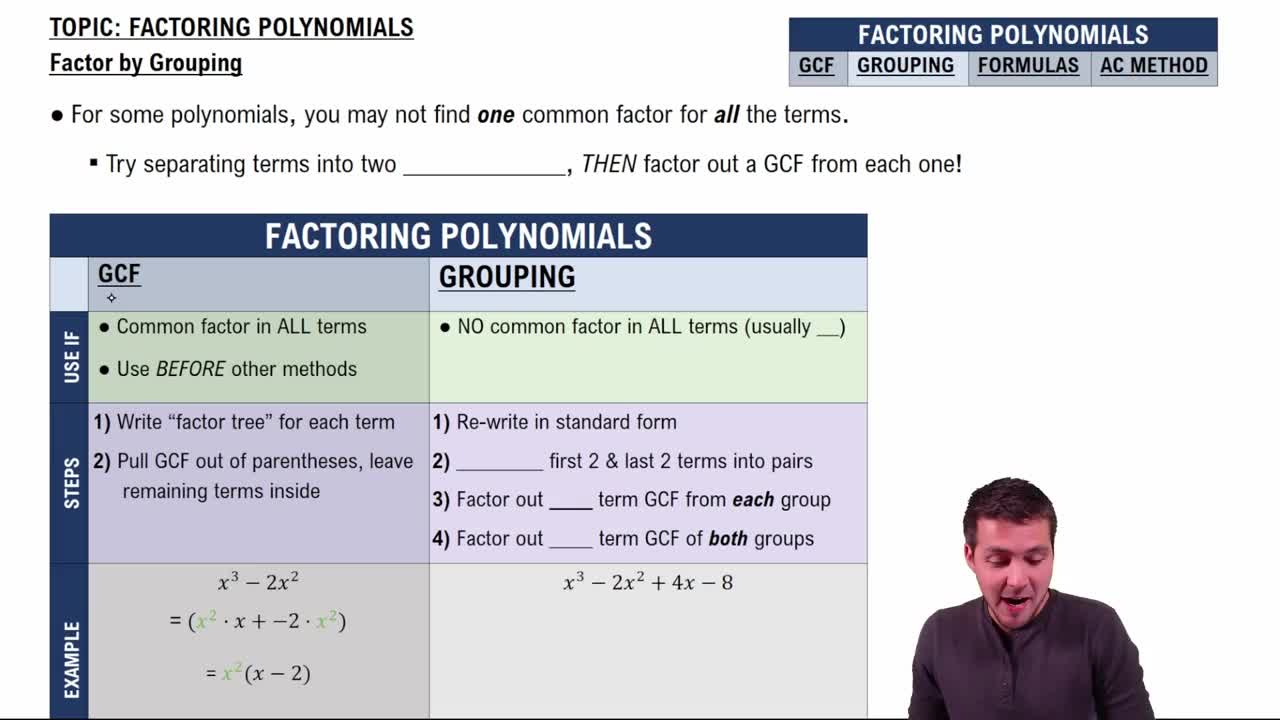
Factor by any method. See Examples 1–7. x2+xy-5x-5y
Verified step by step guidance1
Group the terms in pairs to make factoring easier: \((x^2 + xy) - (5x + 5y)\).
Factor out the greatest common factor (GCF) from each group: \(x(x + y) - 5(x + y)\).
Notice that both terms contain the common binomial factor \((x + y)\).
Factor out the common binomial \((x + y)\): \((x + y)(x - 5)\).
The expression is now factored completely as \((x + y)(x - 5)\).

Verified video answer for a similar problem:
This video solution was recommended by our tutors as helpful for the problem above.
Video duration:
2mWas this helpful?
Key Concepts
Here are the essential concepts you must grasp in order to answer the question correctly.
Factoring by Grouping
Factoring by grouping involves rearranging and grouping terms in a polynomial to find common factors within each group. This method is useful when a polynomial has four terms, allowing you to factor out common binomials and simplify the expression.
Recommended video:
Guided course
Factor by Grouping
Common Factors
Identifying common factors means finding terms or expressions that appear in multiple parts of a polynomial. Extracting these common factors simplifies the polynomial and is a crucial step in factoring complex expressions.
Recommended video:
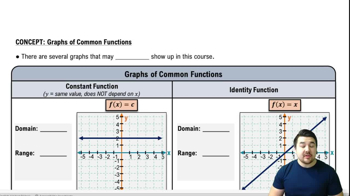
Graphs of Common Functions
Polynomial Terms and Variables
Understanding polynomial terms and variables is essential for factoring. Each term consists of coefficients and variables raised to powers, and recognizing how these combine helps in grouping and factoring the expression correctly.
Recommended video:
Guided course
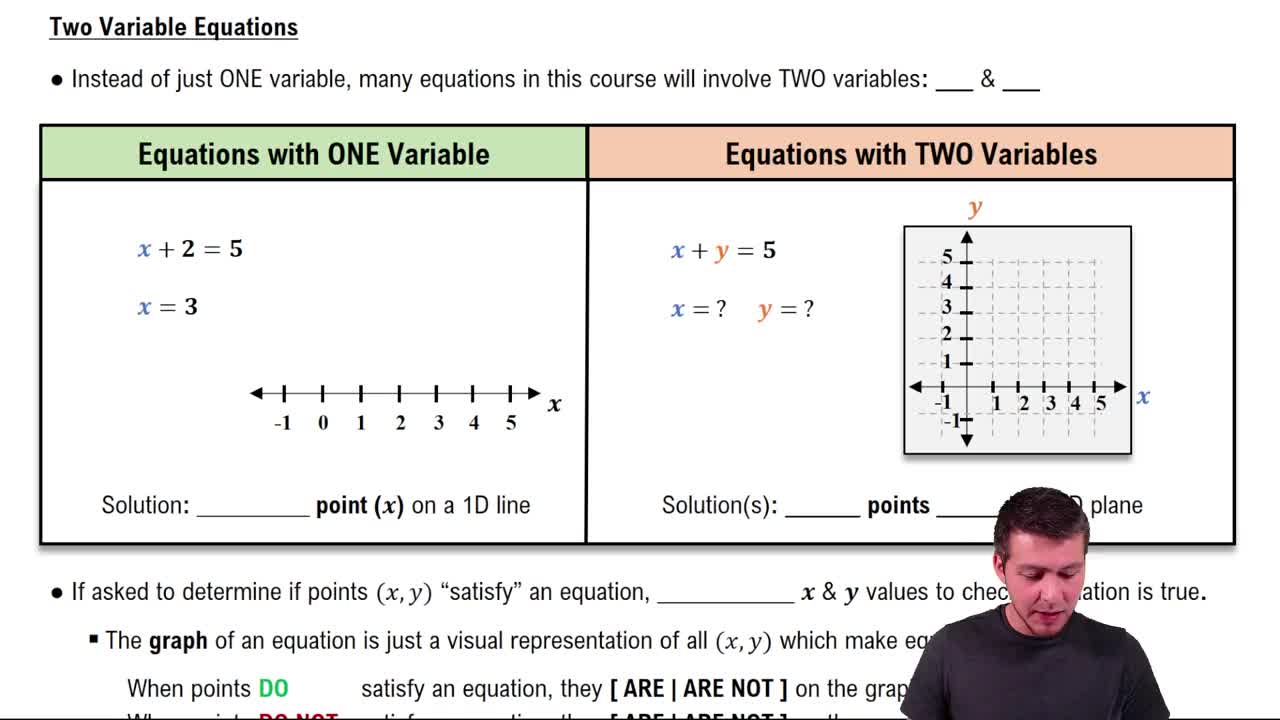
Equations with Two Variables
Related Practice
Textbook Question
946
views
Textbook Question
Evaluate each expression.
1147
views
Textbook Question
Simplify each expression. Write answers without negative exponents. Assume all variables represent positive real numbers. (z3/4)/(z5/4)(z-2)
966
views
Textbook Question
Simplify each rational expression. Assume all variable expressions represent positive real numbers. (Hint: Use factoring and divide out any common factors as a first step.) [4(x2- 1)3 + 8x(x2-1)4] / [16(x2-1)3]
857
views
Textbook Question
Perform each division. See Examples 9 and 10. (4x3+9x2-10x-6)/(4x+1)
449
views
Textbook Question
Let U = {0, 1, 2, 3, 4, 5, 6, 7, 8, 9, 10, 11, 12, 13}, M = {0, 2, 4, 6, 8}, N = {1, 3, 5, 7, 9, 11, 13}, Q = {0, 2, 4, 6, 8, 10, 12}, and R = {0, 1, 2, 3, 4}.Use these sets to find each of the following. Identify any disjoint sets. (N ∪ R) ∩ M
1041
views
