Use the various properties of exponential and logarithmic functions to evaluate the expressions in parts (a)–(c). Given ƒ(x) = 3x, find ƒ(log3 2)
Ch. 4 - Inverse, Exponential, and Logarithmic Functions

Chapter 5, Problem 95b
Use the various properties of exponential and logarithmic functions to evaluate the expressions in parts (a)–(c). Given g(x) = ex, find g(ln ln 52)
Verified step by step guidance1
Start by understanding the given function: \(g(x) = e^x\). We need to find \(g(\ln \ln 5^2)\), which means we will substitute \(x\) with \(\ln \ln 5^2\) in the function.
Rewrite the expression inside the logarithms step-by-step. First, simplify the exponent inside the innermost expression: \$5^2$ becomes \(25\), so the expression becomes \(\ln \ln 25\).
Recall the property of logarithms: \(g(\ln a) = e^{\ln a} = a\). This means that applying \(e^{(\ln (\text{something}))}\) simplifies to just that "something".
Apply this property to \(g(\ln \ln 25)\): since \(g(x) = e^x\), then \(g(\ln \ln 25) = e^{\ln \ln 25} = \ln 25\).
Thus, the original expression simplifies to \(\ln 25\). You can leave the answer in this form or further simplify \(\ln 25\) if needed using logarithm properties.

Verified video answer for a similar problem:
This video solution was recommended by our tutors as helpful for the problem above.
Video duration:
1mWas this helpful?
Key Concepts
Here are the essential concepts you must grasp in order to answer the question correctly.
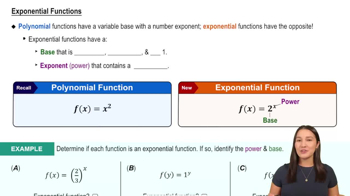
Exponential Functions
Exponential functions have the form f(x) = a^x, where the variable is in the exponent. The function g(x) = e^x uses the constant e (~2.718), which is the base of natural logarithms. Understanding how to evaluate and manipulate these functions is essential for solving expressions involving e raised to a power.
Recommended video:
Exponential Functions
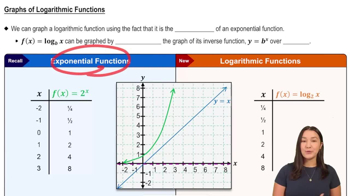
Logarithmic Functions and Natural Logarithm
Logarithmic functions are the inverses of exponential functions. The natural logarithm, denoted ln(x), is the logarithm with base e. It satisfies the property ln(e^x) = x, which is key to simplifying expressions where logarithms and exponentials are nested.
Recommended video:
Graphs of Logarithmic Functions
Properties of Logarithms and Exponents
Key properties include ln(a^b) = b ln(a) and e^{ln(x)} = x for x > 0. These allow simplification of complex expressions by converting powers inside logarithms or exponents into products or by canceling inverse operations. Applying these properties step-by-step helps evaluate nested expressions like g(ln ln 5^2).
Recommended video:
Change of Base Property
Related Practice
Textbook Question
775
views
Textbook Question
Use the various properties of exponential and logarithmic functions to evaluate the expressions in parts (a)–(c). Given g(x) = ex, find g(ln 4)
755
views
Textbook Question
Use the various properties of exponential and logarithmic functions to evaluate the expressions in parts (a)–(c). Given g(x) = ex, find g(ln 1/e)
896
views
Textbook Question
Solve each equation. See Examples 4–6. 1/27 = x-3
93
views
Textbook Question
Use the various properties of exponential and logarithmic functions to evaluate the expressions in parts (a)–(c). Given ƒ(x) = 3x, find ƒ(log3 (ln 3))
761
views
Textbook Question
Solve each equation for the indicated variable. Use logarithms with the appropriate bases. log A = log B - C log x, for A
733
views