Ch. R - Review of Basic Concepts
Lial - College Algebra 13th Edition
Lial13th EditionCollege AlgebraISBN: 9780136881063Not the one you use?Change textbook
Chapter 1, Problem 38

Find each root. ⁷√y⁷

Verified step by step guidance
1
Recognize that the expression ⁷√y⁷ represents the seventh root of y raised to the seventh power, which can be written as \(\sqrt[7]{y^{7}}\).
Recall the property of radicals and exponents: \(\sqrt[n]{a^{m}} = a^{\frac{m}{n}}\). Applying this, rewrite the expression as \(y^{\frac{7}{7}}\).
Simplify the exponent \(\frac{7}{7}\) to 1, so the expression becomes \(y^{1}\).
Understand that \(y^{1}\) is simply \(y\), so the root simplifies to \(y\).
Note that this simplification assumes \(y\) is non-negative if we are considering real numbers, because even roots of negative numbers are not real.

Verified video answer for a similar problem:

This video solution was recommended by our tutors as helpful for the problem above.
Video duration:
1m
Was this helpful?

Key Concepts

Here are the essential concepts you must grasp in order to answer the question correctly.

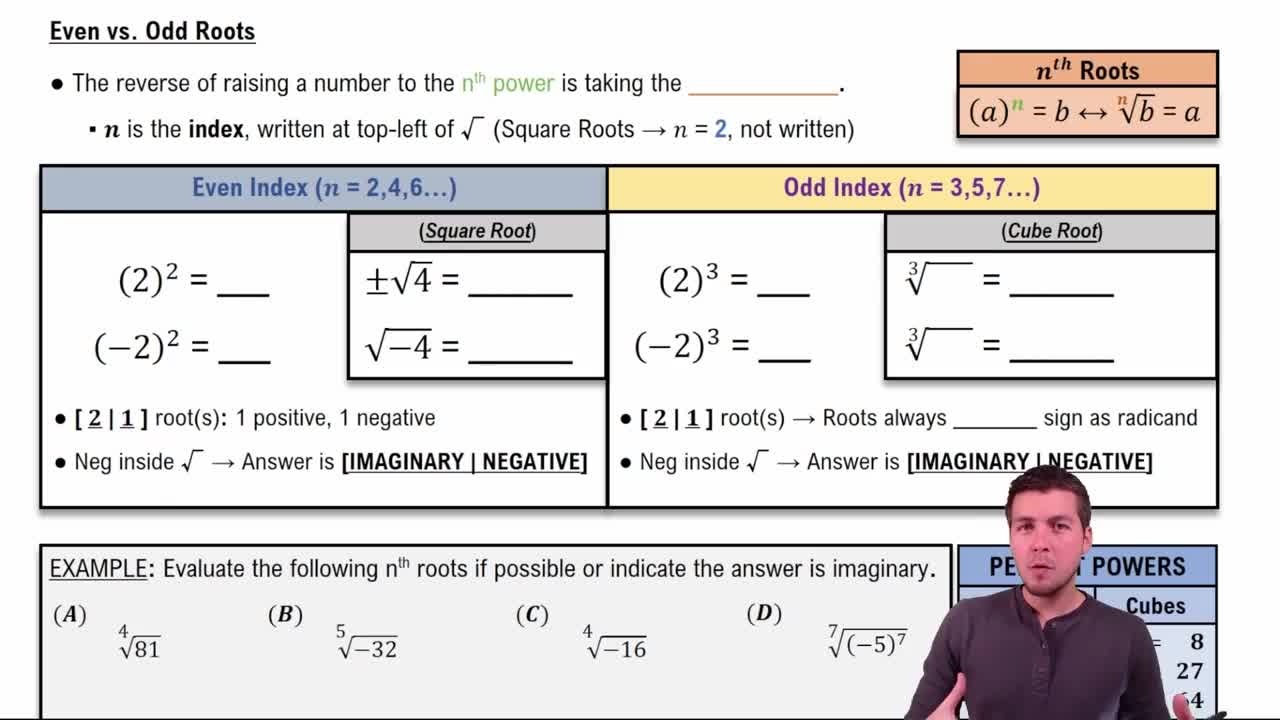
nth Roots and Radicals

The nth root of a number is a value that, when raised to the nth power, gives the original number. For example, the 7th root of y⁷ means finding a number which, when raised to the 7th power, equals y⁷. Understanding how to simplify expressions involving roots is essential.
Recommended video:

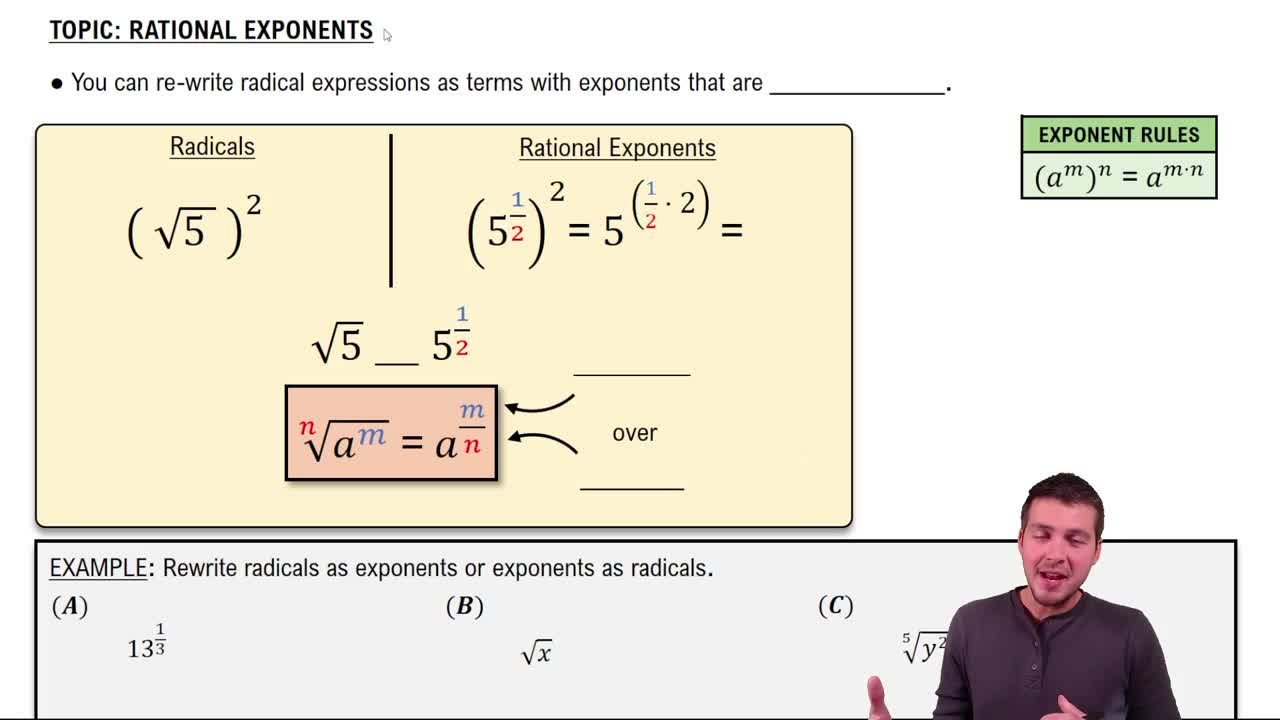
Properties of Exponents

Exponents represent repeated multiplication. Key properties include that (a^m)^n = a^(m*n) and that the nth root of a^m can be expressed as a^(m/n). These properties allow simplification of expressions like ⁷√y⁷ by converting roots into fractional exponents.
Recommended video:
Guided course
04:06
Rational Exponents

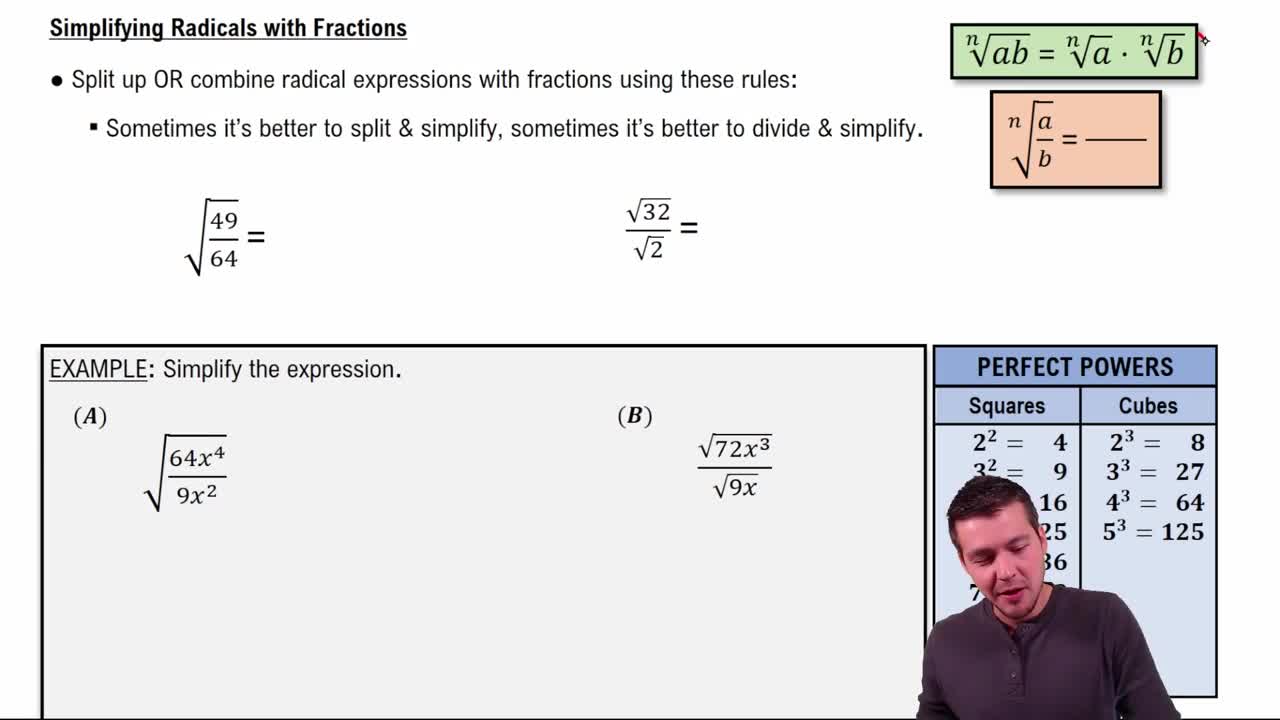
Simplifying Radical Expressions

Simplifying radicals involves rewriting expressions to their simplest form, often by canceling powers or converting roots to exponents. For ⁷√y⁷, simplification uses the fact that the 7th root and the 7th power cancel out, resulting in y, assuming y is non-negative or defined appropriately.
Recommended video:
Guided course
05:45
Radical Expressions with Fractions