Ch. 2 - Graphs and Functions
Lial - College Algebra 13th Edition
Lial13th EditionCollege AlgebraISBN: 9780136881063Not the one you use?Change textbook
Chapter 3, Problem 25

Graph each function. See Examples 1 and 2. ƒ(x)=-(1/2)x2

Verified step by step guidance
1
Identify the type of function given. The function ƒ(x) = -\(\frac{1}{2}\)x^2 is a quadratic function, which graphs as a parabola.
Note the coefficient of x^2, which is -\(\frac{1}{2}\). Since it is negative, the parabola opens downward, and the factor \(\frac{1}{2}\) affects the width, making it wider than the standard parabola y = -x^2.
Find the vertex of the parabola. For a function in the form ƒ(x) = ax^2 + bx + c, the vertex is at x = -\(\frac{b}{2a}\). Here, b = 0, so the vertex is at x = 0. Substitute x = 0 into the function to find the y-coordinate of the vertex.
Create a table of values by choosing x-values around the vertex (for example, x = -2, -1, 0, 1, 2), then calculate the corresponding y-values using the function ƒ(x) = -\(\frac{1}{2}\)x^2.
Plot the points from the table on the coordinate plane, mark the vertex, and draw a smooth curve through these points to complete the graph of the parabola.

Verified video answer for a similar problem:

This video solution was recommended by our tutors as helpful for the problem above.
Video duration:
6m
Was this helpful?

Key Concepts

Here are the essential concepts you must grasp in order to answer the question correctly.

Quadratic Functions

A quadratic function is a polynomial of degree two, typically written as f(x) = ax^2 + bx + c. Its graph is a parabola, which opens upward if a > 0 and downward if a < 0. Understanding the shape and properties of quadratic functions is essential for graphing them accurately.
Recommended video:
06:36
Solving Quadratic Equations Using The Quadratic Formula

Effect of the Leading Coefficient

The leading coefficient (the number multiplying x^2) affects the parabola's direction and width. A negative coefficient, like -1/2, causes the parabola to open downward, while its absolute value determines how wide or narrow the parabola is compared to the standard y = x^2.
Recommended video:
06:08
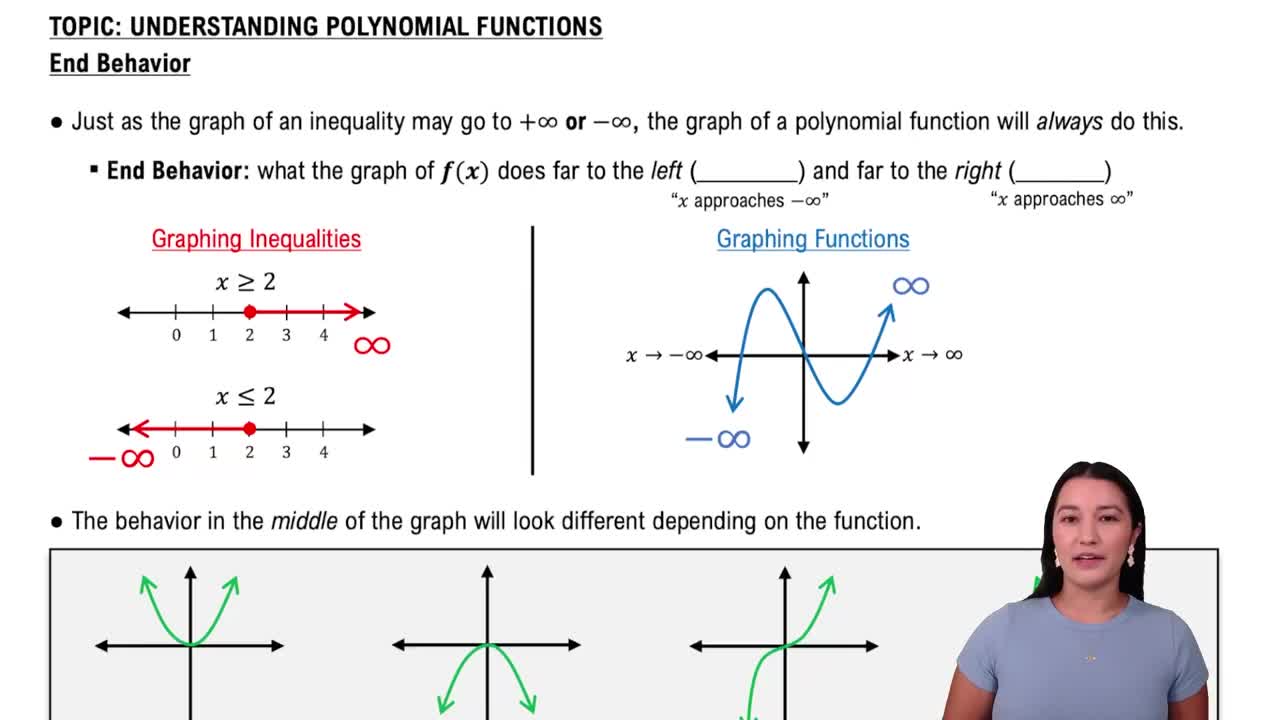
End Behavior of Polynomial Functions

Graphing Techniques for Quadratics

Graphing a quadratic involves plotting the vertex, axis of symmetry, and several points on either side. For f(x) = -(1/2)x^2, the vertex is at the origin (0,0), and symmetry about the y-axis helps in plotting points efficiently to sketch the parabola.
Recommended video:
06:36
Solving Quadratic Equations Using The Quadratic Formula