Ch. 1 - Equations and Inequalities
Lial - College Algebra 13th Edition
Lial13th EditionCollege AlgebraISBN: 9780136881063Not the one you use?Change textbook
Chapter 2, Problem 48

Solve each equation or inequality. | 5x + 2 | - 2 < 3

Verified step by step guidance
1
Start by isolating the absolute value expression on one side of the inequality. Add 2 to both sides to get: \(| 5x + 2 | < 3 + 2\).
Simplify the right side to rewrite the inequality as: \(| 5x + 2 | < 5\).
Recall that for an inequality of the form \(|A| < B\), where \(B > 0\), the solution is \(-B < A < B\). Apply this to get: \(-5 < 5x + 2 < 5\).
Solve the compound inequality by subtracting 2 from all parts: \(-5 - 2 < 5x < 5 - 2\), which simplifies to \(-7 < 5x < 3\).
Finally, divide all parts of the inequality by 5 to isolate \(x\): \(\frac{-7}{5} < x < \frac{3}{5}\). This is the solution set for the inequality.

Verified video answer for a similar problem:

This video solution was recommended by our tutors as helpful for the problem above.
Video duration:
2m
Was this helpful?

Key Concepts

Here are the essential concepts you must grasp in order to answer the question correctly.

Absolute Value Inequalities

Absolute value inequalities involve expressions where the absolute value of a variable or expression is compared to a number. To solve them, you consider the definition of absolute value as distance from zero, leading to two cases: one positive and one negative. For example, |A| < B means -B < A < B.
Recommended video:
06:07
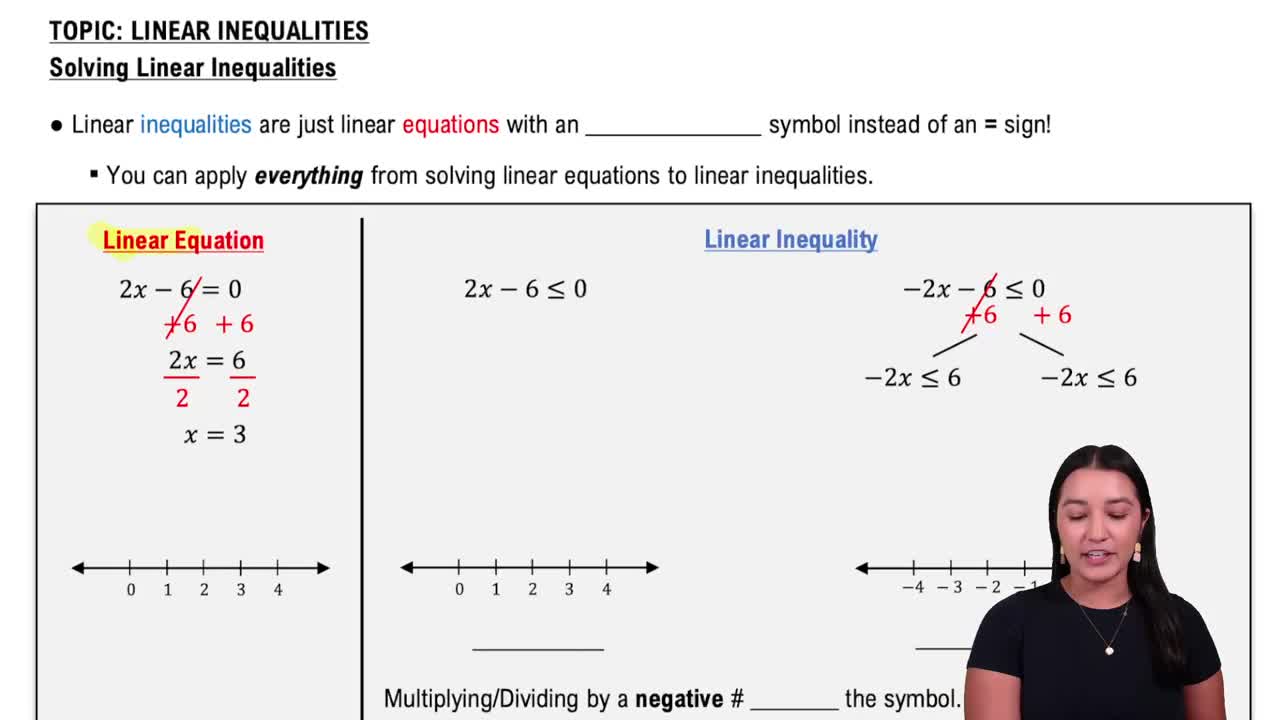
Linear Inequalities

Isolating the Absolute Value Expression

Before solving an absolute value inequality, isolate the absolute value term on one side of the inequality. This often involves adding or subtracting constants and dividing or multiplying by coefficients. Proper isolation is crucial to correctly apply the definition of absolute value.
Recommended video:
Guided course
05:09
Introduction to Algebraic Expressions

Solving Linear Inequalities

After removing the absolute value by splitting into two inequalities, solve each linear inequality separately. This involves standard algebraic techniques like adding, subtracting, multiplying, or dividing both sides by constants, while remembering to reverse inequality signs when multiplying or dividing by negative numbers.
Recommended video:
06:07
Linear Inequalities