Ch. R - Review of Basic Concepts
Lial - College Algebra 13th Edition
Lial13th EditionCollege AlgebraISBN: 9780136881063Not the one you use?Change textbook
Chapter 1, Problem 84

Evaluate each expression. (-2)6

Verified step by step guidance
1
Identify the base and the exponent in the expression \((-2)^6\). Here, the base is \(-2\) and the exponent is \(6\).
Recall that an exponent indicates how many times the base is multiplied by itself. So, \((-2)^6\) means \((-2) \times (-2) \times (-2) \times (-2) \times (-2) \times (-2)\).
Since the exponent is even, multiplying a negative number an even number of times results in a positive number. This is because each pair of negative factors multiplies to a positive.
Calculate the value of \$2^6$ by multiplying \(2\) by itself six times: \(2 \times 2 \times 2 \times 2 \times 2 \times 2\).
Combine the sign consideration from step 3 with the magnitude from step 4 to determine the final value of \((-2)^6\).

Verified video answer for a similar problem:

This video solution was recommended by our tutors as helpful for the problem above.
Video duration:
1m
Was this helpful?

Key Concepts

Here are the essential concepts you must grasp in order to answer the question correctly.

Exponents and Powers

An exponent indicates how many times a base number is multiplied by itself. For example, in (-2)^6, the base is -2 and the exponent 6 means multiplying -2 by itself six times.
Recommended video:
04:10
Powers of i

Negative Base with Even Exponent

When a negative number is raised to an even exponent, the result is positive because multiplying an even number of negative factors results in a positive product.
Recommended video:
Guided course
7:39
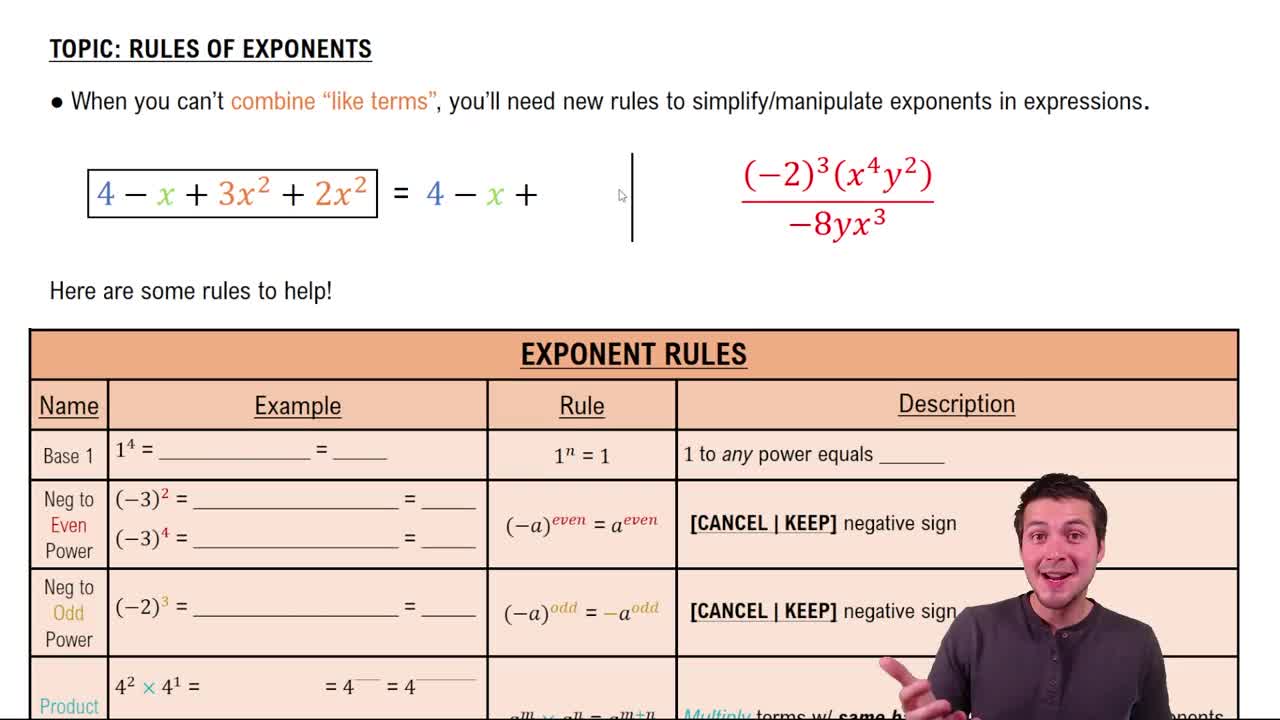
Introduction to Exponent Rules

Order of Operations and Parentheses

Parentheses indicate that the negative sign is part of the base. Thus, (-2)^6 means the entire -2 is raised to the 6th power, unlike -2^6, which would mean the negative of 2 raised to the 6th power.
Recommended video:
Guided course
8:38
Performing Row Operations on Matrices